
Talc powder grinding is not simply a question of reaching the required fineness. For many commercial grades, whiteness and lamellarity are equally important. Talc is a soft mineral, but the grinding circuit still has to control contamination, particle size and particle shape. A deposit can meet the grade requirement at the mine and still lose value if the grinding circuit changes its colour or damages its plate-like structure.
What the Ore Carries

Talc is a hydrous magnesium silicate with a plate-like crystal habit. The plates slide across each other, so the mineral feels soapy to the touch. The same habit carries load along the plate surface, which is why a filled polymer gains stiffness. Ore bodies rarely deliver the mineral pure, and chlorite, magnesite, dolomite and quartz sit alongside it. Each of them shifts the product in a different direction.
Chlorite carries green and grey tones, and grinding concentrates it in the fines the customer receives. Dolomite and magnesite lower the whiteness of the fired or filled product. Quartz is harder than the surrounding talc, so a coarse grain survives into the product as an abrasive speck. A deposit with dark gangue therefore needs beneficiation ahead of the mill, and that flowsheet decision shapes the mill specification. The same logic runs through a feldspar circuit, where iron plays the part that colour plays here.
What Each Buyer Measures
A plastics compounder buys talc for stiffness and for nucleation in polypropylene. Whiteness matters because many compounds are coloured or light. Commercial filler specs commonly sit between 85 and 92 points, with the highest priced grades above 90. The plate shape matters as much as the size, since plates carry load along their surface. A spec that names only D97 can therefore hide a lamellarity loss. Compounders weighing talc against calcium carbonate can start from the filler comparison. The property differences between heavy calcium powder and talc powder cover the rest.
A paint maker buys fineness and oil absorption together. Finer plates raise gloss, and they also raise oil demand. The useful grade is therefore the finest distribution the formulation tolerates at its resin loading. Paper mills use talc for pitch control and as a filler, and hydrophobicity is the property they pay for. Ceramics accept the widest colour range and buy on body behaviour and price. Cosmetic and pharmaceutical grades add certification and purity demands on top. Those specifications are set by regulation before they are set by the mill.
| Use | Whiteness | Fineness | What drives the limit |
|---|---|---|---|
| Plastics filler | Commonly 85 to 92, top grades above 90 | 325 to 1250 mesh, D97 about 10 to 45 µm | Stiffness comes from plates, colour from whiteness |
| Paint | About 90 and above | D97 about 5 to 20 µm | Gloss from fineness, oil absorption from the same fines |
| Paper | Mid range accepted | 200 to 400 mesh | Hydrophobicity controls pitch, price controls the rest |
| Ceramics | Widest range | 200 mesh with controlled residue | Body behaviour and price, not colour |
Limits describe common commercial specifications. The buyer’s own standard and the deposit assay decide the actual figures.
The Whiteness Problem
Geology sets the whiteness of the ore, and the circuit can only preserve it. The mill does not remove dark gangue, and grinding frees dark particles into the white powder. Steel media, liners and chute walls all wear during grinding. Even a small mass of debris reads as a grey shift in a white mineral. A grade sold on whiteness therefore measures the circuit as much as the deposit.
The first defence against grey shift is the choice of wearing parts. A ball mill lined with alumina ceramic and charged with ceramic media removes the main source of grey shift. Talc is soft enough that the energy penalty of a gentle grind stays modest. A jet mill removes the problem at the source, since no media touches the powder and the contact surfaces can be ceramic. A ring roller mill sits between the two. Wear concentrates on its roll and ring surfaces, which can be inspected and replaced on a schedule.
Moisture needs attention ahead of the mill. Free moisture above roughly one percent makes fine talc pasty and unstable in the feed. A dryer therefore sits ahead of the circuit on most plants. The structural water inside the crystal leaves only at kiln temperatures and plays no part in drying.
Three Circuits and Their Limits

The right talc grinding mill depends on the required fineness, whiteness, lamellarity and production rate. In practice, three circuit types cover a large part of industrial talc powder applications: ball mills with classifiers, ring roller mills, and dry jet mills.
A ball mill in closed circuit with a classifier covers high tonnage and a wide fineness range. Its D97 can typically run from about 75 µm down to about 5 µm, depending on the material and operating conditions. This range spans ceramic, paper and plastics grades in one setting family. Whiteness depends almost entirely on lining and media, so a high whiteness grade can be engineered in from the start. A centrifugal classifier sets the top cut by rotor speed, and one line then serves several grades without a rebuild.
A ring roller mill can cover approximately 325 to 2000 mesh, with an indicative D97 range of about 6.5 to 45 µm depending on the material and configuration. Energy per ton sits well below a jet mill at the same cut, and talc grinds soft. Throughput per ton of installed power therefore runs high, which makes it the volume route for filler grades. A 200 mesh ceramic or paper grade falls outside this range and belongs to the ball mill circuit.
A dry jet mill can typically produce a D97 in the range of about 2 to 45 µm, depending on the material and operating conditions, and adds the least contamination of the three, at the highest energy per ton. Plates accelerate in the air stream and media never strikes them, so the aspect ratio can be better preserved at the same fineness. The cost is justified when the specification lists a high whiteness figure, a narrow distribution or a lamellarity requirement. Paint grades and top plastics grades are the natural applications.
| Circuit | Fineness reached | Whiteness risk | Energy per ton | Fits |
|---|---|---|---|---|
| Ball mill with classifier | D97 about 5 to 75 µm | Set by lining and media | Higher | High tonnage across ceramics, paper and plastics |
| Ring roller mill | 325 to 2000 mesh, D97 about 6.5 to 45 µm | Moderate | Low | Volume filler grades |
| Dry jet mill | D97 about 2 to 45 µm | Lowest | Highest | High whiteness, narrow distribution, lamellar grades |
Ranges describe the working range of each machine. A specific material needs a grinding test before the figures become a commitment.
How Fineness Is Set
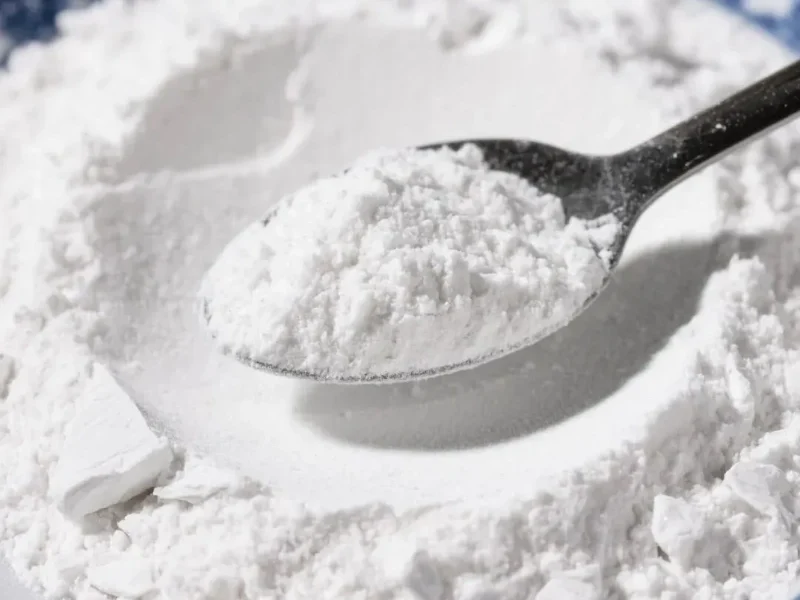
The mesh conventions survive because sieves are cheap and every laboratory owns them. A residue on a 200 mesh sieve tells a ceramic buyer that no coarse speck will survive into the body. Plastics and paint grades move into micronized territory, where the specification names a D97 and sometimes a top size from a laser instrument.
A sieve number alone leaves the top cut undefined, and the top cut is what produces specks and gloss defects. Two powders that both pass 325 mesh can differ in D97 by a factor of two. Sieve residue comes from a test sieve, while D97 comes from a laser instrument reading a dispersed sample. The two figures rest on different methods, so a specification that quotes one cannot be checked against the other.
The fine end carries a price on three fronts. Particles below about 2 µm raise oil absorption, which the paint buyer pays back at the resin balance. Fines raise the dust load in the plant and the demand for dispersants, and over-grinding breaks plates as well. A lamellar grade that is ground past its specification loses the reinforcement the compounder bought it for. The useful target is the coarsest distribution that still meets the colour and gloss standard, and the customer’s own formulation sets that number.
Five Items to Send
A talc circuit is sized from the deposit and the specification together, and five items cover both. Each one changes a machine dimension or a material of construction, so a quotation built without them misses at commissioning.
| Item | What it decides |
|---|---|
| Target use, whiteness of the feed and the ceiling on the product | Whether the deposit fits the grade, and the lining and media material |
| Target fineness as sieve residue plus D97 | Circuit type, classifier speed and number of stages |
| Lamellarity requirement, where the buyer names one | Whether a jet mill enters the comparison at all |
| Feed moisture and the dark gangue content | Dryer requirement and beneficiation step ahead of the mill |
| Tonnage and the number of grades per week | Machine size and changeover time the line can absorb |
Send those five and the proposal returns with a circuit layout and an expected curve on your material. It also states the whiteness the circuit is expected to hold, which decides whether the powder still meets the standard after milling.
Submit Your Talc Grinding Requirements
About EPIC Powder Machinery. We build the circuits used on talc and other non-metallic minerals. The range covers ball mills with ceramic or steel lining, ring roller mills for the 325 to 2000 mesh grades, and dry jet mills for the finest cuts. Centrifugal classifiers set the top cut on each of them.
Every project begins with a grinding test. The report gives the curve before and after, together with the whiteness the circuit held. The machine range lists the models and their working ranges, and the surface modification line covers the coated grades used in plastics. Write to [email protected] with the five items above.

“Thanks for reading. I hope my article helps. Please leave a comment down below. You may also contact EPIC Powder online customer representative Molly for any further inquiries.”
— Jason Wang, Engineer