
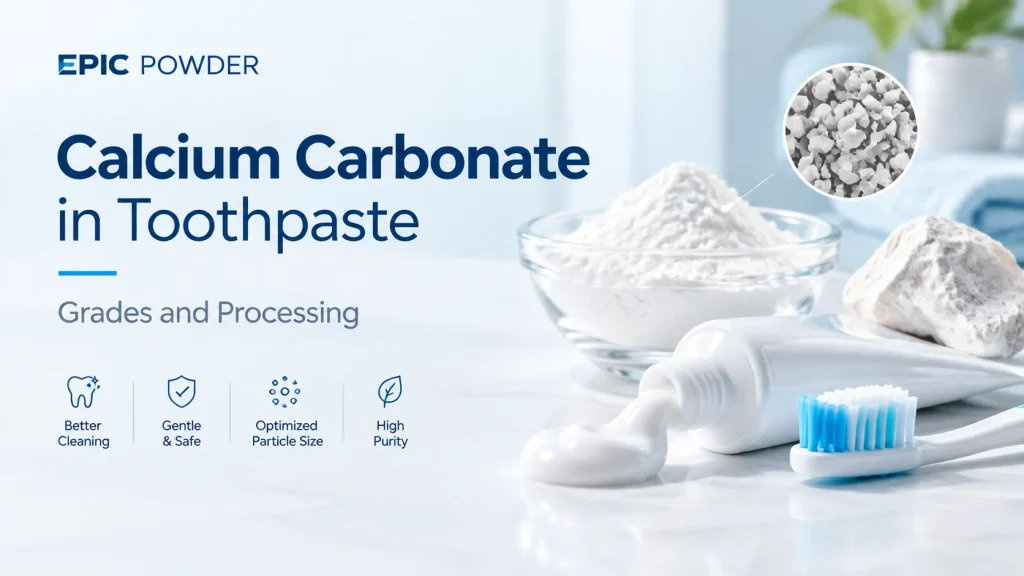
Toothpaste cleans with a fine, gritty powder, and across much of the world that powder is calcium carbonate. The mineral lifts plaque and surface stain off each tooth and leaves the enamel smooth. It also gives traditional opaque white toothpastes their dense, even color.
In a typical formula the abrasive is the largest solid component, commonly around 30–50% by weight, behind only water and humectants. Calcium carbonate shares that role with silica and a few phosphate minerals. It holds a strong position in Asia and in value-priced and whitening lines because it cleans well, is abundant, and costs less than most substitutes. Open a standard Chinese or Southeast Asian toothpaste and the ingredient list often names calcium carbonate as the abrasive.
A Soft Mineral That Cleans Without Heavy Wear
Calcium carbonate sits in a useful middle ground for an abrasive. Its mineral form, calcite measures about 3 on the Mohs hardness scale. It’s below tooth enamel at roughly 5 and above dentin at around 2.5. The powder is hard enough to scrape plaque and stain and soft enough to treat enamel gently.
That balance means particle size, not hardness, drives both cleaning and safety. A powder of well-sized grains cleans efficiently, while a coarse grain can scratch the tooth. Holding the size, especially the largest grains in a batch, protects enamel more than changing the mineral itself would.
The Job Calcium Carbonate Does in Toothpaste
Calcium carbonate works like a fine polish. Each grain drags across the tooth, breaks the bond of plaque, and lifts tannin and food stain out of the surface film while wearing the enamel very little. The clean feeling after brushing comes from this mechanical removal.
The same powder keeps the paste opaque and white. A bright, uniformly fine calcium carbonate holds its color from the first squeeze to the last of a tube. This quality makes it the natural choice for traditional pastes, where a clear gel abrasive such as silica cannot deliver the same dense white look.
Silica, the other common abrasive, is harder than calcium carbonate and shows up in clear gel toothpastes, where an opaque mineral would cloud the product. Calcium carbonate suits the opaque paste formats, and its low hardness places it naturally at the gentler end of the abrasive range.
Precipitated and Ground Calcium Carbonate
Toothpaste draws on two forms of calcium carbonate. Precipitated calcium carbonate, or PCC, forms in a controlled chemical reaction that yields particles of uniform size and shape, high whiteness, and few impurities. Ground calcium carbonate, or GCC, comes from limestone crushed and milled down to a fine powder.
PCC is the standard for toothpaste grades because its particle size and purity stay easy to hold inside a narrow window. GCC costs less and still performs in many formulas after fine grinding and a sharp classification pass, which makes it a practical option for value lines.
One compatibility detail separates the two in the lab. Fresh PCC can react with sodium fluoride, so formulas built on sodium fluoride often switch to sodium monofluorophosphate, which stays stable next to calcium carbonate. A brand chooses its abrasive and its fluoride source as a pair.
The Numbers That Define a Toothpaste Grade
Toothpaste-grade calcium carbonate is small and tightly sized. Most grades target a median particle size, or D50, of about 2–4 micrometers, and they cap the top end so almost no grain reaches a coarse size. Fine grades commonly hold D97 at or below about 6 micrometers.
Two figures then separate a toothpaste grade from an ordinary filler. Whiteness must reach roughly 95 or higher so the paste looks clean on the brush, and calcium carbonate purity should be 98% or more, with trace heavy metals low enough to satisfy food, cosmetic, and pharmacopoeia limits.
Heavy metals receive the tightest limits of all. Lead and arsenic must sit below a few parts per million, and iron must run low enough to avoid gray specks and off-color paste. These limits push producers toward clean limestone feed, magnetic separation, and coated equipment that does not introduce iron during grinding.
Whiteness is read with a brightness meter, and the number reflects how much blue-white light the powder reflects. A shift of a point or two changes the tint of the finished paste, so producers monitor brightness as a running check during production rather than a single test at the end.
A narrow size spread matters as much as the median. A batch with a correct average but a long tail of oversized grains will scratch, and one with too many fines will polish poorly. Consistent classification keeps the entire curve inside the working window instead of holding only the midpoint.
A toothpaste grade typically targets these numbers:
· D50 of 2–4 μm
· D97 of 6 μm or below for fine grades
· Whiteness of 95 or higher
· CaCO₃ purity of 98% or higher
· pH of roughly 8–10.5 in a 10% slurry
Why Oversize Particles Are the Real Risk
The dangerous grain is the large one. A single oversized particle of calcium carbonate can scratch enamel or dentin during brushing, so the top cut of the powder carries more safety weight than the average size does. This top cut is the difference between a pass and a fail in a toothpaste grade.
The industry tracks this wear with Relative Dentin Abrasivity, or RDA. Calcium carbonate toothpastes usually measure in a moderate band, commonly cited around 100 to 180, and children’s and sensitive formulas use finer grades that score far lower. The lower score comes from a stricter top cut and a finer grind.
Sharp classification is the step that removes the coarse tail. Cutting the oversize grains lowers RDA while the fine fraction keeps doing the cleaning. The result is a paste that feels the same every day and wears the tooth predictably.
How Toothpaste-Grade Calcium Carbonate Is Made
Ground calcium carbonate follows a straight route. Quarried limestone is crushed, milled, and classified to the target size in a ball mill and air classifier line, which grinds a high volume while holding the median size steady across batches.
Precipitated calcium carbonate takes a chemical path. The limestone is burned to quicklime, slaked with water, and carbonated with carbon dioxide to precipitate fine crystals. After filtering and drying, the powder is deagglomerated and classified to remove coarse lumps and hit the final top size.
The mill and classifier on the ground route run in a closed loop. Material the classifier rejects returns to the mill for another pass, and material that meets the top cut leaves the circuit as product. This recirculation keeps the mill working and holds the finished size steady without over-grinding the good fraction.
Both routes finish with the same controls. Magnetic separation pulls out iron and other metals, and a final classification locks in the top cut. These two steps decide whether a batch reaches the whiteness and purity of a toothpaste grade or drops into a lower-value filler class.
One Mineral, Several Grades
One calcium carbonate line can make several products by shifting the classifier. A whitening formula works with a cut that cleans more aggressively while staying inside the safe RDA range, and a children’s or sensitive formula takes the finest cut the classifier produces, where the top size is tightest.
Batch-to-batch consistency decides whether a brand trusts a supplier. A toothpaste maker cannot let the product feel change because a milling line drifted by a micrometer, so a stable classifier with repeatable settings holds more value than a mill that occasionally over-grinds.
Calcium Carbonate Grinding and Classifying Equipment
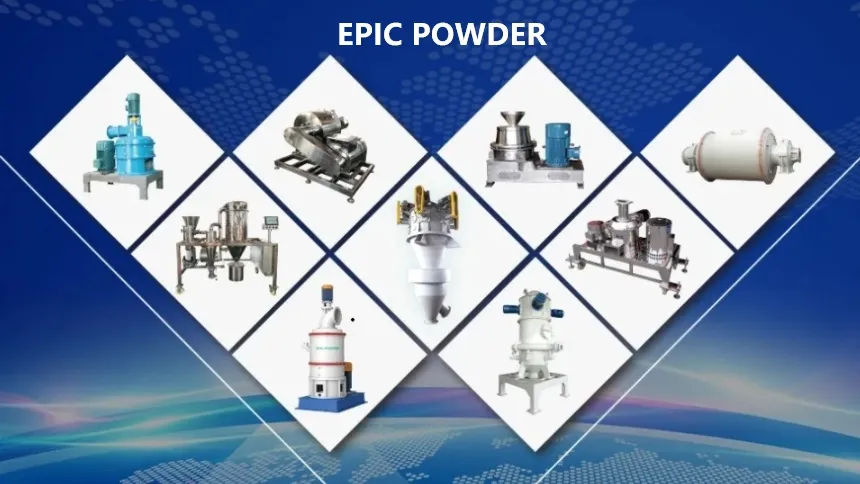
Epic Powder Machinery supplies the grinding, classifying, and coating systems that turn limestone into toothpaste-grade calcium carbonate. Three machines carry most of the load in a production line.
Ball Mill — The workhorse for ground calcium carbonate. It reduces limestone to fine powder at high output, and a downstream classifier holds the D50 inside the 2–4 micrometer window over long runs, a level of control a mill alone cannot hold.
Horizontal Air Classifier — Controls the top cut that safety rests on. It cuts the coarse oversize grains out of the milled powder and splits it into narrow grades, lowering RDA and keeping scoring grains out of the toothpaste. This one step changes abrasivity more than any adjustment to the mill.
Ultra-fine Air Classifier — For the finest toothpaste grades and multi-product plants. A second, ultra-fine classification pass tightens both the top size and the distribution, which suits the sensitive and children’s formulas that need the lowest abrasivity.
A three-roller mill extends the same base powder into coated grades for plastics, rubber, and paint. Coated grades do not enter toothpaste, but the machine lets one plant serve several calcium carbonate markets from a single milling line.
Epic Powder
Epic Powder designs grinding and classifying systems for minerals, chemicals, food, and pharmaceuticals. With more than 20 years of powder processing experience, we match the right mill to your target particle size and capacity. Let us know about your material and we will recommend a tested solution.
Contact Epic Powder Machinery
A toothpaste-grade line is a ball mill and air classifier pair with a sharp final cut and magnetic separation for iron. Epic Powder Machinery grinds a sample of your limestone or PCC feed before quoting, so the target D50, top size, whiteness, and throughput are set against real material rather than a data sheet.
Describe your feed material and finished-size goal through the contact page, or send a sample to the engineering team. The reply includes a machine configuration with the expected capacity and final particle size.
Build a calcium carbonate line for your toothpaste grade
Contact the teamEmail [email protected] or WhatsApp +86 157 6227 2120
Send the feed sample and the target D50, and the team returns the projected output, top size, and power draw for the line.
Specifications listed here reflect typical industry values for toothpaste-grade calcium carbonate and may vary by formula and supplier. Confirm final targets with the engineering team.

“Thanks for reading. I hope my article helps. Please leave a comment down below. You may also contact EPIC Powder online customer representative Zelda for any further inquiries.”
— Emily Chen, Engineer