Raymond Mill
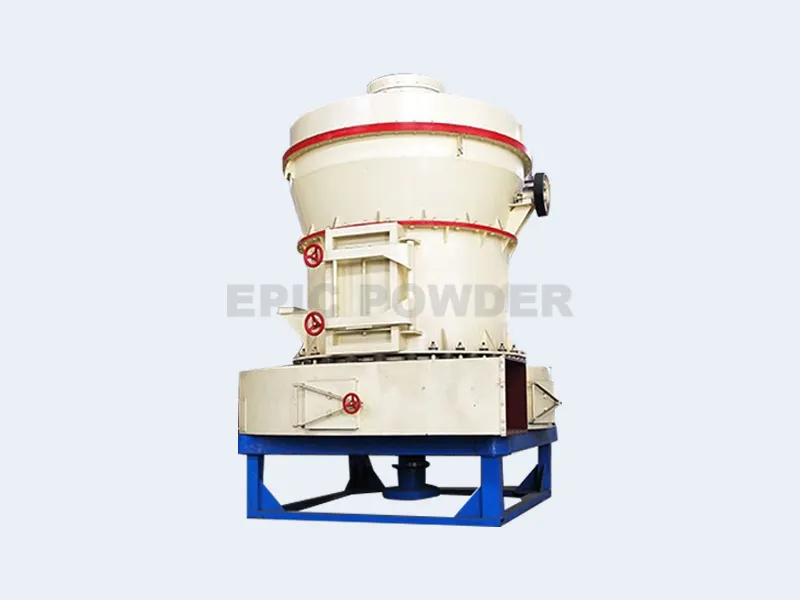
The Raymond mill, also called Raymond roller mill, combines grinding, classifying, and if necessary, drying, in one machine to produce precisely sized powders to meet exact production specifications. It is an efficient fine grinding machine for large-scale powder production.
Applied materials:
various non-flammable and explosive minerals such as gypsum, talc, calcite, limestone, marble, potash feldspar, barite, dolomite, granite, kaolin, bentonite, medical stone, iron ore, etc.
Raymond mill working principle
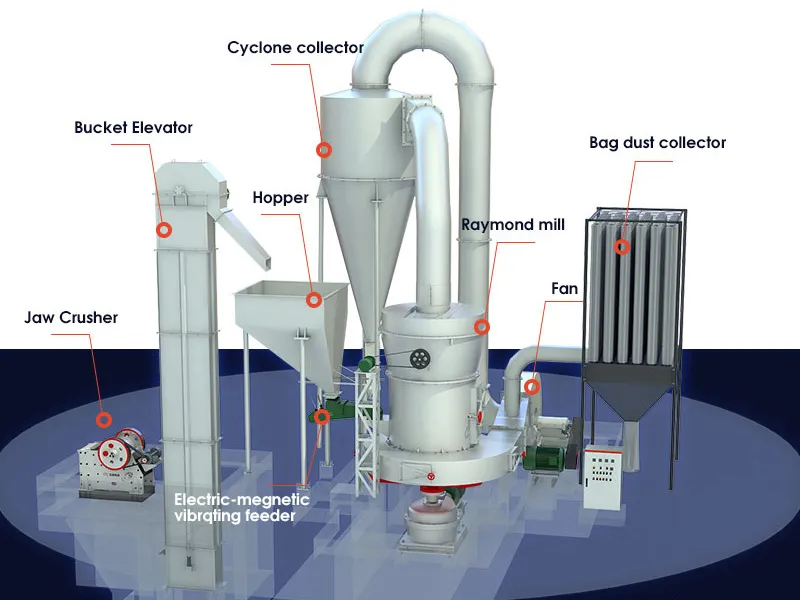
- Raw materials are crushed into specified particle size by a jaw crusher, lift to the hopper by a bucket elevator, and then sent into the grinding chamber by a feeding machine quantitatively.
- Rotating shovels scoop up raw materials and project them between the rollers and the ring where the grinding takes place.
- The pulverized powder is blown to the classifier by the blower airflow for classifying. The oversized particles fall into the grinding chamber for regrinding. Qualified powders flow into cyclone collector through the classifier and are collected as end products.
- To ensure that the Raymond mill works under negative pressure, the increased airflow enters the pulse dust collector through the pipe and is discharged into the atmosphere after purification. The dust-free operation in the workshop is realized by the pulse collector.
Features of Raymond mill
1. Large output and high grinding efficiency
Outputs of 8 to176 tons per shift (8 hours). The finished powder is uniform in fineness, and the passing rate is as high as 99%.
2. Ability to produce powders of different particle sizes
Different uses of powder require different particle sizes. Therefore, the fineness of the Raymond mill can be adjusted arbitrarily between 0.173mm and 0.044mm. The achievable upper particle size is 800 mesh.
3. Low energy consumption
The Raymond pendulum mill achieves high requirements for grain size distribution easily and extremely energy efficiently, even in case of the highest demands regarding the fineness to be achieved.
4. Extremely robust and durable design
Less vibration due to integral gearbox increasing the mass of the mill and special designed anti-vibration device. Vibration reduction avoids cracking or damage to the frame and return box from long-term vibration and fatigue.
The important parts are made of high-quality steel, and the wearing parts are made of excellent wear-resistant materials to improve wear resistance.
5. Environmental protection
The good sealing performance of the equipment and the full-pulse dust collector ensure that the dust removal rate can reach 99%.
6. Automatic control
The electrical system adopts centralized control, and the grinding workshop can basically achieve unmanned efforts.
Calcium carbonate production related cases
Projects in these field

Calcium Carbonate Classification and Grades and How to Choose the Right Grade for Your Application
Calcium carbonate (CaCO3) is the most widely used industrial mineral

How to Achieve an Orange Peel Surface on PETG 3D Prints — The Role of Calcium Carbonate Fillers
A growing number of 3D printing customers ask the same

Ceramic Powder Mixing Equipment: A Complete Guide to Dry and Wet Mixing Processes, Parameters, and Equipment Selection
Mixing is a pre-forming step in ceramic production that is

Modified Calcium Carbonate Technologies and High-Performance Powder Coating Equipment for Plastics & Rubber
Modified calcium carbonate has evolved from a simple filler into

Why ACM is replacing Raymond Mill for High-End Calcium Carbonate Processing?
The case for upgrading from a Raymond mill to an

CTC vs MBS Classifier for GCC: Which One Matches Your Calcium Carbonate Production Goals?
Many GCC producers struggle with the same problem: their existing
30M
RESPOND WITHIN 30 MINUTES
24H
PROVIDE TECHNICAL SOLUTIONS IN 24 HOURS
2H
REPLY TO CUSTOMER QUESTIONS IN 2 HOURS
72H
PROVIDE SOLUTIONS WITHIN 72 HOURS