
Starting a calcium carbonate processing plant or building a ground calcium carbonate production line is a capital-intensive decision. Success depends on matching raw material quality, production scale, and equipment choice to a clear market position. Many new plants fail because investors focus on the mill price while ignoring energy costs, environmental compliance, and logistics.
The global calcium carbonate market reached USD 28.50 billion in 2025 and is projected to grow to USD 49.23 billion by 2035 at a 5.6% CAGR$TRAE_REF. That growth creates opportunities, but only for plants that are designed around real product demand.
Market Overview: Why Calcium Carbonate?
Market Overview: Why Calcium Carbonate?
Calcium carbonate is one of the most widely used industrial minerals. The paper application sector remains the largest consumer, accounting for 28.4% of total consumption. Plastics follows as the second-largest segment at 24.8% of market revenue; processors use ground calcium carbonate to reduce virgin resin consumption by 15–30% by weight while keeping tensile strength and impact resistance. Paints, coatings, construction, and dietary supplements make up the rest.
GCC vs PCC: Which One Should You Produce?
| Feature | Ground Calcium Carbonate (GCC) | Precipitated Calcium Carbonate (PCC) |
| Production method | Mechanical grinding of limestone, marble, or calcite | Chemical precipitation from calcium hydroxide and CO₂ |
| Typical particle size | D97 5–74 μm | D50 0.5–5 μm, finer and more uniform |
| Initial investment | Lower | Higher |
| Feedstock | Limestone, marble, calcite | Limestone + process CO₂ + water |
| Main applications | Plastics, paints, rubber, paper filler, construction | Paper coating, pharmaceuticals, food, premium plastics |
Most new entrants start with GCC because the equipment and process are simpler and the feedstock is easier to secure. PCC requires more complex chemistry and typically suits investors with access to low-cost carbon dioxide and a market for high-brightness, ultrafine products.
Site Selection: Quarry Proximity and Logistics
Transportation cost is one of the strongest determinants of profit margin. A plant located far from the quarry pays far more for raw material delivery than a plant located at the quarry edge. Site selection should start with a radius map around available limestone or calcite deposits.
Road, rail, or port access matters for both inbound raw material and outbound finished product. Coastal or river-side locations reduce bulk shipping costs for export markets. Stable electricity supply is essential because grinding and classification are power-intensive. A GCC line producing D97=10 μm powder can consume 20–25 kWh per ton of finished product using modern vertical mill technology.
Environmental zoning rules often restrict plant locations. Many regions prohibit new mineral processing facilities near residential areas, drinking water sources, or protected landscapes. Early engagement with local environmental authorities prevents expensive relocation later.
Raw Materials: Limestone, Marble, or Calcite?
Feedstock quality defines product value. High-purity limestone or marble with CaCO₃ content above 97% and low iron, silica, and magnesium is preferred for filler-grade products. Lower-grade ore can still work for construction applications but yields lower prices.
Limestone is the most common feedstock. It is widely available and relatively cheap. Marble offers higher whiteness, which is valuable for premium plastics and coatings. Calcite is softer and easier to grind, which reduces energy and wear-part consumption. The choice should match the target product specification and local geology.
Incoming particle size also affects the crushing and grinding flowsheet. Run-of-mine limestone above 300 mm needs jaw or hammer crushing before it can enter a grinding mill. Starting with smaller, pre-crushed material reduces the front-end equipment cost.
Production Process and Fineness Targets
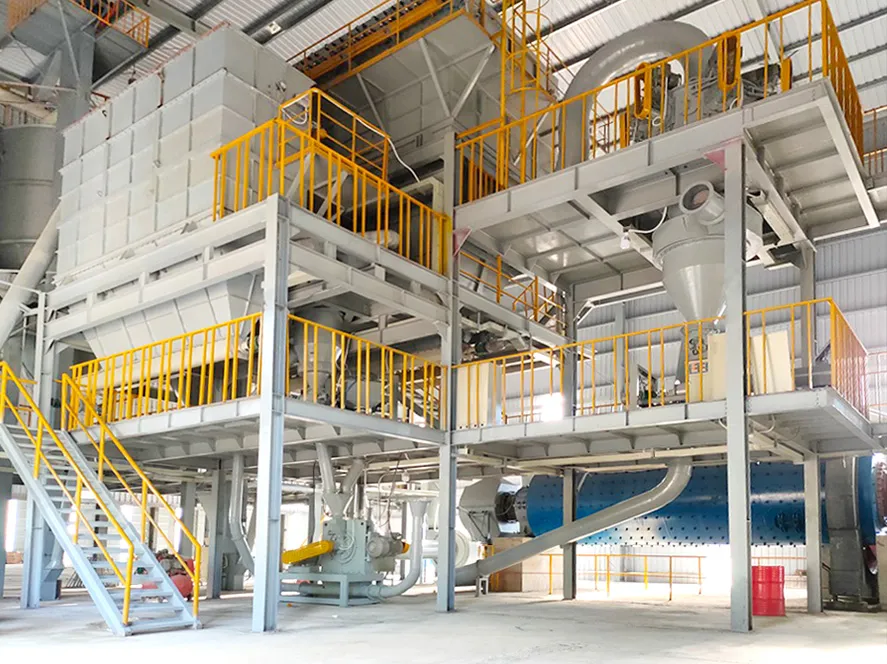
A typical GCC production line includes crushing, grinding, classification, optional surface modification, and packaging. Each step adds cost but also expands the product range.
Fineness targets map directly to applications. Coarse grades around 200 mesh (74 μm) go into construction and animal feed. 600–1250 mesh (20–10 μm) serves plastics, rubber, and paints. Ultrafine grades above 2500 mesh (5 μm or below) command higher prices in paper coating, sealants, and premium plastics. The wrong mill for the target fineness creates waste and rework.
Fineness-to-Equipment Mapping
| Target Fineness | Common Equipment | Typical Applications |
| 74 μm (200 mesh) | Raymond mill, hammer mill | Construction, animal feed |
| 20–45 μm (325–600 mesh) | Ring roller mill | Plastics, rubber, paints |
| 10–20 μm (600–1250 mesh) | Ring roller mill, vertical roller mill | Plastics, rubber, coatings |
| ≤10 μm (2500 mesh and above) | Ball mill + air classifier | Paper coating, sealants, premium plastics |
Surface coating with stearic acid or other modifiers makes calcium carbonate more compatible with polymers. Coated products sell at a premium in masterbatch and PVC applications. Adding a coating line requires extra investment but often pays back faster than expanding grinding capacity alone.
Core Equipment for Calcium Carbonate Processing
Crushing Equipment
Jaw crushers handle large blocks. Hammer crushers and impact crushers suit softer limestone or secondary crushing. The goal is to reduce feed size to below 30–40 mm before grinding. Oversized feed damages the mill and increases energy use.
Grinding Mills
Raymond mills work for medium-fine products up to about 325 mesh. Ring-roller mills reach 600–1500 mesh with lower investment than ball mill systems. Vertical roller mills offer high efficiency for fine and ultrafine GCC. Ball mills paired with air classifiers produce the most uniform particle distribution for high-end paper coating and plastics.
For a detailed comparison of these technologies, see Epic Powder’s guide on ball mill vs vertical roller mill vs air classifier mill.
Air Classifiers
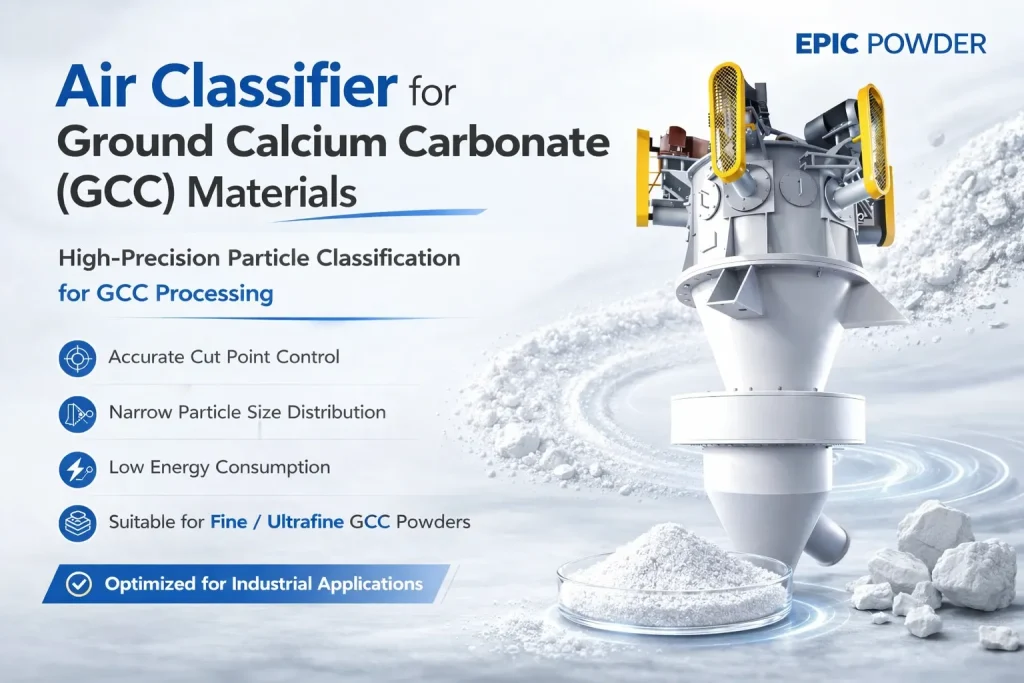
Air classifiers separate fine and coarse particles after grinding. A good classifier keeps the cut point stable and maximizes yield in the target size range. Without precise classification, even an efficient mill produces off-spec product.
Dust Collection and Environmental Controls
Calcium carbonate dust is not toxic like silica, but it creates housekeeping, equipment wear, and regulatory problems. A plant needs hoods at every transfer point, ductwork sized for the airflow, and a bag filter or cartridge collector. Cyclone pre-separation reduces the load on the final filter and extends media life.
Powder Coating and Packaging
Powder surface modification equipment modifies particle surfaces to improve dispersion in polymers. Options include turbo mill coating, cell mill coating, pin mill coating, and three-roller coating machines. Packaging systems range from 25 kg valve bags to bulk tanker loading. The choice depends on customer requirements and logistics.
Permits, Licenses, and Environmental Compliance
Business registration and project filing are the first steps. Land-use approval or factory lease registration establishes the legal basis for the facility. Environmental impact assessment and emissions permits determine whether the plant can start production. Mining rights or long-term raw material purchase agreements secure feedstock supply. Food-grade or pharmaceutical-grade production requires additional certification such as FDA registration, ISO 22000, or HACCP.
Permit requirements vary by country and region. Some Chinese provinces, for example, require calcium carbonate projects to locate in designated industrial parks and meet specific emission and energy-efficiency standards. Investors should consult local authorities and licensed consultants before finalizing site or equipment decisions.
Investment and Operating Cost Overview
Capital investment for a complete calcium carbonate grinding plant typically ranges from USD 500,000 to USD 2,000,000 depending on capacity and technology. Equipment accounts for 60–70% of the total project cost. Civil works, electrical systems, installation, and commissioning make up the rest.
Typical Investment Breakdown
| Cost Item | Share of Total Investment | Notes |
| Equipment | 60–70% | Grinding mills, classifiers, dust collectors, packaging |
| Civil works | 15–20% | Building, foundations, silos |
| Electrical and automation | 10–15% | Power distribution, PLC, instruments |
| Installation and commissioning | 5–10% | Transport, erection, trial runs |
Operating costs are dominated by electricity, wear parts, and labor. Energy alone can reach USD 8–12 per ton in markets with industrial power tariffs around USD 0.10 per kWh. Wear parts such as grinding rollers, rings, and classifier rotors add another USD 1–2 per ton. These numbers change with local energy prices and ore hardness.
Common Mistakes New Plants Make
Many investors choose equipment based only on the lowest quoted price. A cheaper mill with higher energy use or shorter wear-part life becomes more expensive within two years. Others skip detailed feedstock testing and discover later that the ore cannot reach the promised whiteness or fineness.
Poor layout is another frequent error. A plant designed without space for dust collection ducts, maintenance access, or future expansion faces costly retrofits. Some producers also enter the market without a clear product strategy and end up competing on price in oversupplied coarse grades.
Epic Powder Machinery
Epic Powder Machinery has supplied grinding, classifying, and powder-coating equipment for non-metallic minerals for more than 20 years. Its product range includes Raymond mills, ring-roller mills, vertical mills, ball mill-classifier lines, jet mills, and surface modification systems. The company serves customers in over 160 countries and provides layout design, installation guidance, and after-sales support.
Get a Calcium Carbonate Processing Line Quote
Send Epic Powder your feedstock analysis, target capacity, and required fineness. The engineering team can recommend a solution that matches your market and budget.

“Thanks for reading. I hope my article helps. Please leave a comment down below. You may also contact EPIC Powder online customer representative Zelda for any further inquiries.”
— Jason Wang, Engineer