
For ultrafine grinding of non-metallic minerals, three equipment systems are most commonly used: the Ball Mill + Air Classifier production line, the Vertical Roller Mill (VRM), and the Air Classifier Mill (ACM). Each has its own grinding mechanism, application range, and cost structure. Choosing the wrong system can lead to high energy bills, inconsistent product quality, or unnecessary capital expense.
This article compares the three systems across five key dimensions: fineness, capacity, energy consumption, material compatibility, and total cost. It helps match the right solution to your mineral, production scale, and business goals.
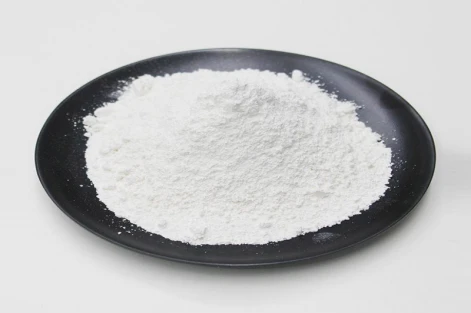
1. Ball Mill + Air Classifier Production Line
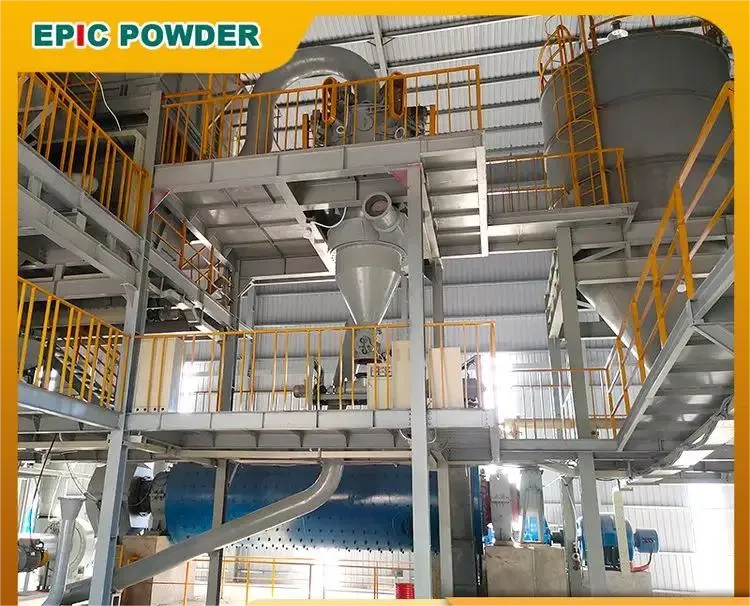
How It Works
A ball mill is a rotating horizontal cylinder filled with grinding media. Common media types include steel balls, alumina balls, or ceramic beads. As the cylinder rotates, the grinding media is lifted and cascades down, crushing the material through impact and attrition. The ground material is pneumatically conveyed to an external air classifier, which separates fine powder from coarse particles. Oversized material returns to the mill for re-grinding, forming a closed-loop system.
Epic Powder’s ball mill design is built for ultrafine filler-grade mineral processing. It features optimized length-to-diameter ratios, an advanced jaw plate design, and tail-end discharge that prevents over-grinding.
Key Advantages
Large single-machine capacity. Models range from 1 to 20+ tons per hour, suitable for large-scale operations.
Stable product quality. Once parameters are set, the ball mill + classifier combination delivers consistent particle size distribution over long production runs.
Narrow PSD achievable. Paired with multi-rotor classifiers (HTS series for D97: 3–20 μm, ITC series for D97: 8–45 μm), the system produces precisely cut products.
Contamination control. With ceramic linings and alumina grinding media, the system achieves iron-free grinding for high-whiteness applications.
Multi-product flexibility. Multi-stage classifiers in series can produce two or more fineness grades at the same time.
Lowest specific energy consumption among the three systems for large-scale production.
Limitations
High initial investment. Requires substantial civil engineering, foundation work, and auxiliary equipment (classifier, fan, dust collector, conveying system).
Large footprint. A complete ball mill classifying line takes up significant floor space.
Less flexible for frequent product changeovers. The system is optimized for stable, long-run production rather than batch-to-batch switching.
Grinding media wear. Ongoing cost of media replenishment, especially with harder minerals.
Best For
Annual output exceeding 20,000 tons. Examples: paper-grade GCC, large-scale industrial filler production.
Medium to hard minerals: quartz, feldspar, dolomite, barite.
Applications requiring iron-free, high-whiteness output (with ceramic lining).
Target fineness: D97: 5–45 μm.
Vertical Roller Mill (Superfine Vertical Mill / Table Roller Mill)
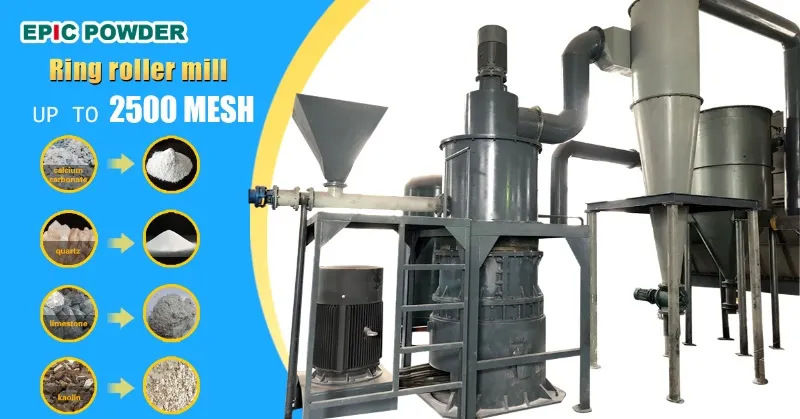
How It Works
The vertical roller mill uses material bed grinding. Raw material is fed onto a rotating grinding table. Centrifugal force pushes the material under hydraulically loaded grinding rollers. The material is crushed by compression and shear within the grinding bed. At the same time, hot gas enters from the bottom nozzle ring, drying the material and carrying ground particles upward to an integrated high-efficiency classifier. Fine powder exits with the airflow. Coarse particles fall back to the table for further grinding.
Epic Powder’s vertical roller mill is one of the largest ultrafine vertical mills in Asia, with proven market operation. It integrates crushing, drying, grinding, classifying, and conveying into a single compact unit.
Key Advantages
Low energy consumption. Uses 30–50% less energy than a ball mill producing the same fineness.
High single-machine throughput. Up to 50 t/h, equivalent to 5 or more conventional micro-powder mills.
All-in-one integration. Drying, grinding, and classifying happen in one machine. Materials with up to 5–8% moisture can be processed without a separate dryer.
Compact footprint. Only 50% of the space required by an equivalent ball mill system. Can be installed outdoors.
Low wear and easy maintenance. Roller sleeves can be turned over for extended service life. The hydraulic system allows rollers to be swung out for quick inspection.
Low iron contamination. Short material residence time reduces repeated grinding, preserving whiteness and purity.
PLC automation. Remote control and monitoring reduce labor costs.
Limitations
Not suitable for extremely hard minerals (Mohs hardness above 7). Best for soft to medium-hard materials.
Minimum fineness limit. Typically D97 down to 10–20 μm. Not the best choice for sub-10 μm products.
Higher technical expertise required for operation and maintenance compared to simpler systems.
Less flexible on particle size. Product fineness adjustment range is narrower than a ball mill + classifier combination.
Best For
Large-scale production of calcium carbonate (GCC), limestone, dolomite, talc, gypsum, bentonite, quicklime.
Target fineness: D97: 10–40 μm (specific surface area up to 25,000 cm²/g).
Operations where energy cost is a primary concern and single-product consistency matters.
Projects with space constraints or wanting to minimize civil engineering costs.
Air Classifier Mill (ACM)
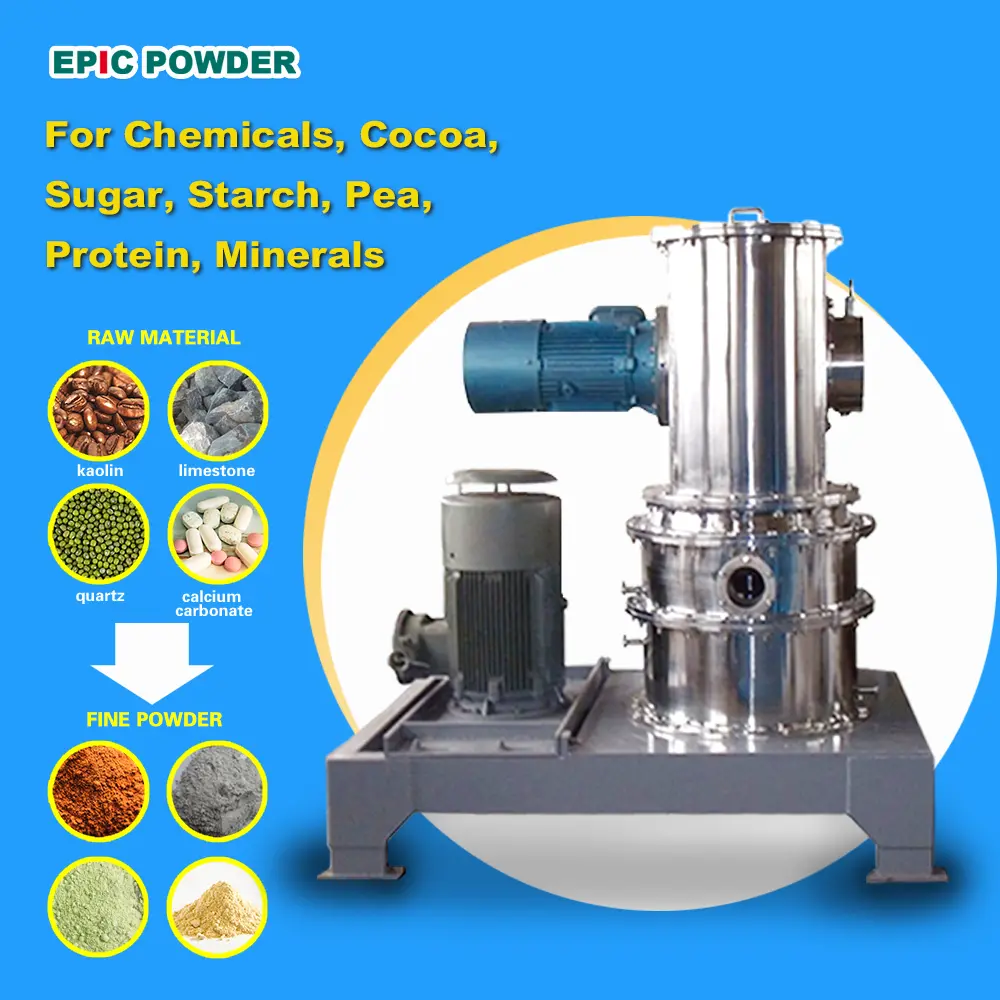
How It Works
The Air Classifier Mill is a high-speed mechanical impact mill with an integrated dynamic classifier. Material enters the grinding chamber and is struck by a high-speed rotor equipped with hammers, blades, or pins. The impact, shear, and particle-to-particle collision break the material down. An upward airflow carries the particles into the classifier zone. A high-speed classifier wheel separates fine from coarse. Fine powder passes through the wheel to collection. Coarse particles are thrown back into the grinding zone.
Epic Powder’s MJW series ACM covers multiple models for different capacities and applications.
Key Advantages
Lowest upfront investment. Significantly cheaper than a ball mill line or vertical roller mill of similar capacity.
Integrated design. Grinding and classifying in one compact unit. No external classifier needed.
Fast product changeover. Adjust rotor speed and classifier frequency to switch between products.
Wide fineness range. Capable of D97: 8–150 μm, covering coarse fillers to fine powders.
Cost-effective for soft materials. The most economical choice for materials below Mohs 3.5.
Quick installation. Minimal civil works required. Ready to run shortly after delivery.
Limitations
Not suitable for hard or highly abrasive minerals. Rotor and liner wear accelerates significantly above Mohs 3.5–4.
Heat generation. Mechanical impact produces heat. Not ideal for heat-sensitive materials without cooling measures.
Lower per-unit capacity. Typical range of 0.2–15 t/h, limited by rotor size and motor power.
Higher wear cost on abrasive materials. Replacement of hammers, liners, and classifier blades adds to operating expenses.
Best For
Soft minerals: talc, kaolin, graphite, calcium carbonate (medium fineness), food-grade powders, pharmaceuticals.
Target fineness: D97: 10–150 μm.
Small to medium production scale. Examples: pilot plants, contract manufacturing, regional mills.
Operations requiring frequent product changes or short production runs.
Head-to-Head Comparison
| Dimension | Ball Mill + Classifier | Vertical Roller Mill | Air Classifier Mill |
| Grinding Mechanism | Impact + attrition (media) | Compression + shear (bed) | Mechanical impact + shear |
| Fineness (D97) | 5–45 μm | 10–40 μm | 8–150 μm |
| Max Single-Machine Capacity | Up to 20 t/h | Up to 50 t/h | Up to 15 t/h |
| Energy Consumption | Low (per ton) | Lowest (30–50% less than ball mill) | Medium |
| Material Hardness Limit | Up to Mohs 7 (with ceramic lining) | Up to Mohs 5–6 | Up to Mohs 3.5 (optimal) |
| Iron Contamination Risk | Low (ceramic media/liner) | Very Low | Medium (requires lining for high-purity) |
| Initial Investment | High | Medium-High | Low |
| Footprint | Large | Compact (50% of ball mill) | Compact |
| Multi-Product Flexibility | Excellent (multi-classifier configuration) | Moderate | Excellent (quick parameter change) |
| Integrated Drying | No (requires separate dryer) | Yes (up to 5–8% moisture) | Limited |
| Maintenance Complexity | Moderate | Moderate-High | Low |
| Best Suited For | Large-scale, hard minerals, ultra-stable PSD | Large-scale, soft-medium minerals, energy-sensitive | Small-medium scale, soft minerals, high flexibility |
5. How to Choose: A Decision Framework
Step 1: Know Your Mineral
Start with three questions:
What is the Mohs hardness? If it is below 3.5 (talc, GCC, kaolin, graphite), all three systems work. If it is above 5 (quartz, feldspar), the ACM is not recommended without heavy wear protection.
Is purity critical? For battery-grade materials or high-whiteness fillers, the ball mill (with ceramic lining) or vertical roller mill gives the lowest iron contamination risk.
Is the material heat-sensitive? If yes, add cooling or choose a system with lower heat generation.
Step 2: Define Your Target Product
D97 below 10 μm: Ball Mill + HTS fine classifier is the recommended choice. ACM can reach this range but at higher specific energy cost.
D97: 10–45 μm: All three systems are viable. The decision shifts to capacity and cost.
D97 above 45 μm: ACM offers the simplest, lowest-cost path to this range for soft minerals.
Step 3: Calculate Your Scale Economics
Below 5,000 t/year: ACM is the most practical choice. Low capital, quick ROI, flexible.
5,000–20,000 t/year: Compare ACM vs. Vertical Roller Mill. The VRM wins if energy costs are high and you run a single product family.
Above 20,000 t/year: Ball Mill + Classifier or Vertical Roller Mill. Choose the ball mill if you need the finest PSD and highest stability. Choose the VRM if you want the lowest energy bill and a smaller footprint.
Step 4: Factor in Total Cost of Ownership (TCO)
Do not look at equipment price alone. Calculate the 5-year TCO including:
Capital expenditure. Equipment, civil works, installation, commissioning.
Energy cost. VRM typically saves 30–50% vs. ball mill; ACM sits in the middle.
Wear parts. Grinding media (ball mill), roller sleeves and table liner (VRM), hammers and liners (ACM).
Labor. VRM and ACM need fewer operators than a full ball mill classifying line.
Maintenance downtime. Lost production during parts replacement.
6. Real-World Application Mapping
| Mineral | Typical Target (D97) | Recommended System | Why |
| Calcium Carbonate (GCC), Paper Filler | 10–20 μm | Vertical Roller Mill | Best energy efficiency at 30,000+ t/year scale |
| Calcium Carbonate (GCC), Plastic Filler | 5–15 μm | Ball Mill + Classifier | Narrow PSD, stable for high-end formulations |
| Calcium Carbonate (GCC), Coarse Filler | 45–150 μm | Air Classifier Mill | Lowest cost for medium-fineness products |
| Talc, Coatings / Plastics | 5–10 μm | Ball Mill + Classifier | Preserves lamellar structure, narrow PSD |
| Talc, General Industrial | 15–45 μm | Air Classifier Mill | Soft mineral, ACM handles it efficiently |
| Kaolin, Ceramics | 10–45 μm | Vertical Roller Mill | Integrated drying handles moisture content |
| Quartz / Silica Powder | 10–45 μm | Ball Mill + Classifier (ceramic lined) | Hard mineral, needs ceramic protection for purity |
| Barite, Oil Drilling | 45–75 μm | Ball Mill + Classifier | Stable, high-capacity, meets API specification |
| Dolomite, Glass / Ceramics | 10–45 μm | Vertical Roller Mill | Good hardness fit, energy-efficient at scale |
| Graphite, Battery Anode | 5–15 μm | Ball Mill + Classifier | Preserves particle shape, narrow distribution |
| Bentonite, Drilling / Cat Litter | 45–75 μm | Vertical Roller Mill | Handles moisture, stable output, compact |
7. Conclusion
There is no single “best” grinding system. The right choice depends on your mineral, your scale, and your market requirements.
Choose the Ball Mill + Air Classifier System if you process hard minerals at large scale, need the finest or most precisely controlled particle size distribution, and can justify the upfront investment with long-term stability.
Choose the Vertical Roller Mill if you process soft to medium-hard minerals at scale, prioritize energy efficiency, and want a compact, all-in-one solution with integrated drying.
At Epic Powder Machinery, we have over 20 years of experience designing and delivering ultrafine grinding systems for customers in 160+ countries. Our ball mill + classifier lines, vertical roller mills, and air classifier mills are built to deliver reliable, high-quality powder output for your specific application.
Need help deciding which system fits your mineral? Contact our engineering team for a free consultation. We can arrange lab-scale grinding tests on your material so you can review real particle size data before making a capital decision.

“Thanks for reading. I hope my article helps. Please leave a comment down below. You may also contact EPIC Powder online customer representative Zelda for any further inquiries.”
— Jason Wang, Engineer