
Introduction
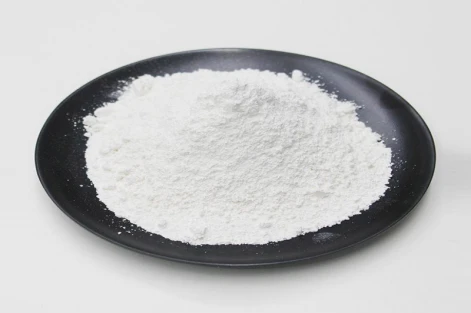
Calcium carbonate (CaCO?) is the most widely used mineral filler in the rubber industry. Few materials match its combination of low cost, brightness, chemical inertness, and ease of handling. Formulators use it in tires, shoe soles, conveyor belts, hoses, and gaskets to control cost, adjust hardness, and hold tight dimensional tolerances.
Calcium carbonate is not one material, however. The grade you pick (ground, precipitated, nano, or surface-treated) changes the compound’s mechanical properties, extrusion behavior, and final price. This guide explains how calcium carbonate is used in rubber and tires, what each grade offers, and how to match a grade to your application.
Why Calcium Carbonate Is Used in Rubber
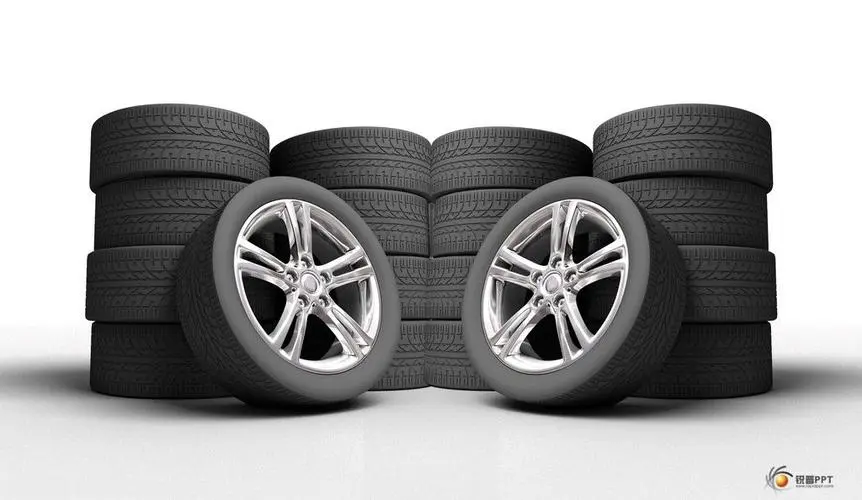
Rubber compounding is a trade-off between performance and cost. Polymer, carbon black, silica, plasticizer, and process oil all add cost, and calcium carbonate is one of the least expensive ingredients available. That is why it is the most widely used filler in general-purpose rubber goods.
Calcium carbonate does four main jobs in a rubber formula:
- Extends the polymer. Replacing part of the base rubber or an expensive filler lowers the material cost per part.
- Builds stiffness. It increases hardness and modulus without the weight penalty of coarser mineral fillers.
- Improves processability. It raises extrusion rate and surface finish, reduces die swell, and helps parts release from molds.
- Controls shrinkage. Fine particles reduce post-cure shrinkage and improve dimensional accuracy.
Because it is white, calcium carbonate also lets formulators make light-colored and colored rubber goods that carbon black would darken.
Types of Calcium Carbonate for Rubber Compounding
How well calcium carbonate performs in rubber depends on particle size, particle size distribution, and surface treatment.
Ground Calcium Carbonate (GCC)
Ground calcium carbonate (GCC) is made by crushing and grinding limestone or marble, then classifying the powder. Most rubber grades have a median particle size (D50) of about 1 to 20 microns.
GCC is the least expensive option and is used mainly to cut cost. It appears in high-volume products such as sheet rubber, floor mats, footwear, and general mechanical goods. Its reinforcing effect is small, so formulators usually combine it with carbon black or use it where high tensile strength is not required.
Precipitated Calcium Carbonate (PCC)
Precipitated calcium carbonate (PCC) is made by carbonating hydrated lime. This produces a purer, finer, and more uniform particle with higher surface area than GCC.
PCC offers better reinforcement, higher brightness, and tighter particle size control. It is the usual choice for white and light-colored rubber products that need whiteness, cleanliness, and moderate reinforcement, such as extruded profiles, medical rubber, and food-contact seals.
Nano Calcium Carbonate
Nano calcium carbonate (nano-CaCO?) is a sub-micron grade, typically 20 to 100 nanometers in primary particle size. Its fine size and high surface area give a semi-reinforcing effect that coarser grades do not have. A 2023 peer-reviewed study of natural rubber and SBR blends measured nano-CaCO? particles around 34 nanometers and found an optimum loading near 3.5% by weight for the best dispersion and mechanical balance.
At low loadings (usually below 15 phr), nano calcium carbonate can raise tensile strength, tear resistance, and elongation. It is also used as a lower-cost partial replacement for reinforcing fillers such as fumed silica or precipitated silica in seals, gaskets, and specialty goods.
Surface-Treated / Coated Calcium Carbonate
Most calcium carbonate for rubber is surface-treated, usually with stearic acid. Untreated calcium carbonate is hydrophilic, while rubber polymer is hydrophobic, so the two do not mix well and the filler disperses poorly.
Stearic acid coating improves wetting and dispersion, allows higher loading, and improves tensile strength, elongation, and tear strength. Note that stearic acid does not create a chemical bond to the rubber; it mainly improves dispersion. For real filler-matrix adhesion, formulators use a coupling agent such as maleated polybutadiene.
How Calcium Carbonate Improves Rubber Compounds
Cost Reduction
Cost is the main reason formulators use calcium carbonate. Loadings in general rubber goods commonly run from 20 to 100 phr, and each phr of calcium carbonate replaces a phr of more expensive polymer or filler. Savings scale with volume, which is why calcium carbonate dominates high-volume, price-sensitive products.
Mechanical Properties
The grade determines the mechanical effect. Coarse GCC mostly raises hardness and modulus while slightly reducing tensile and tear strength. Nano and surface-treated PCC can improve tensile, tear, and abrasion resistance at the correct loading. Every filler has an optimum loading; above it, strength falls.
Processing and Dispersion
Fine, well-dispersed calcium carbonate improves extrusion and calendering. It smooths the surface of extruded profiles, reduces die swell, and helps parts release cleanly from molds. Dispersion matters most: a fine, uniform, surface-treated powder disperses far better than a coarse, agglomerated one.
Dimensional Stability and Aging
Calcium carbonate is chemically inert and thermally stable across normal rubber curing temperatures. It reduces shrinkage, improves the dimensional stability of molded parts, and can improve resistance to aging and weathering in outdoor products.
Calcium Carbonate in Tires and Rubber Products
Tires
In tires, calcium carbonate is used selectively. Tread compounds rely on carbon black and silica for wet grip and rolling resistance, so calcium carbonate plays a smaller role there. It is more common in non-tread components such as inner liner, carcass, and sidewall compounds in cost-driven formulations, where stiffness, processing, and cost matter more than ultimate grip.
This matters: calcium carbonate is a cost-control filler in tires, not a replacement for reinforcing fillers in the tread. Knowing where it fits is the difference between an optimized low-cost compound and a poorly performing one.
Footwear and Soles
Footwear is one of the largest consumers of calcium carbonate in rubber. In shoe soles, outsoles, and EVA foam compounds, calcium carbonate controls hardness, reduces cost, and improves surface finish. Nano grades are used in premium soles to balance weight and mechanical performance.
Hoses, Belts, and Seals
In extruded and molded industrial goods such as hoses, conveyor belts, gaskets, and seals, calcium carbonate improves extrusion surface, dimensional stability, and resistance to compression set when properly formulated. PCC and nano grades are common where whiteness, tight tolerances, and moderate reinforcement are required.
How to Choose the Right Calcium Carbonate Grade
Particle Size (D50 and D97)
Particle size is the most important specification. D50 is the median particle size. D97 is the top cut, meaning 97% of particles are smaller than that value. A narrow distribution gives more consistent dispersion and mechanical properties. Rubber grades typically fall between 1 and 10 microns in D50, depending on whether you want cost reduction or reinforcement.
Whiteness and Purity
For white and colored rubber goods, whiteness and purity matter. High-purity grades with low iron and heavy-metal content keep white compounds bright and prevent discoloration. Specify whiteness (typically R457 or Hunter L value) and CaCO? content when buying.
Surface Treatment
As noted above, a surface-treated grade is almost always preferable for rubber. It disperses better, allows higher loadings, and improves the final mechanical properties. Confirm with your supplier whether the grade is coated and what coating system is used.
Loading Levels
Choose loading by the result you want. For pure cost reduction, 50 to 100 phr or more is common in low-performance goods. For reinforcement, nano grades are used around 5 to 15 phr. Start low and increase while watching tensile strength, elongation, and tear strength to find the optimum.
Processing: Grinding and Surface Modification Matter
The quality of calcium carbonate in a rubber compound is set before it reaches the mixer. Two processing steps determine the result:
- Grinding and classification. A rubber-grade powder with the right D50, narrow distribution, and high whiteness needs a well-designed grinding and air-classification circuit. Ball mill classifier systems and vertical roller mills (VRM) are the two most common routes for high-quality GCC.
- Surface modification. A stearic acid or coupling-agent coating is applied in a dedicated surface modifier or pin mill coating system. This step turns an ordinary filler into a higher-performing, well-dispersing one.
For compounders who want consistent, repeatable results, the powder’s particle size distribution and coating quality are just as important as the chemistry of the base mineral.
Grinding Equipment for Rubber-Grade Calcium Carbonate
Rubber-grade calcium carbonate is defined in the grinding, classification, and coating steps, before it ever reaches a mixer. Epic Powder Machinery Co., Ltd. builds the three machines that produce a consistent, high-value rubber filler:
SRM vertical roller mill
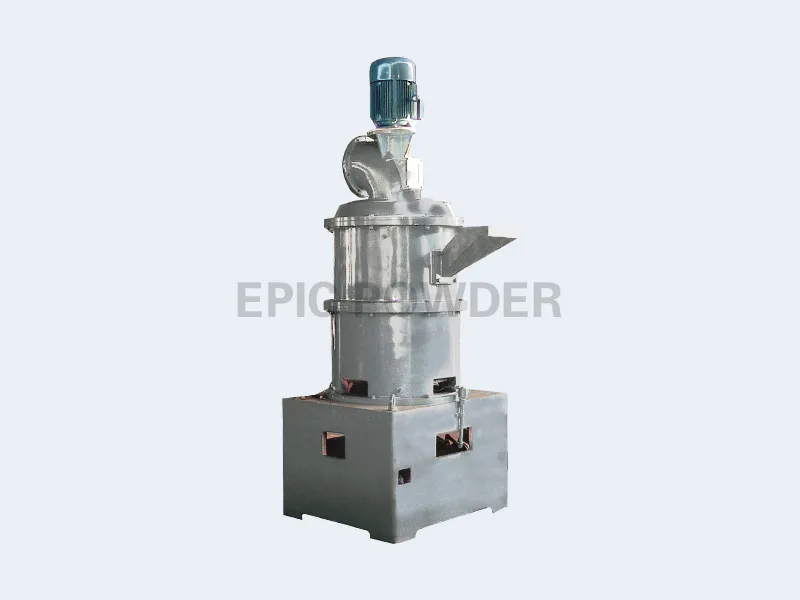
The SRM ring roller mill grinds limestone to 325 to 2500 mesh with a narrow particle size distribution. Models range from SRM800 to SRM1680, covering production capacities from about 0.5 to 20 tonnes per hour. A tight distribution reduces oversize, keeps dispersion consistent, and gives stable mechanical properties batch after batch.
HTS high-precision air classifier
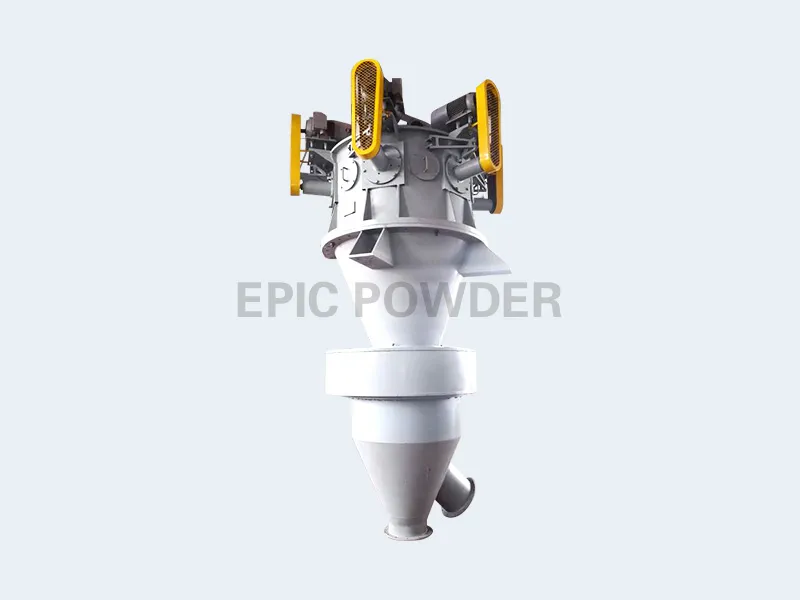
The HTS classifier sets the D50 and D97 of the final powder. It handles dry classification from D97 3 microns to 45 microns. For rubber, this is the step that turns a broad mill output into the tight 1 to 10 micron range compounding depends on.
Pin mill coating system

For surface-treated grades, a pin mill coating system applies stearic acid or a coupling agent to the particle surface. This step controls dispersion and allows higher loadings without losing mechanical properties.
Epic Powder has more than 20 years of experience and installations around the world. Systems are built with PLC automation for continuous operation and wear-resistant linings for contamination-free grinding.
If you produce calcium carbonate for the rubber industry, send your target specification for a free material test and a grinding solution matched to your grade: [email protected] or nonmetallic-ore.com.
Conclusion
Calcium carbonate is the rubber industry’s most cost-effective filler, but its value depends on choosing the right grade. Ground calcium carbonate controls cost in high-volume goods. PCC and nano grades add brightness, reinforcement, and precision for demanding applications. Surface treatment controls dispersion and mechanical performance.
For rubber compounders and powder producers alike, a better product comes down to particle size control and surface modification. If you produce calcium carbonate for the rubber industry, the right grinding, classification, and coating equipment is the first step toward a consistent, high-value powder.

“Thanks for reading. I hope my article helps. Please leave a comment down below. You may also contact EPIC Powder online customer representative Zelda for any further inquiries.”
— Emily Chen, Engineer