
A biodegradable film can fail from a single coarse calcium carbonate particle. That is why two powders with the same D50 can perform completely differently in a PLA or PBAT film line. Calcium carbonate is the filler most degradable packaging makers reach for first, and for a simple reason: it cuts cost without breaking the properties that matter. But technical staff who specify calcium carbonate for biodegradable plastics learn fast that the result depends less on the mineral itself than on three things:
- How finely it is ground
- How tightly its particle size distribution and top cut are controlled
- How its surface is treated
All three come from the milling and classification equipment behind the powder. This guide walks through those controls so formulators and buyers can specify the right grade for PLA and PBAT.

Key Takeaways
- Film-grade calcium carbonate usually targets D50 ≈1.5 μm and D97 ≤5 μm.
- D50 alone is not enough. D97 and the coarse tail decide whether a thin film pinholes or tears.
- Surface coating determines dispersion and how high you can load the filler.
- PLA commonly runs 10–30% loading; PBAT film studies most often work in the 10–20 wt% range.
- Cost should be judged per ton of finished compound, not per ton of powder.
- Batch-to-batch consistency is the main thing a serious buyer should verify in a supplier.
Why PLA and PBAT Depend on Calcium Carbonate
PLA and PBAT both carry a cost problem.
- PLA is stiff but brittle.
- PBAT is soft and tough but expensive.
On their own, neither delivers the full set of properties a film, bag, or food container needs at a price the market will accept. Loading them with a low-cost mineral is the standard fix, and calcium carbonate is the first filler most formulators test.
Calcium carbonate filler plays three roles in a PLA or PBAT compound:
- It replaces expensive polymer at a cost usually below the resin price, so every point of filler lowers compound cost.
- It raises stiffness, measured as Young’s modulus, which helps thin films hold their shape.
- It acts as a nucleating agent and can influence degradation in products designed to break down.
Those three effects, namely lower cost, higher stiffness, and controlled breakdown, explain why calcium carbonate shows up in so many PLA and PBAT compounds.
Particle Size Sets a Ceiling on What the Powder Can Do
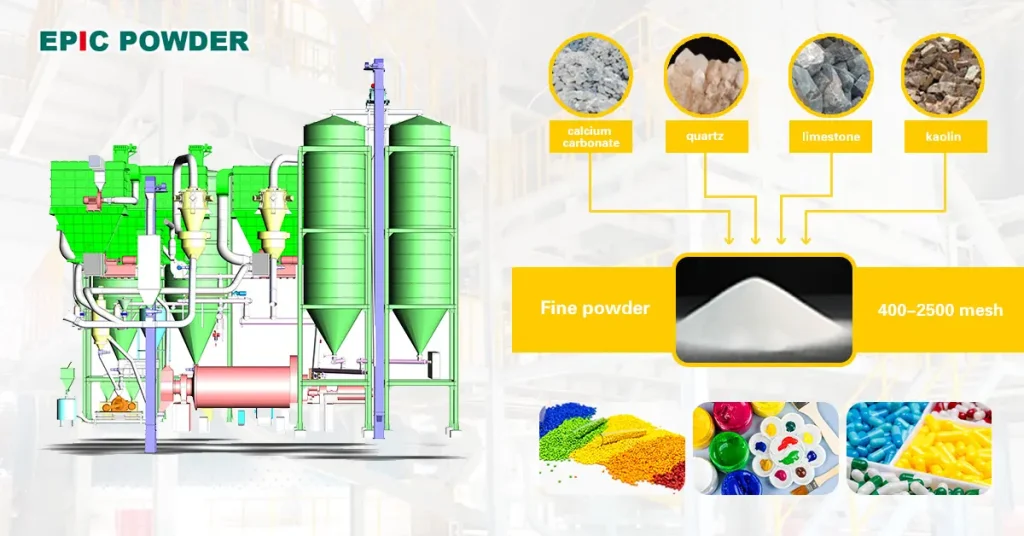
When particles are too large for the part they go into, they become defects instead of filler. In a thin film, a particle larger than a fraction of the film thickness concentrates stress during stretching, and the film tears or pinholes around it. Film-grade calcium carbonate is therefore ground far finer than the grade that goes into injection molded parts.
The right particle size depends on the application, not on a fixed rule. For the 10 to 30 micron films used in bags and packaging, the working target is a median particle size, or D50, around 1.5 microns, with a maximum particle size, or D97, held at or below 5 microns.
For thin films, D97 is often the most critical specification, because coarse particles can act as stress concentrators and create pinholes or tears. The exact limit depends on film thickness, stretching ratio, and dispersion quality, but many film grades target D97 ≤5 μm.
The coarser 2 to 5 micron grades belong in injection molding, sheet, and thicker parts, where the surrounding polymer absorbs local stress instead of rupturing.
Formulators and buyers should therefore ask for two numbers, not one. D50 describes the average, and D97 describes the top cut. A powder can have a fine D50 and still fail in film if the tail of coarse particles is not controlled. Keeping that tail tight is exactly what an air classifier does.
| Application | Typical D50 | Typical D97 (top cut) | Typical loading | Recommended route | What goes wrong if too coarse |
|---|---|---|---|---|---|
| Thin film, 10–30 μm | ≈1.5 μm | ≤5 μm | 10–20% | Jet mill + high-precision classifier | pinholes, tearing, fish eyes |
| Sheet / thermoforming | 2–3 μm | ≈8 μm | 20–30% | Ball mill + air classifier | surface roughness, low gloss |
| Injection molding | 2–5 μm | ≈10 μm | 20–30% | Ball mill + air classifier | weak weld lines, lower impact |
The Distribution Also Decides Film Quality
A D50 value only tells you the median. Two powders can share the same D50 and behave very differently if their size distributions differ.
- A wide distribution means a population of oversize particles that tear thin films, plus a population of fines that raise melt viscosity and make dispersion harder.
- A narrow distribution removes both problems.
This is where the classifier decides quality. Grinding alone produces a spread of sizes. A high-precision air classifier splits the stream and returns oversize particles for regrinding, so the finished powder leaves the line with a tight distribution and a controlled D97 top cut.
For biodegradable film, where one coarse particle can pinhole an entire reel, a tight top cut is worth more than an extra fraction of a micron off the median.
Surface Treatment Turns Powder into a Working Filler
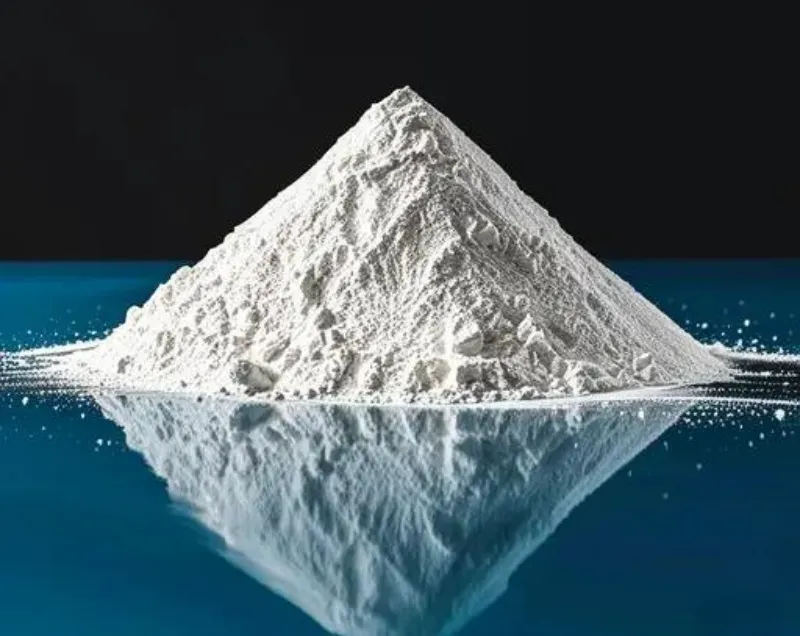
Untreated calcium carbonate is hydrophilic, which means it does not mix well with the hydrophobic polymers it fills. The powder clumps, and those clumps behave like oversize particles in the melt. The fix is a surface coating, most often stearic acid or a coupling agent, applied after grinding and classification.
Surface modification changes two things:
- It lowers surface energy, so particles separate more easily in the polymer.
- It improves adhesion at the particle-polymer interface, which is what lets a filled compound keep its strength instead of failing at the filler boundary.
Because dispersion is usually the first property to fail as loading rises, a well-coated powder is what makes higher loadings usable at all.
Coating level is usually kept low, typically around 0.8–1.5 wt% for stearic acid, depending on surface area and application. Over-coating can reduce particle-polymer adhesion, while under-coating leaves agglomerates. Buyers should ask for:
- Coating type (stearic acid, coupling agent, etc.)
- Coating level
- Surface area
- A dispersion test in the target polymer
Loading Level Is a Trade-Off, Not a Guessing Game
How much calcium carbonate to add depends on the polymer and on what the part has to do.
PLA
In PLA, loadings from 10 to 30 percent are common. The filler raises stiffness, and under industrial thermophilic composting conditions, mineral-filled PLA can degrade faster than its unfilled counterpart. This effect depends strongly on loading, dispersion, particle size, and composting conditions. In soil burial or home composting, the same compound may not show the same rate, and some studies report slower degradation because the filler reduces water uptake.
The trade-off is that overfilling pushes already brittle PLA into a range where impact strength and elongation drop fast.
PBAT
Most published PBAT/CaCO₃ film studies work in the 10–20 wt% range. Loadings approaching 30 wt% can still be practical, but they require careful dispersion control. Above roughly 40 percent, agglomeration increases and the particle-matrix interface weakens.
Mechanical properties fall faster than the cost keeps dropping, so the practical target for most PBAT compounds sits below 30 percent unless the formulation and compounding line are set up to handle the higher load.
How the Equipment Shapes the Final Powder
Everything above traces back to how the powder is made. Two production routes dominate ground calcium carbonate for bioplastics.
| Route | Typical product | Advantages | Limitations | Best fit |
|---|---|---|---|---|
| Jet mill | D50 1–2 μm, tight PSD | No media contamination, narrow PSD | Higher energy cost, lower throughput | Thin film, premium compounds |
| Ball mill + air classifier | D50 1.5–5 μm | Scalable, lower cost, flexible top cut | Media wear, broader PSD if poorly controlled | High-volume film, injection, sheet |
Jet mill grinds by high-speed air impact, with no grinding media to add contamination. The result is a clean, fine powder with a concentrated size distribution, which suits the ultrafine grades used in thin film and premium compounds. Jet milling is the route when purity and a low defect rate matter more than raw throughput.
Ball mill with an air classifier is the standard route for large-scale, cost-sensitive production. The mill grinds to a target range and the classifier controls the top size, recycling oversize material until the whole output meets specification. This combination produces the tightly classified, competitively priced grades that high-volume bag and film makers actually buy.
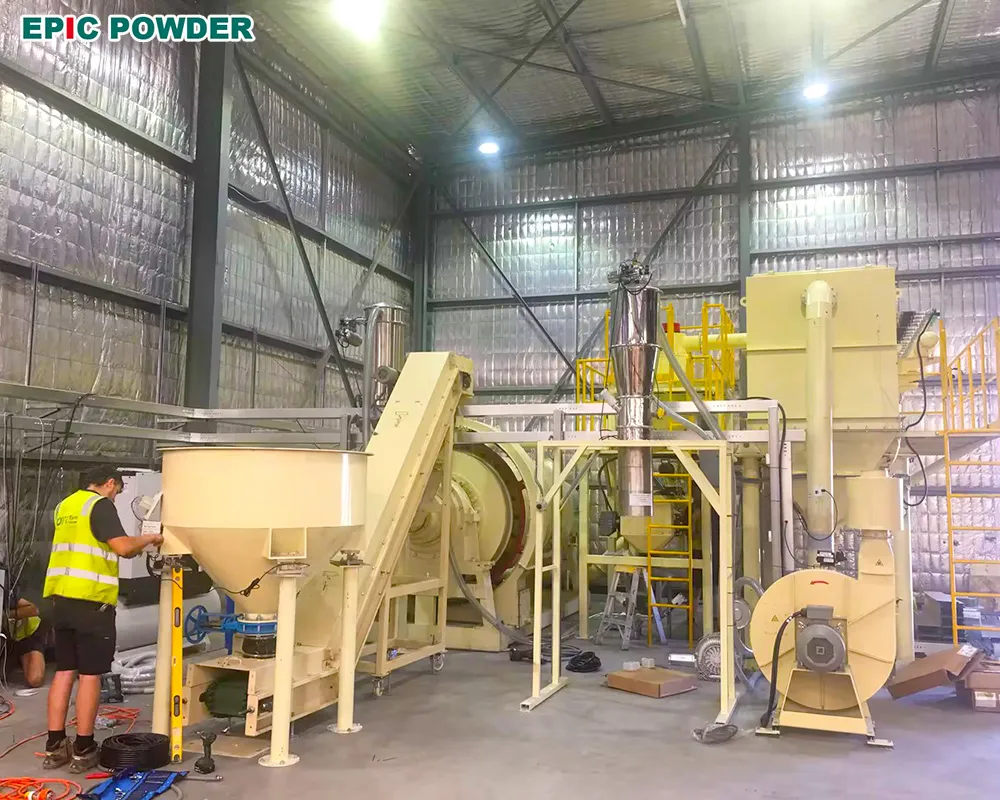
Whichever route fits, the line has to hold the same D50, the same top cut, and the same coating quality from batch to batch. Film makers run continuous lines and cannot stop to retune for powder drift. That consistency is a function of the grinding and classification setup, and it is the main thing a serious buyer should check in a supplier.
A Buyer’s Checklist for Calcium Carbonate in Bioplastics
Purchase decisions usually come down to four checks.
| Check | Why it matters | How to verify |
|---|---|---|
| Purity ≥98% | Avoids contamination that hurts color and long-term stability | COA, XRD, ash content |
| Particle size and top cut | Controls film defects and processability | Laser diffraction, sedigraph, supplier batch data |
| Surface coating | Determines dispersion and usable loading | TGA, contact angle, dispersion test in PLA/PBAT |
| Batch-to-batch consistency | Continuous film lines cannot tolerate drift | SPC data, incoming inspection records |
Purity: at least 98 percent, to avoid the contamination that hurts color and long-term stability.
Particle size and top cut: a grade matched to your product. Film needs a D50 around 1.5 microns and a D97 at or below 5 microns; thicker parts can run 2 to 5 microns.
Surface coating: a consistent stearic acid or coupling agent treatment applied after classification, so dispersion holds steady at your target loading.
Cost per ton of finished compound, not per ton of powder. A filler that loads cleanly at 20 percent and disperses without defects often costs less in the finished part than a cheaper powder that forces you to back the loading down.
The purchasing decision should be based on total delivered cost and batch consistency, not the spot price of the mineral.
Get a Line That Holds the Spec
If you are setting up or upgrading a calcium carbonate production line for bioplastic grades, send us your target D50, D97, and coating specification. Epic Powder will recommend the grinding and classification layout that holds those numbers.
Epic Powder
At Epic Powder, we offer a wide range of equipment models and tailor solutions to meet your specific needs. Our team has more than 20 years experience in various powders processing. Epic Powder is specialized in fine powder processing technology for mineral industry, chemical industry and food industry, etc.
Contact us today for a professional consultation and customized solutions!

“Thanks for reading. I hope my article helps. Please leave a comment down below. You may also contact EPIC Powder online customer representative Zelda for any further inquiries.”
— Emily Chen, Engineer