
Calcium carbonate is the most widely used mineral filler in PVC wire and cable compounds. It appears in both insulation and sheathing, where it cuts material cost, improves dimensional stability, and adds flame retardancy. The main choice for a compounder is simple: use uncoated calcium carbonate, or pay a little more for a coated, surface-treated grade. This guide walks through loading levels, the difference between the two, and how to pick the right cable-grade powder.
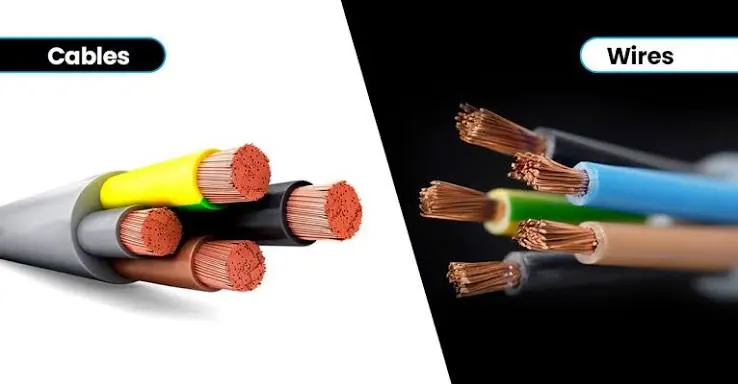
Why Cable Compounds Depend on Calcium Carbonate
Calcium carbonate earns its place in cable formulations for practical reasons. It is cheap and easy to source, which makes it the fastest way to lower compound cost. During processing and long-term service, PVC releases hydrogen chloride, and calcium carbonate absorbs part of it, taking load off the stabilizer and slowing degradation. In sheathing it also helps flame retardancy, because it decomposes under heat, releases carbon dioxide, and dilutes combustible content. It leaves the sheathing surface drier and reduces shrinkage too.
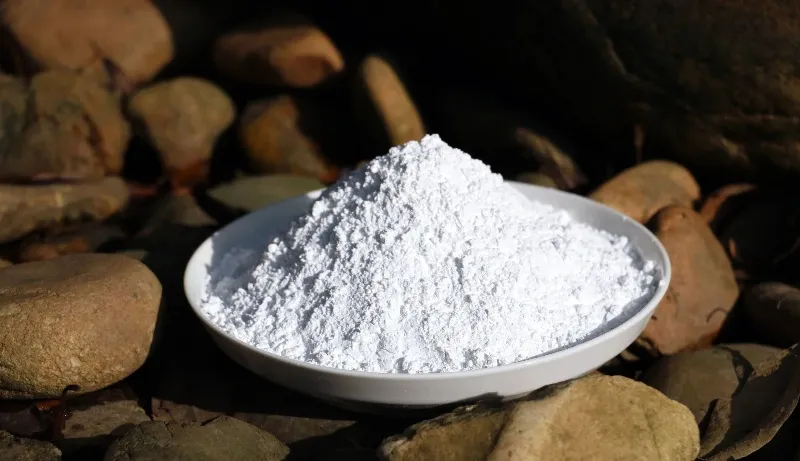
How Much Calcium Carbonate Goes into Insulation vs Sheathing
First, one term. Filler loading in PVC is usually given in phr, short for parts per hundred resin. A 30 phr loading means 30 parts of filler for every 100 parts of PVC.
Loading depends on the application. Sheathing tolerates a lot of filler, so ground calcium carbonate (GCC) is commonly added at 10 to 100 phr, where it mainly controls cost, stiffness, and dimensional stability. Insulation is far more sensitive electrically, so loading usually stays between 5 and 25 phr, and the grade matters more than the amount. Insulation calls for fine, high-purity powder that has been surface treated.
Coated vs Uncoated Calcium Carbonate
| Attribute | Uncoated | Coated (Surface-Treated) |
| Surface | Hydrophilic | Hydrophobic |
| Coating | None | Stearic acid, 1% to 3% |
| Dispersion in PVC | Moderate, clumps at high loading | Good, stays even at high loading |
| Typical loading (sheathing) | 10 to 100 phr, watch tensile drop | Higher safe loading, often plus 10 to 20 phr |
| Typical particle size | 5 to 25 microns | 5 to 15 microns, finer grades available |
| Mechanical impact | Tensile and elongation fall as loading rises | Less loss at the same loading |
| Electrical performance | Lower resistivity when moist | Higher dielectric strength and resistivity |
| Best use | General sheathing | Insulation and demanding sheathing |
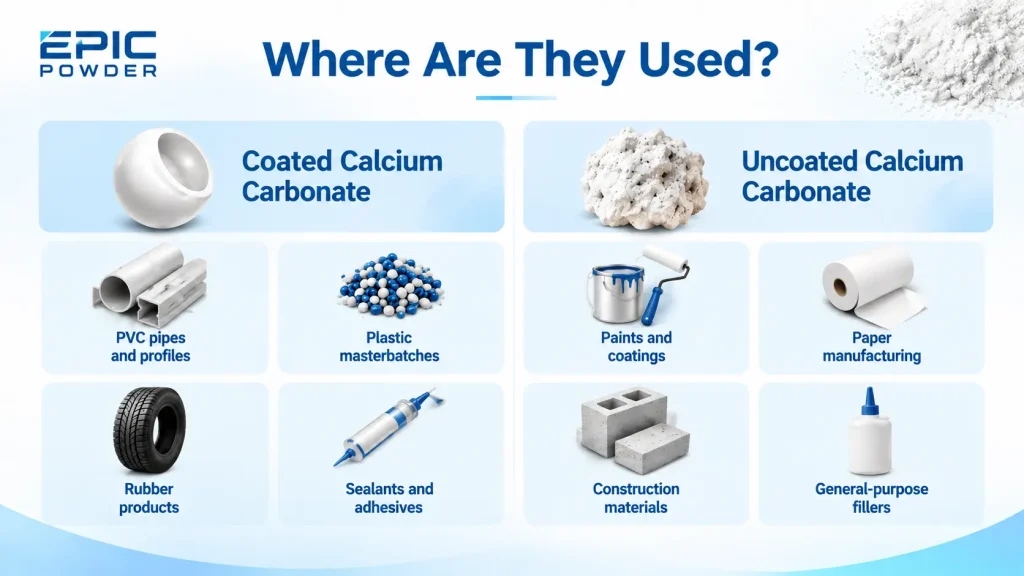
Uncoated Calcium Carbonate
Uncoated calcium carbonate, ordinary GCC or precipitated calcium carbonate (PCC), has a hydrophilic surface. That gives it only moderate compatibility with hydrophobic PVC. At low loading this hardly matters. Once loading climbs, the powder disperses poorly and clumps, and both tensile strength and elongation at break fall noticeably. Extrusion gets heavier too, with higher torque on the screw. For this reason uncoated powder is used mainly as a general filler in less demanding sheathing, with a typical particle size of 5 to 25 microns.
Coated (Surface-Treated) Calcium Carbonate
Coated calcium carbonate carries a stearic acid layer, usually 1% to 3% by weight. The coating turns the surface hydrophobic, improves dispersion, and bonds more strongly with the resin. At the same loading, mechanical properties fall away less, and you can often lift loading by another 10 to 20 phr without hurting the compound. Coated powder in insulation has been reported to raise dielectric strength by roughly 40% and volume resistivity by one to two orders of magnitude. In sheathing it gives a smoother surface, lower moisture uptake, and steadier electrical performance. Surface treatment removes the old trade-off between high loading and processability, so you can use more filler to save cost without ruining the compound.
Where GCC, PCC, and Nano Calcium Carbonate Fit
Most cable compounds start with ground calcium carbonate. It is inexpensive and covers the bulk of filler demand in sheathing. Precipitated calcium carbonate is finer and more uniform, so it shows up where a compounder needs consistency or a whiter, softer-feeling finish. Nano calcium carbonate sits at the high end, used in thin-wall or high-performance insulation where a very fine, well-dispersed particle improves both strength and electrical properties. The choice comes down to what the compound must do and how much the customer will pay for that performance.
How to Choose the Right Calcium Carbonate Grade
Particle size: insulation benefits from 0.1 to 5 micron powder, while sheathing can take coarser feed. A typical coated cable-grade ground calcium carbonate is around 1250 mesh, with a D50 near 5 microns and a D97 near 15 microns.
Purity: this matters more than brightness. Conductive impurities pull down insulation performance, so a cheap, poorly refined powder is a false economy in insulation.
Oil absorption and moisture: powder with low oil absorption and low moisture needs less plasticizer and is less likely to create bubbles or pinholes in extrusion. Cable grades should be hydrophobic, well dispersed, and low in moisture, with oil absorption kept in the low teens where the grade allows.
FAQ
What is the difference between coated and uncoated calcium carbonate?
Uncoated calcium carbonate has a hydrophilic surface and disperses poorly at high loading. Coated calcium carbonate carries a stearic acid layer that makes it hydrophobic, so it disperses better, allows higher loading, and performs better in insulation.
How much calcium carbonate is used in PVC cable compounds?
Sheathing can use 10 to 100 phr, while insulation usually stays in the 5 to 25 phr range because it is more electrically sensitive.
Is calcium carbonate used in cable insulation?
Yes. Insulation uses lower loadings of fine, high-purity, surface-treated calcium carbonate to control cost without reducing dielectric strength or volume resistivity.
What particle size of calcium carbonate is best for cable sheathing?
Sheathing tolerates coarser powder, typically 5 to 25 microns, and commonly uses 1250 mesh coated ground calcium carbonate with a D50 near 5 microns. Finer grades are reserved for insulation.
Calcium Carbonate Processing Equipment from Epic Powder Machinery
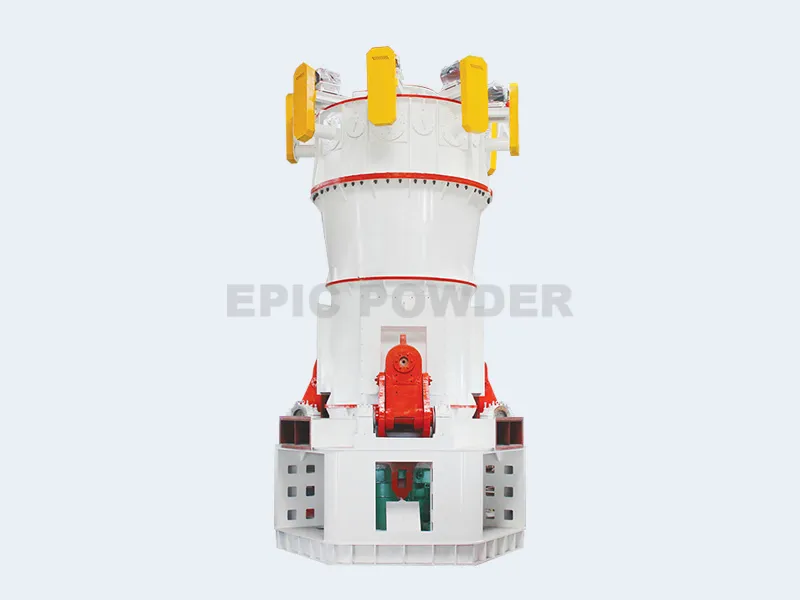
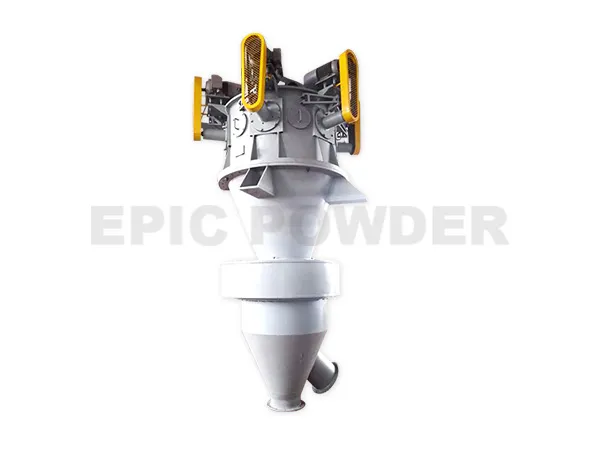
Epic Powder Machinery builds powder processing systems. Our table roller machine and air classifier are designed to make cable-grade ground calcium carbonate with a narrow particle size distribution, high purity, and uniform surface treatment. These matter most when the powder goes into insulation and sheathing.
Epic Powder
At Epic Powder, we offer a wide range of equipment models and tailor solutions to meet your specific needs. Our team has more than 20 years experience in various powders processing. Epic Powder is specialized in fine powder processing technology for mineral industry, chemical industry and food industry, etc.
Contact us today for a free consultation and customized solutions!

“Thanks for reading. I hope my article helps. Please leave a comment down below. You may also contact EPIC Powder online customer representative Zelda for any further inquiries.”
— Emily Chen, Engineer