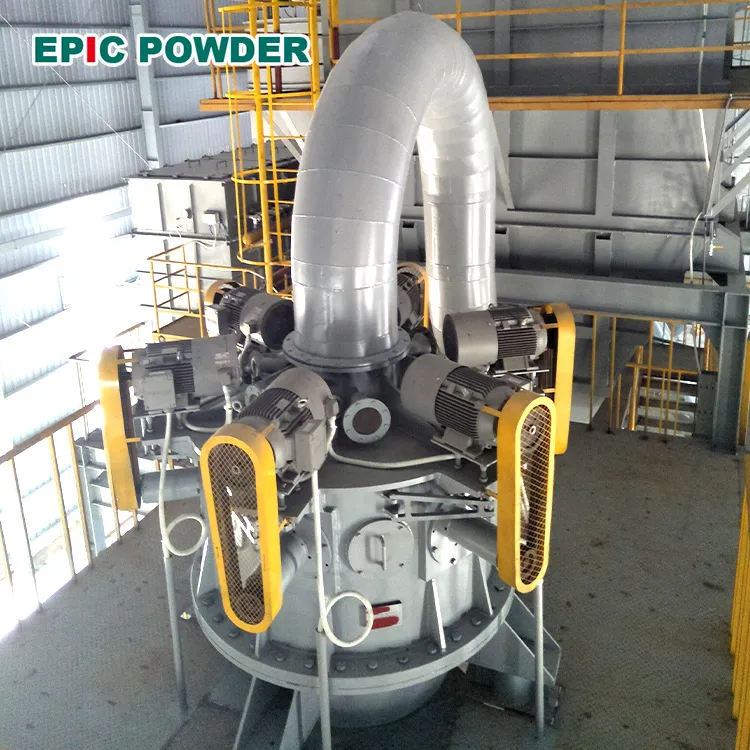
Ultrafine Air Classifier

air classifier

Ceramic Powder Mixing Equipment: A Complete Guide to Dry and Wet Mixing Processes, Parameters, and Equipment Selection

Mixing is a pre-forming step in ceramic production that is easy to underestimate. The mixing step comes after raw material grinding and before forming (pressing, extrusion, or tape casting). Its output is a homogeneous blend of ceramic powder, sintering aids, dopants, and binders. This directly determines the consistency and performance of everything downstream. Non-uniform mixing […]

Ceramic Powder Mixing Equipment: A Complete Guide to Dry and Wet Mixing Processes, Parameters, and Equipment Selection Read More »

GCC-classification-equipment

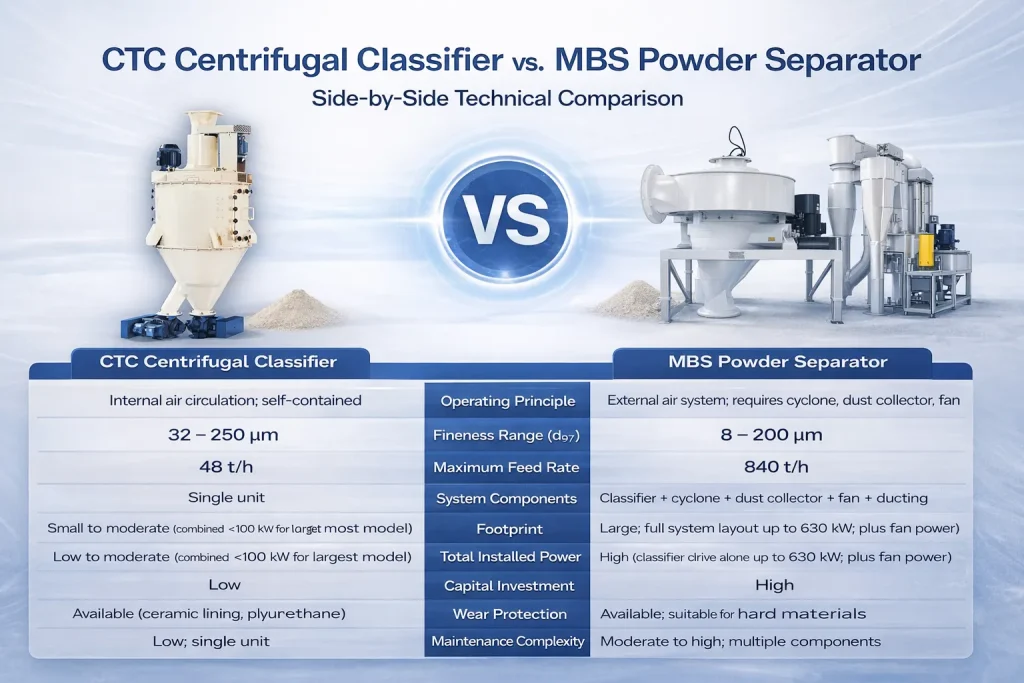
CTC vs MBS Classifier for GCC: Which One Matches Your Calcium Carbonate Production Goals?

Many GCC producers struggle with the same problem: their existing equipment can no longer meet customer demands for finer particle sizes, yet upgrading to a full system seems costly and complex. If this sounds familiar, understanding the difference between CTC and MBS classifiers is your first step toward a solution. Ground calcium carbonate is one

CTC vs MBS Classifier for GCC: Which One Matches Your Calcium Carbonate Production Goals? Read More »

air classifier GCC

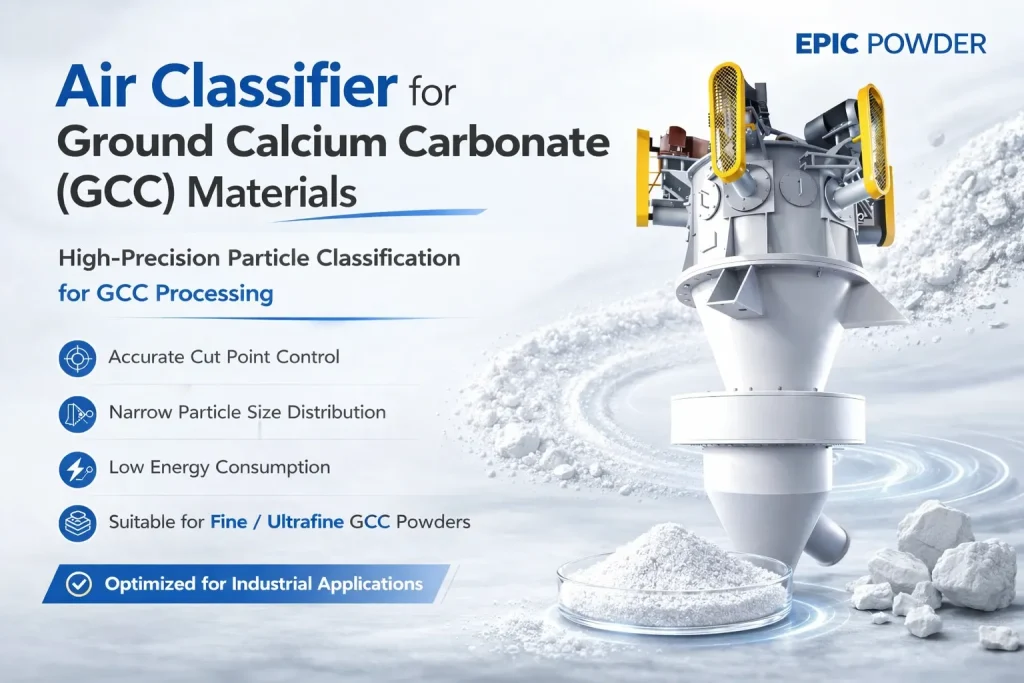
Precision Air Classifiers for GCC Production: Why Classification Determines Product Grade More Than Grinding Does

Most GCC producers focus their attention on the mill — the ball mill motor rating, the grinding media, the liner material. The classifier gets less attention. However it is the classifier that actually defines the particle size distribution of the product. The mill produces a broad range of particle sizes. The classifier is what decides

Precision Air Classifiers for GCC Production: Why Classification Determines Product Grade More Than Grinding Does Read More »

Calcium Carbonate

Is Calcium Carbonate Really Flame Retardant? The Role of Inorganic Fillers in Fire-Safe Materials

Inorganic particles offer a range of benefits including non-toxicity, excellent dimensional stability, high-temperature resistance, and large specific surface area. These properties help enhance the thermal stability, mechanical performance, and electrical conductivity of flame retardants while reducing water absorption. As a commonly used filler in polymer modification, calcium carbonate has lots of advantages. They include rigidity,

Is Calcium Carbonate Really Flame Retardant? The Role of Inorganic Fillers in Fire-Safe Materials Read More »

kaolinite 1

Kaolin Grinding Machine Guide for Ultra Fine Powder with High Efficiency

Introduction to Kaolin and Its Industrial Importance Kaolin, also known as kaolinite clay, is a naturally occurring mineral prized for its unique properties and wide industrial use. This soft, white clay is chemically inert and features a distinctive plate-like structure, making it highly versatile across various applications. With growing demands from high-tech and high-value markets,

Kaolin Grinding Machine Guide for Ultra Fine Powder with High Efficiency Read More »

non-woven-fabric-rolls

How to Select the Right Machine to Produce Calcium Carbonate Suitable for Nonwoven Fabrics

Calcium carbonate plays a critical role in the nonwoven fabrics industry. As a functional filler and performance enhancer, it improves fabric opacity, softness, dimensional stability, and cost efficiency. However, not all calcium carbonate powders are suitable for nonwoven applications. The key lies not only in the raw material but also in selecting the right machine

How to Select the Right Machine to Produce Calcium Carbonate Suitable for Nonwoven Fabrics Read More »

Air Classifer and Ball Mill2

Top 8 Non-Metallic Minerals in High Demand for 2025-2030

As the world accelerates its transition to clean energy, advanced electronics, and sustainable manufacturing, non-metallic minerals are emerging as critical enablers of innovation. From battery anodes powering electric vehicles (EVs) to high-purity fillers enhancing solar panels and semiconductors, these materials are experiencing unprecedented demand growth. According to the International Energy Agency’s (IEA) Global Critical Minerals

Top 8 Non-Metallic Minerals in High Demand for 2025-2030 Read More »

diatomaceous-earth-uses

Ultrafine Grinding Diatomaceous Earth 325 Mesh to D50 56 Microns

Understanding Diatomaceous Earth and Its Properties Diatomaceous earth (DE) is a naturally occurring, soft, siliceous sedimentary rock formed from fossilized remains of diatoms—microscopic algae with unique porous shells. Its composition is primarily high-purity silica, often exceeding 80-90%, giving it excellent thermal stability and chemical inertness. This natural porous structure results in an exceptionally large surface

Ultrafine Grinding Diatomaceous Earth 325 Mesh to D50 56 Microns Read More »

ball mill and classifier Production line

Calcium Carbonate Is Reshaping the Plastic Composites Industry

In the history of the plastics industry, calcium carbonate has long been regarded as a low-cost filler, valued mainly for reducing raw material costs. However, with breakthroughs in processing technology and the evolution of application demands, this traditional perception is being completely redefined. Today, calcium carbonate has transformed into a functional modifier that combines three

Calcium Carbonate Is Reshaping the Plastic Composites Industry Read More »