
Calcium carbonate (CaCO3) is the most widely used industrial mineral filler in the world. It can be consumed in paper, plastics, paints, adhesives and construction materials at hundreds of millions of tonnes per year. Despite this ubiquity, calcium carbonate encompasses a wide range of distinct materials with very different properties and price points. Ground calcium carbonate from marble differs from precipitated calcium carbonate from a chemical synthesis route. Calcite-structure PCC differs from aragonite-structure PCC. Fine GCC at D50 3 microns differs functionally from coarse GCC at D50 25 microns. Even if both are described as ground calcium carbonate on a specification sheet.
This guide maps the five main classification systems for calcium carbonate. It’s by raw material source, manufacturing process, crystal structure, particle size, and surface treatment. It connects each classification to the applications and performance requirements it serves. The aim is not just to define the grades but to explain which grade is the right choice for specific downstream uses.
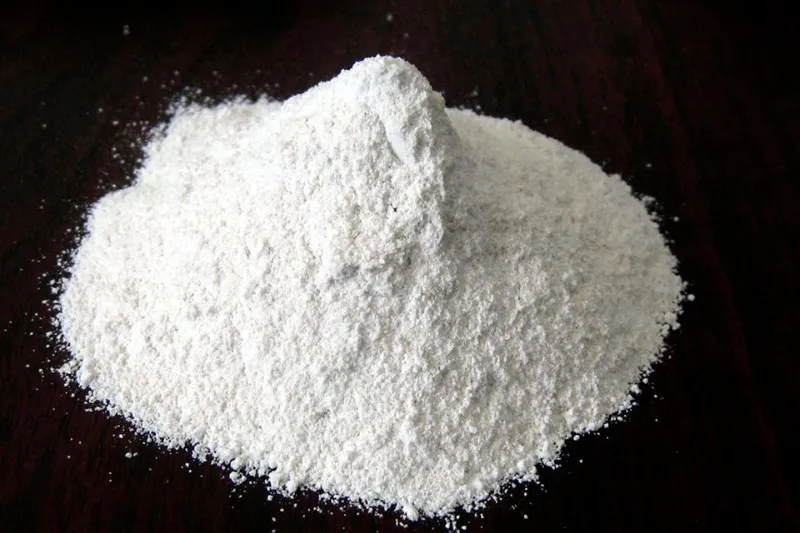
Classification by Raw Material Source
Natural calcium carbonate occurs in three main rock types, each with different mineral purity, whiteness, and grinding characteristics. The raw material determines the ceiling on product quality. A limestone with high silica and iron impurities cannot produce GCC with the whiteness required for premium paper or paint applications, regardless of how finely it is ground.
| Raw Material | Formation | Typical Whiteness | Key Characteristic |
| Marble | Metamorphic — limestone recrystallised under heat and pressure | 92-97% ISO | High purity, dense structure; best whiteness for premium GCC |
| Limestone | Sedimentary carbonate rock, calcite dominant | 88-95% ISO | Most abundant; moderate purity; variable impurity content by deposit |
| Chalk | Soft, porous biomicritic sedimentary rock (Cretaceous) | 85-92% ISO | Soft and easily ground; used for coarse grades; higher porosity |
Marble is the preferred raw material for premium GCC in paper coating and fine coatings applications because its recrystallisation process produces a denser, purer calcite with higher whiteness. The major GCC production regions like Guangxi and Guizhou in China, Norway, Finland, Austria all have access to high-whiteness marble deposits. Limestone is the most abundant raw material globally and is adequate for most standard GCC applications. Chalk, while easily ground due to its softness, is typically used for coarser GCC grades in agricultural lime and construction applications.
Classification by Manufacturing Process: GCC vs PCC
The manufacturing process is the most commercially important classification distinction. It determines the particle shape, particle size distribution achievability, and price point of the calcium carbonate.
Ground Calcium Carbonate (GCC) — Heavy Calcium Carbonate
GCC is produced by physical mechanical grinding of natural carbonate ore like crushing, milling, and air classification and without any chemical transformation. The product is called ‘heavy’ calcium carbonate because its settled volume is smaller (1.1-1.9 mL/g) than precipitated calcium carbonate, reflecting its denser, more compact particle structure.
GCC is produced by two routes. Dry grinding uses ring-roller mills, ball mills, or air classifier mills without water, producing powder from 80 mesh (D97 approximately 180 microns) down to 2500 mesh (D97 approximately 5 microns) in a single circuit. It is the most economical production route for grades above D50 2-3 microns. Wet grinding uses a ball mill or bead mill with water and dispersant, producing particles from D50 5 microns down to D50 0.7 microns with a narrow PSD — the route used for the finest paper coating grades where PSD control is critical.
Precipitated Calcium Carbonate (PCC) — Light Calcium Carbonate
PCC is produced by a chemical synthesis route: limestone is calcined to produce quicklime (CaO) and CO2, the quicklime is slaked to produce lime milk (Ca(OH)2), and the lime milk is carbonated with CO2 to precipitate CaCO3. The precipitate is dewatered, dried, and processed to the target product. PCC is called ‘light’ because its settled volume (2.4-2.8 mL/g) is larger than GCC. Its particles are less dense and more porous.
The key advantage of PCC over GCC is particle morphology control. By adjusting carbonation temperature, CO2 concentration, agitation, and additives during the precipitation reaction, manufacturers can control the crystal form (calcite, aragonite, or vaterite), particle shape (rhombohedral, scalenohedral, acicular, spherical), and particle size independently. This is not possible with GCC, where particle shape is determined by the mineral crystal structure and grinding mechanism. PCC is therefore preferred for applications requiring specific particle shapes. Acicular aragonite for improved paper tensile strength, scalenohedral calcite for paper bulk, spherical vaterite for speciality applications.
Modified (Activated) Calcium Carbonate
Both GCC and PCC can be surface-modified to change their surface chemistry from hydrophilic (the natural state polar hydroxyl groups on the CaCO3 surface are incompatible with hydrophobic polymer matrices) to hydrophobic. Surface modification is performed by treating the calcium carbonate with stearic acid, titanate coupling agents, silane coupling agents, or other surface modifiers.
The practical benefit for plastics and rubber applications is significant. Unmodified calcium carbonate in a polypropylene or PVC matrix has poor interfacial adhesion. The filler particle is effectively a void rather than a reinforcing element. Stearate-modified calcium carbonate bonds more effectively to the polymer matrix, improving elongation at break, impact strength, and dispersibility at higher filler loadings. Modified calcium carbonate commands a 20-50% price premium over unmodified grades — justified by the formulation performance improvement and the reduction in coupling agent needed at the compounder.
Nano Calcium Carbonate
Nano calcium carbonate has primary particle size below 100 nm in at least one dimension. It is produced by PCC synthesis routes with controlled carbonation conditions and surface treatment. At nano scale, CaCO3 exhibits substantially different properties from micron-scale material: dramatically higher specific surface area, improved reinforcement efficiency in polymer matrices, and modified optical properties.
In paper filling applications, nano-activated calcium carbonate provides high opacity and brightness, smoother surface finish, and the ability to achieve higher filler loadings without equivalent strength loss compared to micron-scale GCC. In specialty papers (cigarette paper, thin printing paper, premium art paper), the combination of high oil absorption, good dispersibility, and fine particle size makes nano CaCO3 a performance-critical ingredient.
Classification by Crystal Structure
Calcium carbonate has three anhydrous crystalline polymorphs with different stability, density, and morphology. Crystal form is primarily relevant for PCC, where the synthesis conditions can be controlled to produce a specific form. In GCC, calcite is the overwhelmingly dominant form because it is the thermodynamically stable polymorph.
| Crystal Form | Crystal System | Stability | Density (g/cm3) | Typical Morphology |
| Calcite | Trigonal | Most stable — thermodynamically | 2.71 | Rhombohedral, scalenohedral, prismatic; diverse habits |
| Aragonite | Orthorhombic | Metastable — converts to calcite above 440 degrees C | 2.93 | Acicular (needle-like), rod-like, columnar; aspect ratio 3:1 to 8:1 |
| Vaterite | Hexagonal | Least stable — easily converts to calcite | 2.54 | Spherical, disc, flower-like aggregates; polycrystalline spherulites |
Why Crystal Form Matters for Applications
Calcite is the form in essentially all GCC and most PCC. Its stability makes it the default choice. Acicular aragonite PCC is specifically used in applications where a high aspect ratio particle is needed. Paper wet-end applications where the needle-like particles interlock with cellulose fibres and improve paper tensile strength, or in speciality sealants where fibrous filler morphology improves sag resistance. Acicular aragonite PCC typically has aspect ratios of 3:1 to 8:1.
Vaterite is rare in nature (found only in the otolith organs of certain fish and some marine invertebrates) and is produced synthetically for speciality applications. Its spherical morphology produces spherical PCC particles with large specific surface area and high surface energy. Spherical vaterite CaCO3 is being researched for drug delivery (the porous structure can load and release pharmaceutical actives), cosmetics, and as a template for hollow sphere synthesis. For industrial filler applications, vaterite’s instability and conversion to calcite over time limits its practical use.
Classification by Particle Size: What Each Grade Is Used For
| Grade | D50 Range | D97 Approximate | Typical Applications |
| Coarse GCC | 10-75 um | 50-200 um | Construction fill, agricultural lime, cement, road base |
| Fine GCC | 3-10 um | 10-30 um | Plastics compounding, rubber, adhesives, sealants |
| Ultra-fine GCC | 0.5-3 um | 2-10 um | Premium paints, coatings, paper filler |
| Nano CaCO3 | < 0.1 um (100 nm) | < 0.3 um | Specialty paper, high-performance rubber, nano composites |
Within each grade, the particle size distribution (span value and D97) matters as much as the D50. Two products with the same D50 but different span values perform very differently: the one with the wider span has a significant coarse tail that causes surface defects in paint films, die-line in film extrusion, and stress concentration in rubber. Premium-grade calcium carbonate commands its price premium not just for the D50 target but for the tightness of the distribution around that target.
Quick Application-to-Grade Selection Guide
• Construction fill, agricultural lime: Coarse GCC, D97 50-200 um — lowest cost, basic Raymond mill or jaw crusher output
• Rubber and standard plastics compounding: Fine GCC D50 3-8 um, stearate-modified — improves impact strength and elongation at break
• Premium architectural paint: Ultra-fine GCC D50 2-5 um, D97 below 12 um, whiteness above 93% ISO — opacity and gloss sensitive to coarse tail
• Paper filler (printing and writing): Fine to ultra-fine GCC D50 2-5 um or scalenohedral PCC — opacity, brightness, and smoothness
• Paper coating (coated art paper): Ultra-fine GCC or PCC D50 0.7-2 um by wet grinding — coating layer requires very fine, narrow PSD
• High-performance sealant or adhesive: Acicular aragonite PCC D50 1-3 um — aspect ratio improves sag resistance and tensile strength
• Specialty paper (cigarette, thin printing): Nano activated CaCO3 D50 below 100 nm — oil absorption, opacity, and burning speed control
EPIC Powder Machinery Equipment for GCC Production
EPIC Powder Machinery’s dry grinding and classification equipment covers the full GCC production range from fine to ultra-fine grades. Our equipment is used specifically for the dry grinding route — the most economical production path for GCC at D50 above 1-2 microns.
• Air classifier mill (ACM series):
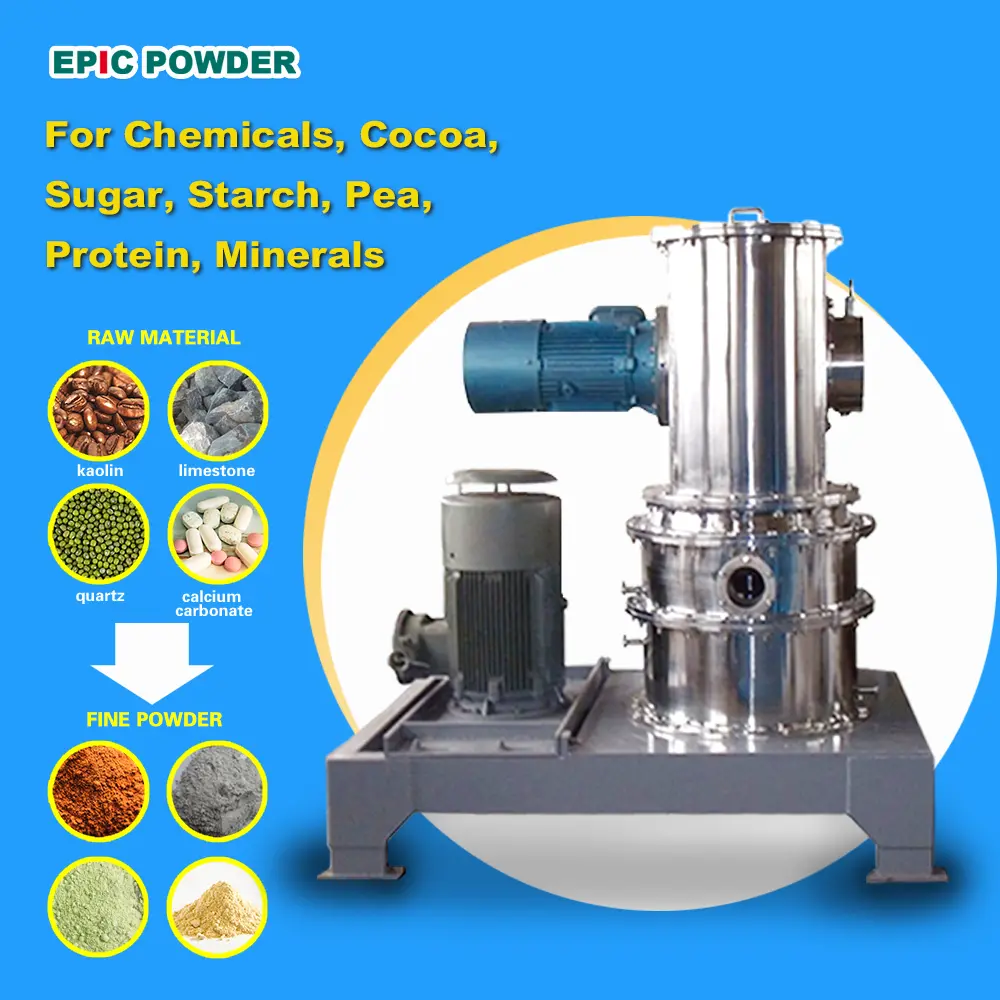
ACM series are for fine and ultra-fine GCC at D50 3-15 microns. Combines impact grinding with integrated air classification in a single unit. Product D50 is adjusted by classifier wheel speed via VFD without stopping the line. Suitable for plastics-grade and paint-grade GCC. Lower energy consumption and simpler circuit than a ball mill plus external classifier for this fineness range.
• Ring-roller mill (SRM series):
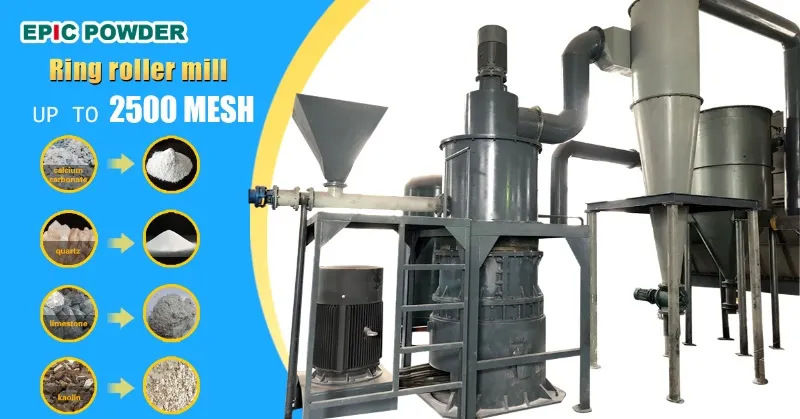
SRM series are for GCC from 325 mesh (D97 approximately 45 microns) to 2500 mesh (D97 approximately 5 microns). Multi-layer compression-shear grinding with integrated VFD classifier. Well-established technology for standard fine and ultra-fine GCC production for plastics, paint, and paper filler applications. The dominant technology in Chinese GCC production for this fineness range.
• Air classifier (ITC, MBS, CTC series):
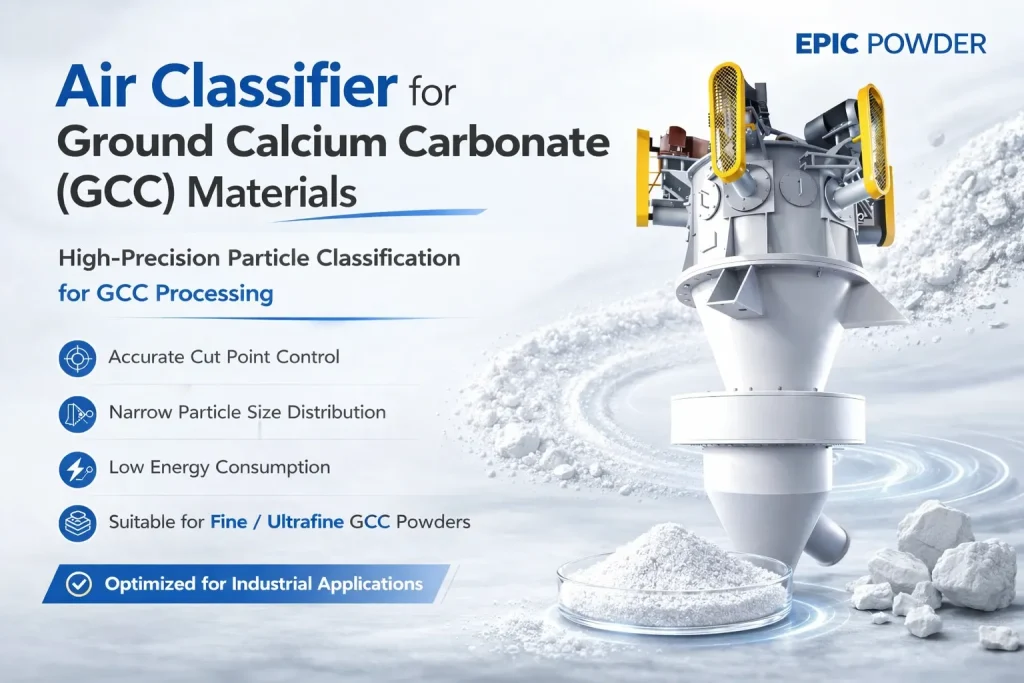
Air classifiers are for precision classification of GCC to tighten D97 from an existing mill, produce multiple product grades from a single grinding line, or upgrade a coarser product to a finer specification. Key equipment for any GCC plant that needs to serve multiple market grades from one production circuit.
• Dry surface modification unit:
Dry surface modification unit is integrated directly downstream of the air classifier for producing stearate-modified or coupling-agent-treated GCC in a continuous inline process. The GCC powder exits the classifier at 50-80 degrees C, which promotes surface modifier reaction kinetics without a separate heating step.
For ultra-fine wet-ground GCC (D50 below 1 micron for premium paper coating), the wet grinding route uses different equipment — a bead mill or agitated media mill — which is outside EPIC Powder’s current product scope. Our equipment specialises in the dry grinding route, which covers the majority of GCC production by volume and serves all markets from construction grade through premium coating-grade at D50 2-3 microns.
Processing Calcium Carbonate for a Specific Market Grade?
EPIC Powder Machinery designs and supplies dry grinding and classification systems for GCC production — from 80-mesh construction grade through 2500-mesh ultra-fine coating and paper grade. Tell us your limestone or marble feed, your target D50 and D97, your market application, and your production volume and we will recommend the right configuration with projected throughput and energy data.
Free material trials at our R&D facility available before any equipment commitment.
Request a Free Process Consultation: www.nonmetallic-ore.com/contact
Explore Our GCC Grinding Equipment: www.nonmetallic-ore.com
Frequently Asked Questions
What D50 of calcium carbonate should I specify for a plastics compounding application?
For plastics compounding, the appropriate D50 depends on the polymer type, filler loading, and the end-product’s mechanical requirements. Standard polyolefin (PP, PE, EVA) compounds for packaging and consumer goods typically use fine GCC at D50 3-8 microns, stearate-modified. At this particle size, the filler distributes well in the melt, does not cause die-line in extrusion, and provides a reasonable balance of stiffness and impact resistance.
For higher filler loadings (above 40% by weight), finer GCC at D50 2-4 microns improves dispersibility and reduces agglomeration tendency. For high-performance engineering plastics where maximum mechanical performance is required, ultra-fine GCC at D50 1-3 microns with coupling agent surface treatment (silane or titanate) provides better interfacial bonding and higher reinforcement efficiency than stearate treatment alone. The D97 upper limit is as important as D50 for plastics. It’s a coarse tail above 20 microns causes surface defects and can initiate stress cracking. Specify both D50 and D97 maximum in your incoming material specification.
Why does whiteness vary between calcium carbonate grades and which applications are most sensitive to it?
Whiteness in calcium carbonate is measured as ISO brightness (percentage reflectance at 457 nm) and is determined primarily by iron and manganese content in the raw material. Iron oxide (Fe2O3) and manganese oxide (MnO) are yellowish-brown impurities that absorb blue light and reduce measured whiteness. Marble with low iron content (Fe2O3 below 0.05%) can produce GCC with whiteness above 95% ISO. Limestone with higher iron content may only produce GCC at 88-93% ISO regardless of grinding fineness.
Applications with the highest whiteness sensitivity are paper coating (where whiteness below 92% ISO causes perceptible yellowing of the paper sheet), premium architectural paint (where titanium dioxide content must be increased to compensate for lower-whiteness filler, adding formulation cost), and food-contact and pharmaceutical applications (where strict purity limits exist). Construction materials, rubber, and agricultural applications have low whiteness sensitivity and can use lower-purity limestone-derived GCC without performance impact. If your application requires whiteness above 93% ISO, specify the raw material as marble or high-whiteness limestone and request a whiteness certificate with each production lot.
Epic Powder
At Epic Powder, we offer a wide range of equipment models and tailor solutions to meet your specific needs. Our team has more than 20 years experience in various powders processing. Epic Powder is specialized in fine powder processing technology for mineral industry, chemical industry, food industry, pharama industry, etc.
Contact us today for a free consultation and customized solutions!

“Thanks for reading. I hope my article helps. Please leave a comment down below. You may also contact EPIC Powder online customer representative Zelda for any further inquiries.”
— Emily Chen, Engineer