
Calcium carbonate (CaCO₃) is one of the most versatile and cost-effective fillers in the world. From PVC pipes to silicone sealants and interior paints, it adds bulk, improves mechanical properties, and reduces formulation costs. But how to use it effectively? The key lies in matching the right type of calcium carbonate to your specific application. Another important thing is to get the formulation and processing right.
This guide walks you through practical, field-tested approaches for three major applications: PVC pipe, neutral silicone sealant, and interior latex paint. We’ll cover material selection, formulation benchmarks, and critical process control points that separate success from failure.
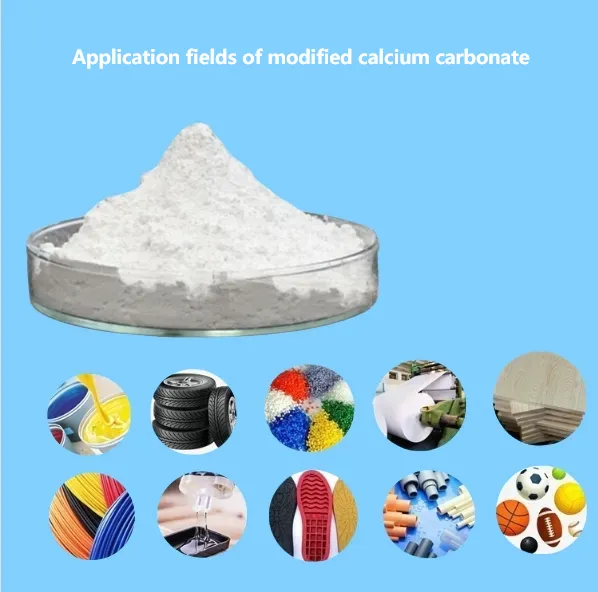
1. PVC Pipe Formulation
Material Selection
PVC pipe demands stiffness, ring stiffness, processability, and low-temperature impact resistance. Standard ground calcium carbonate (GCC) disperses poorly and makes the pipe brittle at high loadings. Precipitated calcium carbonate (PCC) costs more without proportional benefit. Nano-calcium carbonate offers little practical value at its price point.
Best choice: 400–800 mesh stearic acid–modified activated GCC. It balances cost, interfacial bonding, and extrusion smoothness. A small amount of activated PCC can fine-tune toughness.
Reference Formulation (per 100 parts PVC SG-5 resin)
| Component | Parts | Function |
|---|---|---|
| Activated GCC (600 mesh) | 30–50 | Primary filler. Start at 30, test up to 50. Above 50 risks brittleness and delamination |
| Activated PCC | 0–10 | Fine-tunes toughness and surface gloss. Keep low—excess causes foaming and shrinkage instability |
| CPE 135A | 6–8 | Impact modifier. Compensates for toughness loss from filler |
| Lead salt / Ca-Zn stabilizer | 3–4 | Thermal stability—prevents decomposition and yellowing during extrusion |
| PE wax / Stearic acid | 0.8–1.2 | Lubrication. Prevents screw buildup and die drool |
| Titanium dioxide | 2–3 | Whitening and weatherability |
Process Control Points
- Mixing: High-speed hot mixing at 80–110°C, then cool mixing below 40°C before discharging. Add activated calcium carbonate before the lubricant system to ensure dispersion and prevent agglomeration.
- Extrusion: Barrel temperature 160–180°C, die head 185–190°C, screw speed 200–300 RPM. A acceptable surface should be smooth, free of pitting, and show no powder exudation.
- Quality checks: Test tensile strength, elongation at break, 0°C drop impact, ring stiffness, and surface gloss.
2. Neutral Silicone Sealant
Material Selection Logic
Sealants require thixotropy (anti-sag), tensile adhesion, elasticity, and storage stability. GCC settles too fast and produces a rough texture. Ordinary PCC disperses poorly and separates easily.
Best choice: 30–60 nm fatty acid–activated nano-calcium carbonate builds the thixotropic network and provides reinforcement. Pair it with activated PCC to reduce cost and adjust viscosity—but never use PCC alone.
Reference Formulation (per 100 parts 107 silicone rubber, 50,000–80,000 mPas viscosity)
| Component | Parts | Function |
|---|---|---|
| Activated nano-CaCO₃ (40 nm) | 80–100 | Core functional filler—builds thixotropy, reinforcement, and sag resistance |
| Activated PCC | 20–40 | Cost reduction and viscosity adjustment. Total filler around 120 parts for best cost-performance |
| Methyl silicone oil | 10–15 | Improves extrusion and elasticity |
| Fumed silica | 3–5 | Auxiliary thickening and reinforcement (premium grade only) |
| Crosslinker (methyl tributylketoxime silane) | 6–8 | Curing |
| Coupling agent (KH550) | 1–2 | Bonding to glass and aluminum |
| Organotin / amine catalyst | 0.1–0.3 | Curing speed control |
Process Control Points
- Equipment: Planetary mixer with vacuum < -0.095 MPa. Mix 107 rubber + silicone oil first, then add nano-CaCO₃ in stages at low speed to break agglomerates before increasing speed—this minimizes dust and clumping.
- Addition order: After mixing powders under vacuum for 30 minutes, cool below 35°C before adding crosslinker, catalyst, and coupling agent. Adding them hot triggers premature curing and ruins the batch.
- Quality checks: Test extrusion rate, sag (≤3 mm qualifies), tack-free time, tensile adhesion strength (≥300% elongation), and 7-day storage stability (no separation, no hardening).
3. Interior Latex Paint
Material Selection Logic
Latex paint prioritizes low cost, hiding power, sandability, and film smoothness. The main filler skeleton should be 800–1250 mesh GCC (most economical). Pair with finer PCC (1250 mesh) for improved smoothness and whiteness, plus kaolin/talc for anti-settling. Avoid premium activated or nano-calcium carbonate—the cost doesn’t justify the benefit.
Reference Formulation (per 100 parts styrene-acrylic emulsion, 45% solids)
| Component | Parts | Function |
|---|---|---|
| GCC (1000 mesh) | 60–80 | Primary filler—builds volume, leveling, and easy sanding |
| PCC (1250 mesh) | 15–25 | Improves smoothness, whiteness, and oil absorption control |
| Kaolin / Talc | 20–30 | Anti-settling, thickening, and brushability |
| Titanium dioxide (rutile) | 15–20 | Core hiding pigment—cannot be replaced by calcium carbonate |
| HEC thickener | 0.8–1.2 | Thickening and water retention |
| Polyacrylate dispersant | 1.5–2.5 | Critical: add before emulsion to prevent calcium carbonate flocculation |
| Defoamer / wetting agent / coalescent | 0.5–2 as needed | Foam control and film formation |
| Deionized water | To ~50% total solids | Balance |
Process Control Points
- Addition order: Water + dispersant + wetting agent at high speed (1200 RPM) → add GCC, PCC, and kaolin in stages → sand mill / high-speed disperse until fineness < 50 μm → reduce speed and add emulsion and additives. Calcium carbonate must be fully dispersed before adding emulsion to avoid emulsion breaking and coagulation.
- Quality checks: Test dry/wet film time, film smoothness, dry rub resistance (no powdering), and scrub resistance (≥200 cycles to pass).
General Best Practices for Trial Production
Regardless of application, follow these universal rules:
- Incoming material inspection: Always test moisture content (< 0.3% for sealants and plastics—excess moisture requires drying) and activation degree (hydrophobic float rate ≥ 90%).
- Gradient trials: Start with 500 g–1 kg lab batches (test 3 filler levels) → qualify performance → scale to 20–50 kg pilot run → 4-hour production trial. Record all key parameters: extrusion current, screw speed, mixer power, etc.
- Retain samples: Keep samples from each stage for side-by-side comparison and customer reference.
How Epic Powder Helps You Process Calcium Carbonate Right
Getting the formulation right is only half the battle. The other half is producing calcium carbonate powder with consistent particle size, purity, and surface properties—batch after batch.
Epic Powder Machinery specializes in complete calcium carbonate processing solutions:
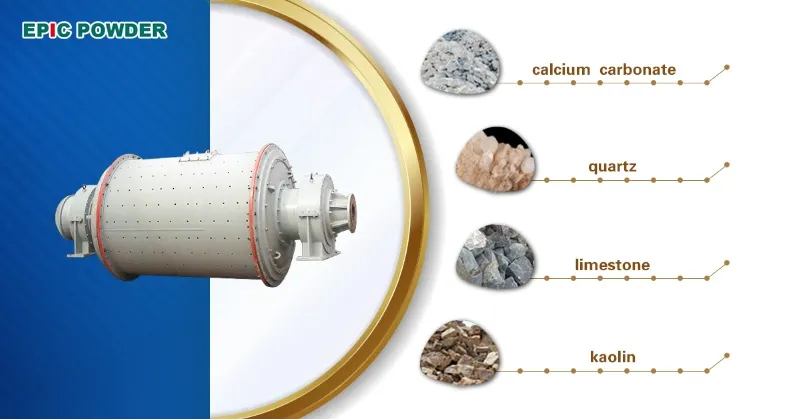
- Ball Mill + Classifier Systems – Produce GCC from fine to ultra-fine (5–75 μm) with precise D50 and D97 control. Our systems achieve stable output at 5+ t/h with D50 ≤ 5 μm.
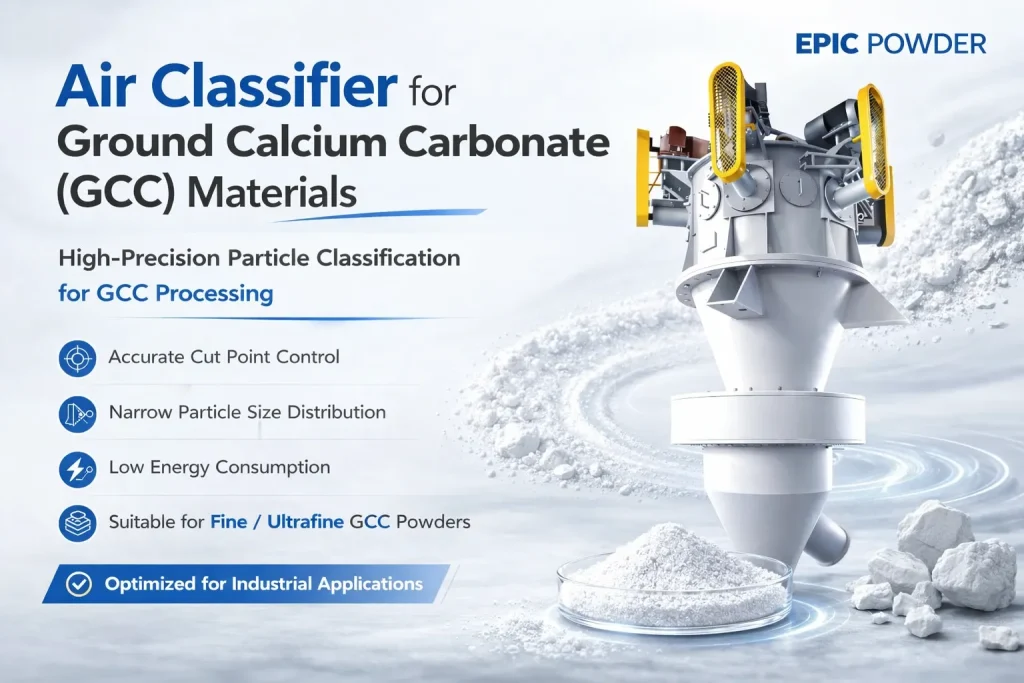
- HTS Series Air Classifiers – Deliver some of the tightest particle size cuts in the industry. D97 cuts as fine as 6–10 μm with ±0.5 μm shift-to-shift repeatability—critical for high-end coatings, plastics, and sealants.
- Turnkey Production Lines – From crushing and conveying to grinding, classifying, packing, and optional surface coating. PLC-controlled automation ensures efficiency and consistency.
- Surface Modification – Customized coating systems to produce activated calcium carbonate with tailored hydrophobicity and dispersion properties.
Whether you’re producing GCC for PVC pipe, nano-CaCO₃ for sealants, or fine-grind filler for paints, Epic Powder provides the equipment and process expertise to help you hit your target fineness, purity, and throughput—consistently.
FAQ
Q: What is the difference between GCC and PCC for plastic filling?
A: GCC (Ground Calcium Carbonate) is produced by mechanical grinding of natural limestone or marble. It is cost-effective and works well as a general-purpose filler in PVC and polyolefins. PCC (Precipitated Calcium Carbonate) is synthesized through a chemical process, giving it higher purity, finer particle size, and more controlled morphology. PCC offers better reinforcement and surface finish but costs significantly more. For most plastic applications, activated GCC provides the best balance of performance and cost, while PCC is reserved for high-end products requiring superior impact strength or optical properties. The choice ultimately depends on your target properties and budget.
Q: Why is activated nano-calcium carbonate necessary for silicone sealant?
A: Standard calcium carbonate lacks the surface chemistry and fine particle size needed to build the thixotropic (anti-sag) structure that silicone sealants require. Activated nano-calcium carbonate (30–60 nm) is surface-treated with fatty acids, which gives it two critical functions: it forms a three-dimensional network that prevents sagging in vertical applications, and it provides reinforcement that improves tensile strength and elongation. Without nano-CaCO₃, a sealant would either sag off the joint or cure into a brittle, low-elasticity material. In short, it’s not optional—it’s the functional backbone of a high-performance sealant formulation.
Q: What equipment is needed to process calcium carbonate powder?
A: A complete calcium carbonate processing line typically includes: jaw crusher or hammer crusher for primary size reduction, bucket elevator for material conveying, ultrafine grinding mill (such as ball mill or roller mill) to achieve target fineness, air classifier to separate fine and coarse particles with sharp cut-point control, cyclone collector and bag filter for dust collection, and optionally a surface coating system to produce activated products. For ultra-fine GCC (D97 < 10 μm), a high-precision air classifier is the most critical piece of equipment—it determines your final product quality and consistency. Epic Powder provides complete turnkey solutions covering all these stages, from crushing to packaging.
Ready to optimize your calcium carbonate processing? Contact Epic Powder for a free consultation and process recommendation.

“Thanks for reading. I hope my article helps. Please leave a comment down below. You may also contact EPIC Powder online customer representative Zelda for any further inquiries.”
— Jason Wang, Engineer