
Heavy calcium carbonate (GCC) is a powdered calcium carbonate material produced by mechanically grinding raw minerals such as calcite, chalk, and marble. It is characterized by its wide availability of raw materials, high whiteness, low oil absorption, good applicability, and low cost. Currently, it is the most extensively used and highest-volume inorganic non-metallic mineral powder product.
The production of GCC primarily relies on grinding and surface modification technologies to manufacture products that meet the fineness requirements of various applications. These products include fine powder, ultra-fine powder, surface-modified (activated) powder, and ultra-fine slurry for papermaking, among others. There are over ten specialized GCC products with different fineness levels and surface modification treatments.
GCC Production Process and Equipment
Taking GCC for the coating industry as an example, the production process mainly includes: washing and impurity removal, primary crushing, secondary crushing, screening, grinding and classification, product collection, surface treatment, and packaging.
GCC Grinding Technology and Equipment
Currently, GCC with a particle size of d97 ≥ 5μm is primarily produced via dry methods. Equipment used includes improved Raymond mills (suspension roller mills or pendulum mills), roller mills (including pressure roller mills/vertical mills, ring roller mills), and ball mills.
Ultra-fine GCC with a particle size of d97 < 5μm generally employs a dry production process, though some production uses a wet grinding + drying method. Dry production mainly utilizes cylindrical ball mills + classifiers, roller mills (including internally classified ring roller mills, vertical mills/pressure roller mills), and dry stirred mills + classifiers.
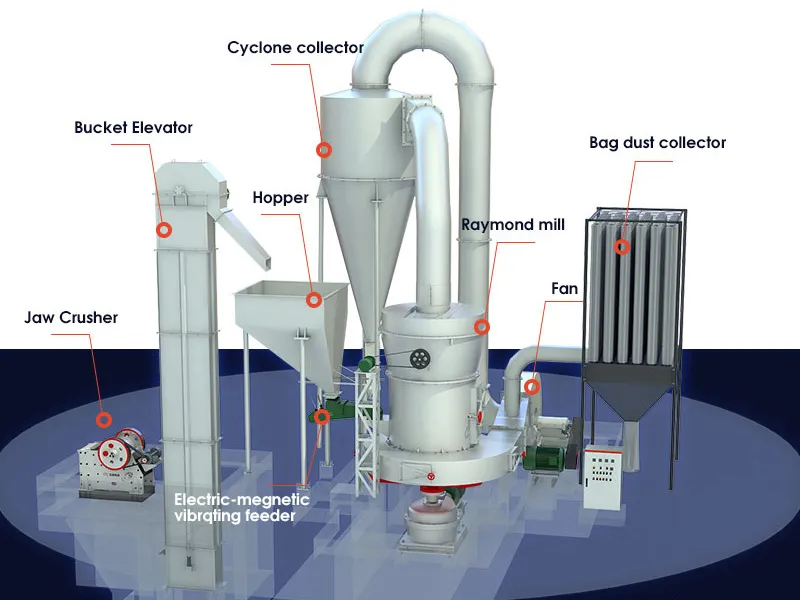
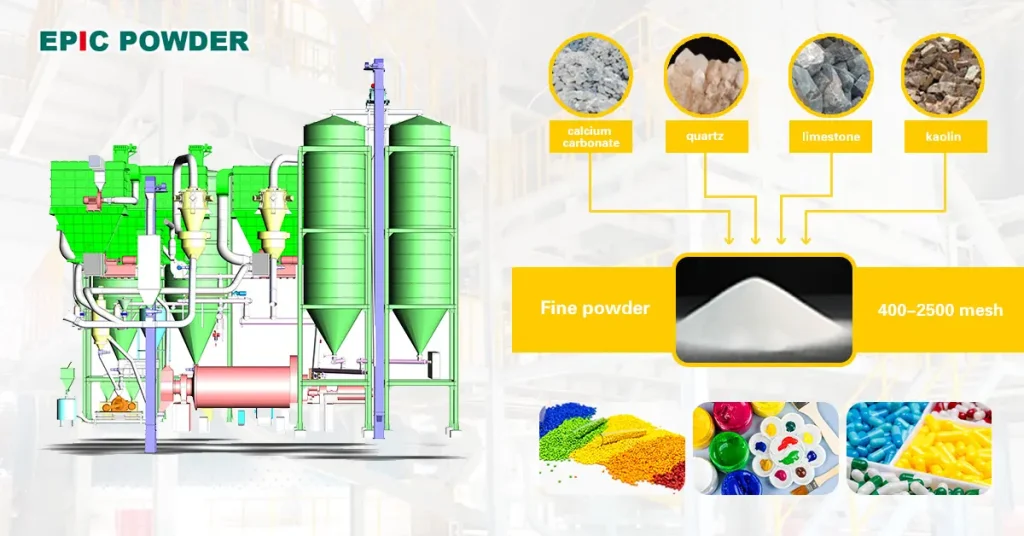
The ball mill + classifier production line is primarily used to produce GCC fine and ultra-fine powders with d97 = 5–43μm. Its features include continuous closed-circuit operation, multi-stage classification, high circulation load (300%–500%), and large single-unit production capacity.
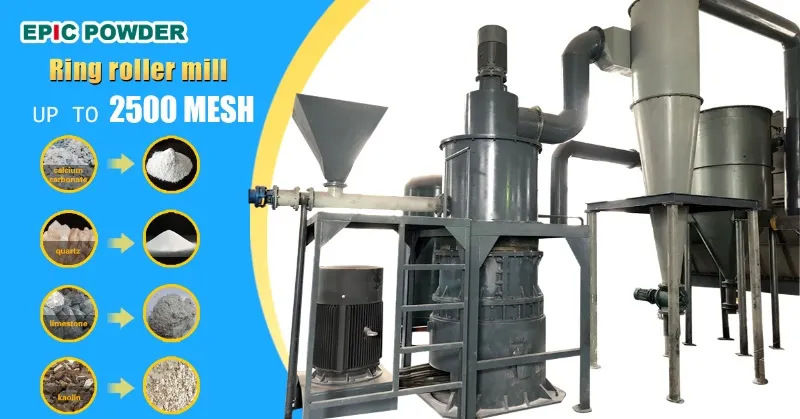
The ring roller mill has been the most widely used fine and ultra-fine grinding equipment. It is characterized by a high size reduction ratio and low energy consumption per unit product. When equipped with internal or external fine classifiers, it can produce ultra-fine products with d97 ≤ 10μm. The product fineness is adjustable between d97 = 5–40μm, with the optimal product size range being d97 = 10–30μm.
The roller mill is one of the primary large-scale pieces of equipment for fine and ultra-fine grinding of GCC. It features a high crushing ratio and is most suitable for producing products in the d97 = 15–45μm range. When paired with an external fine classifier, it can produce ultra-fine products with d97 ≤ 10μm. The resulting product has good particle shape and a low oil absorption value. This makes it particularly suitable for producing GCC fillers used in unsaturated polyester-based composites (e.g., artificial stone). It also boasts low energy consumption and wear per unit product.
GCC Surface Modification Technology and Equipment
The surface modification of GCC primarily employs organic coating and composite modification methods.
Organic coating modification involves coating and modifying GCC powder using organic surface coating agents/modifiers. The agents include stearic acid and its salts, aluminate coupling agents, titanate coupling agents, and water-soluble polymers.
Composite modification is a surface modification method where another inorganic powder is uniformly mixed into or coated onto the surface of GCC or ultra-fine GCC particles using physical or chemical methods.
Currently, dry modification is the mainstream process for GCC. Wet modification is rarely used unless it is integrated with wet ultra-fine grinding.
Common surface modification equipment for GCC includes continuous powder surface modifiers, high-efficiency mixing modifiers, high-speed heating mixers, and vortex mills. Some surface modification of GCC is also performed simultaneously with fine or ultra-fine grinding. In these integrated processes, surface modifiers are added during the grinding stages, allowing for both size reduction and surface modification to be completed within the same equipment.
Epic Powder
Epic Powder Machinery is more than an equipment supplier; we are your long-term partner in powder processing. Our comprehensive after-sales services—from installation and training to ongoing maintenance—ensure you achieve optimal performance from day one. Choose Epic Powder for reliable, efficient, and sustainable solutions engineered for your success. Contact us to elevate your operations.

“Thanks for reading. I hope my article helps. Please leave a comment down below. You may also contact EPIC Powder online customer representative Zelda for any further inquiries.”
— Jason Wang, Senior Engineer