
Plaster quality traces back to two steps that happen far apart in the plant. Calcination turns the raw mineral into the binder. Gypsum grinding then turns the calcined product into a powder the line can dose. The two steps control different properties, and a problem in one cannot be fixed in the other. This article splits the responsibilities, and it maps the machines to the gypsum bands.
Calcination Sets the Phase
Raw gypsum is calcium sulfate dihydrate, and it carries two molecules of water of crystallization. Heat drives most of that water off, and the product becomes hemihydrate, the plaster binder. The temperature window decides how much anhydrite forms alongside the hemihydrate, and anhydrite reacts slowly. Reactors, kettles and rotary calciners all do this job, and the mill follows whatever leaves them. Grinding cannot repair a wrong phase mix, because water demand and set time follow the chemistry. A mill downstream of a bad kiln only makes a finer bad product.
Grinding Sets the Behavior
Particle size then decides how the binder behaves in water. Finer powder dissolves and hydrates faster, so the mix sets quicker and needs more water to stay workable. Extra water leaves pores as it dries, and the hardened strength falls with it. Construction plaster therefore carries a wide target, and published lines commonly specify 80 to 200 mesh. Specialty grades go finer, and the specification moves above 325 mesh. The PSD curve matters more than a single mesh number, and the trial reports the whole curve. Mortar and putty plants dose binders the same way, and the calcium carbonate guide covers that dosing logic.
Which Machine Fits Each Band
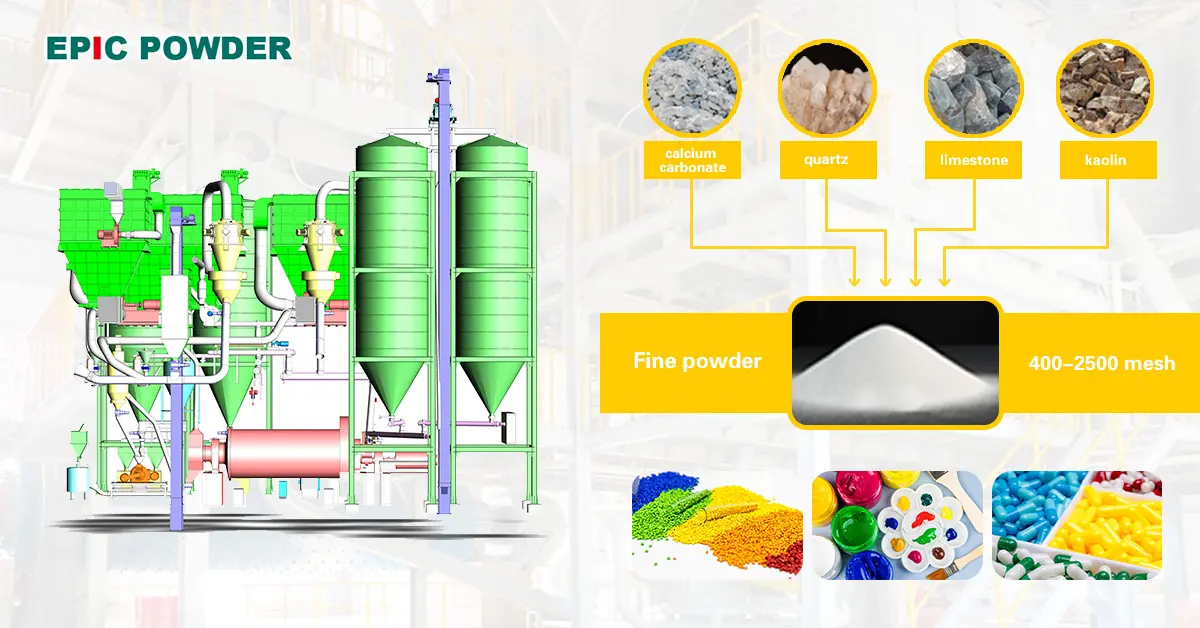
The 80 to 200 mesh band equals roughly 180 down to 75 µm. A ball mill circuit with a classifier holds that band, and it takes the coarse crushed rock in directly. The mill comparison guide weighs the three routes on cost and floor space. The fine end belongs to the ring roller mill, which holds 325 to 2000 mesh, about 6.5 to 45 µm. The band logic repeats across minerals, and our dolomite grinding guide applies it to another carbonate. A jet mill covers the bottom of the fine window for medical grades, and it runs without media contact. Gypsum grinding above the spec fineness costs energy the plaster never uses. The application sets the target, and the target sets the mill.
Where the Bands Land by Application
The application decides which band a plant targets. Construction plaster and cement retarder duty commonly run 80 to 200 mesh. Our limestone selection guide starts that same decision one step earlier, at the quarry face. Precision casting and medical grades move above 325 mesh, and self-leveling mortars expect narrow bands near the fine end. Each step up in fineness adds energy, and the price must follow.
By-product Gypsum Comes With Conditions
Flue gas desulfurization gypsum and phosphogypsum dominate new plaster capacity. Both arrive wet, and free moisture above a few percent plugs feeders and blinds screens. The drying step therefore comes first, and many lines combine it with the calcination heat. A mill fed with wet lump gypsum makes a fine wet cake, and no specification rewards that. Grinding removes no soluble impurities, so the chloride and phosphate levels must be handled before the mill. Washing, classification of the feed and blending decide those numbers.
What a Trial Must Report
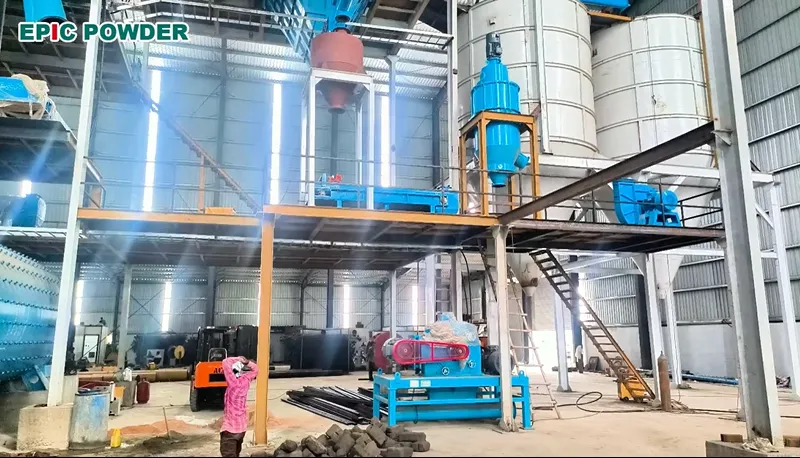
Gypsum grinding trials answer five items. The report lists the phase composition and the PSD curve. Water demand of the standard mix, setting time and dry strength complete the set. Setting time is the number the plaster plant feels first, and it moves with both the phase and the size. The feed varies between natural rock, FGD and phosphogypsum. The trial therefore runs on the material the plant will actually buy. A powder sample without its phase data answers none of the questions that matter.
FAQ
Can grinding replace calcination?
No. Grinding changes the size distribution, and calcination changes the mineral phase. Powder ground from raw dihydrate plaster sets weakly or never, because the binder chemistry is missing. The kiln and the mill are separate investments.
Why does very fine gypsum powder lose strength?
Finer powder needs more water to reach the same workability. That water evaporates and leaves pores, and porosity lowers the hardened strength. The fix is a tighter size band, and the trial finds the finest band the strength spec allows.
Is by-product gypsum as good as natural gypsum?
It can be, after preprocessing. FGD gypsum reaches high purity once the chloride and free moisture are under control. Phosphogypsum carries phosphate and sometimes radionuclides, so it needs a stricter feed test. The application decides, and the trial confirms.
Epic Powder
Epic Powder designs grinding and classifying systems for minerals, chemicals, food, and pharmaceuticals. With more than 20 years of powder processing experience, we match the right mill to your target particle size and capacity. Tell us about your material and we will recommend a tested solution.

“Thanks for reading. I hope my article helps. If your gypsum line is still on paper, leave a comment with your target mesh and feed source. You may also contact EPIC Powder online customer representative Molly for any further inquiries.”
— Published by Mr. Wang, Chief engineer