
How Non-Metallic Minerals Drive Modern Industry and the Processing Technology
When people think of mineral resources, coal, iron ore, and gold usually come to mind. Yet it is non-metallic minerals like limestone, quartz, graphite, fluorite, kaolin, and talc that quietly underpin everything. They help produce a wide range of materials, from paper and ceramics to lithium-ion batteries for electric vehicles.
This article examines the application value of non-metallic minerals across traditional and emerging industries. More importantly, the advanced powder processing equipment and technologies required to transform raw ores into high-performance functional materials.
I. What Are Non-Metallic Minerals?
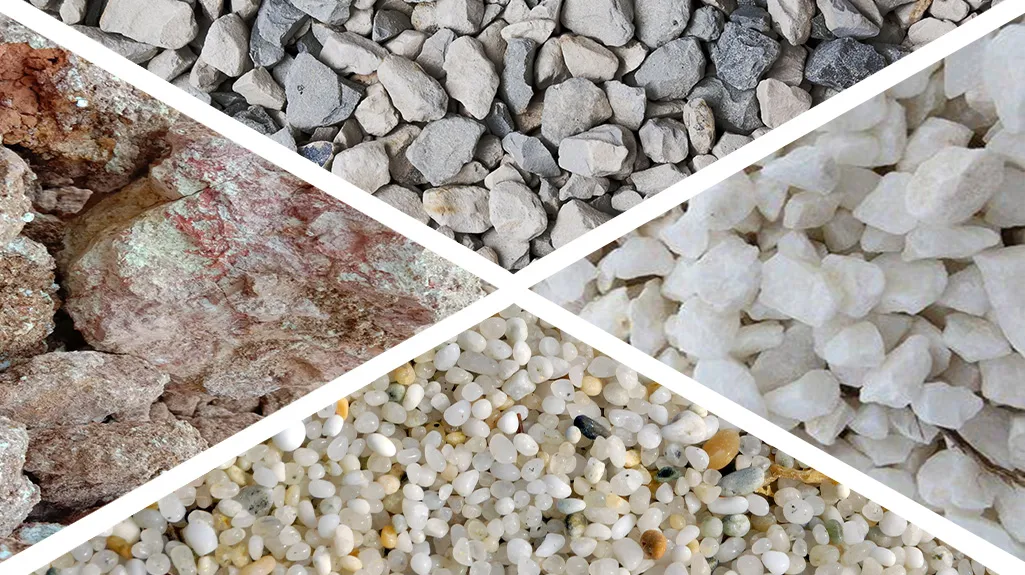
Non-metallic mineral resources are naturally occurring minerals with economic value, excluding metallic ores and fossil fuels. This category includes well-known materials such as limestone, quartz sand, and kaolin. It also introduces strategic resources like graphite, fluorite, and high-purity quartz, as well as specialty functional minerals including attapulgite, bentonite, diatomaceous earth, wollastonite, and talc.
What sets non-metallic minerals apart is their unique physical, chemical, optical, electrical, adsorption, and heat-resistant properties. They can be transformed into functional materials for high-end manufacturing, new energy, and semiconductor applications. These advanced processing include ultrafine grinding, precise classification, and surface modification.
II. Application Value Across Industries
The Cornerstone of Traditional Industries
Calcium Carbonate — Calcium carbonate is widely used in paper, plastics, rubber, coatings, building materials, pharmaceuticals, and food industries. In papermaking, it enhances opacity and smoothness. In plastics and rubber, it improves rigidity and reduces costs.
Kaolin — Kaolin is essential for household ceramics, architectural ceramics, and sanitary ware. It also serves as a coating pigment in paper, an insulating material for cables, and a bulking filler in cosmetics.
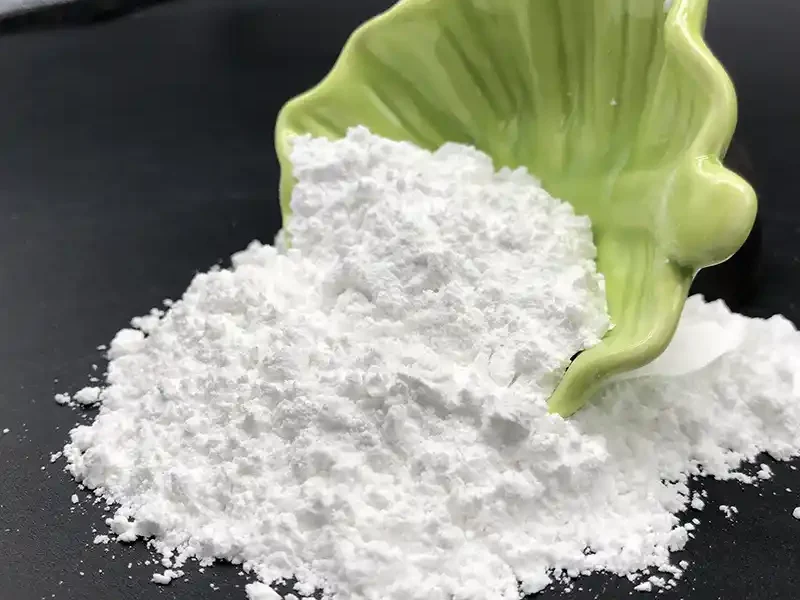
Talc — A layered silicate mineral with excellent lubricity, refractoriness, insulation, and chemical stability. It is a high-quality additive in coatings, plastics, rubber, pharmaceutical excipients, cosmetics, and food products.
Wollastonite — Its needle-like fibrous structure provides reinforcing and toughening properties, along with high-temperature and corrosion resistance. It can replace asbestos in automotive brake pads and friction materials, and is also a key raw material for ceramics and eco-friendly building materials.
The Core of Strategic Emerging Industries
Graphite — Classified as a strategic mineral, graphite is one of the most critical materials in the new energy sector. Spherical graphite is the core raw material for lithium-ion battery anodes — over 90% of global anode materials are graphite-based. Isostatic graphite is used in photovoltaic monocrystalline silicon furnaces and semiconductor crystal furnaces. Graphene is applied in battery cooling systems, flexible electronics, and anti-corrosion coatings; nuclear-grade graphite serves as a neutron moderator in the nuclear industry.
High-Purity Quartz — With SiO₂ purity of 99.998% or higher, this is a world apart from ordinary construction sand. It is an essential consumable for the photovoltaic industry and semiconductor manufacturing. Quartz crucibles for pulling monocrystalline silicon ingots, and consumables like quartz etching tanks, boats, and diffusion tubes for wafer processing, all depend on high-purity quartz — the only natural material that maintains chemical stability at high temperatures without contaminating wafers.
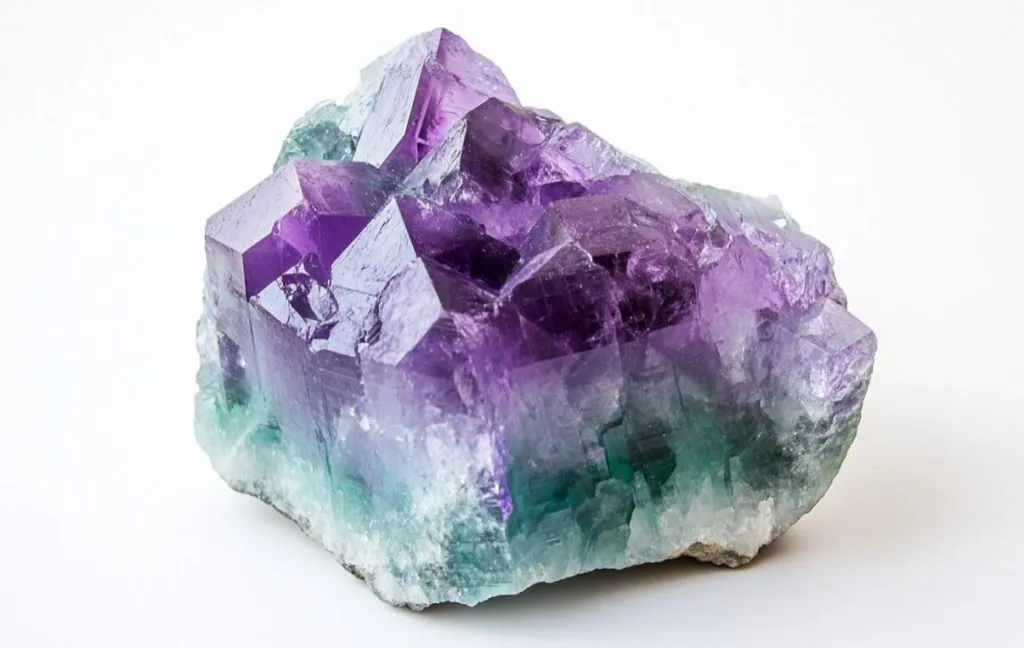
Fluorite — Also known as fluorspar, it is the only natural mineral that provides fluorine on a large scale and is listed in China’s Strategic Mineral Resources Catalog. Hydrofluoric acid derived from fluorite is the source for refrigerants in EV air conditioning systems, lithium hexafluorophosphate for battery electrolytes, photoresists and etching solutions for semiconductors, high-performance fluoropolymers, and materials for uranium enrichment in the nuclear industry.
Specialty Minerals — Attapulgite (a scarce natural nanoscale porous mineral) is used in wastewater treatment, soil remediation, and aerospace insulation. Bentonite (the “universal clay”) serves in drilling mud, pharmaceutical montmorillonite powder, and food decolorization. Diatomaceous earth provides filtration for beer and drinking water, and is used in soundproofing, insulation, and catalyst carriers.
III. From Ore to Engineered Powder: The Processing Challenge
For engineers and procurement professionals, the real question is not what these minerals can do — but how to consistently produce powders that meet the precise particle size, morphology, purity, and surface property requirements of each application.
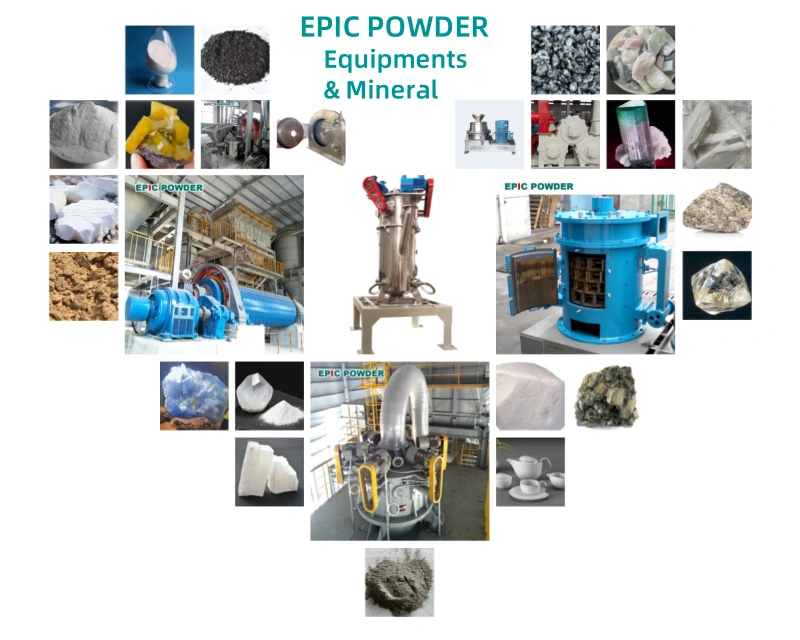
At Epic Powder Machinery, we address this challenge through a comprehensive portfolio of powder processing solutions. As a technology-driven enterprise with over 20 years of experience, we specialize in the R&D and manufacturing of advanced powder processing systems — from grinding and classifying to surface modification, drying, and spheroidizing. Our equipment serves industries including non-metallic minerals, new energy battery materials, pharmaceuticals, food, chemicals, and solid waste recycling.
Core Equipment for Non-Metallic Mineral Processing
Ball Mill + Air Classifier Systems
This remains the mainstream solution for large-scale production of fine and ultrafine non-metallic mineral powders. The ball mill features continuous feed control for maximum grinding efficiency and reduced energy consumption. When combined with multi-wheel classifiers, it can produce powders with D97 from 5µm to 40µm, with capacities ranging from 1 to 100 tons per hour. The system operates in a closed loop with circulating loads of 300%–500%, making it one of the primary technologies for large-scale ultrafine calcium carbonate and mineral powder production. It is widely used for grinding calcium carbonate, calcined alumina, quartz, kaolin, zircon, bauxite, magnesite, and other minerals.
Ring Roller Mills
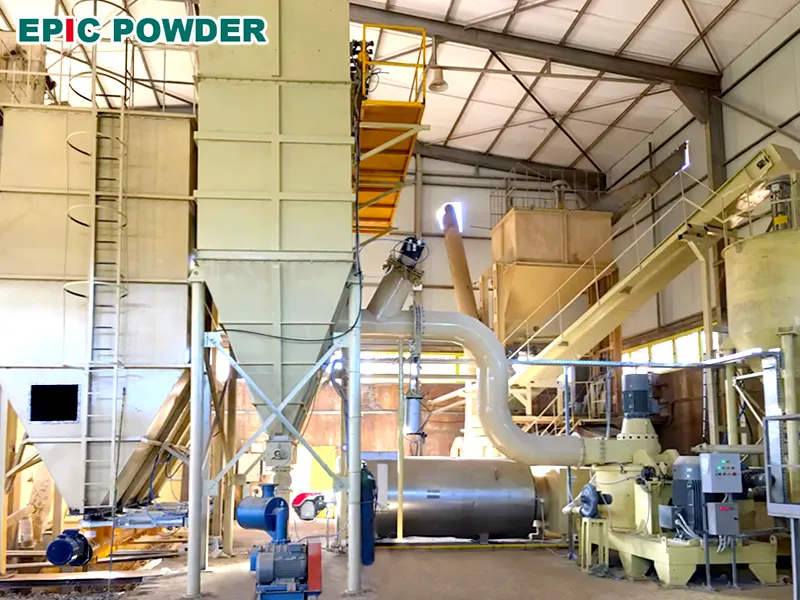
Designed and developed based on years of research in grinding mill production, the ring roller mill pulverizes non-metallic minerals into fine powder using impact, extrusion, and grinding principles. It features multi-layer grinding rollers and rings — material passes through multiple grinding stages from top to bottom, with a classification wheel at the top separating qualified fine powder from coarse particles that return for further grinding.
Key advantages include output more than double that of Raymond mills and jet mills, favorable product granularity and stability, easy installation without large-scale civil works, and full powder recovery with dust emissions meeting industry standards. It is ideal for dry grinding of calcium carbonate (calcite, marble, limestone, chalk), barite, kaolin, dolomite, magnesite, alumina, and other materials. Product fineness can be adjusted between D97 = 5–40µm, with an optimal range of 10–30µm.
Air Classifiers
Precise classification is critical for producing powders with narrow particle size distributions. Epic Powder offers both vertical and horizontal air classifiers.
The Vertical Air Classifier (ITC series) features a drive located beneath the classifying zone with central feed from above for optimal distribution and dispersion. It is especially suitable for non-metallic mineral materials including calcium carbonate, kaolin, quartz, talc, and mica. With single rotor diameters from 150mm to 2200mm and particle size ranges of 2–45µm, the system operates with PLC control and achieves classification efficiency of 60–90%.
The HTS Air Classifier is an ultra-fine classifier ideal for D97 between 2 and 45 microns, delivering high product fineness, high output, and low energy consumption through optimized airflow dynamics and multi-wheel design. Both classifiers feature wear-resistant linings for abrasive materials and can be integrated into complete production lines with filters, fans, and cyclones.
Jet Mills
For heat-sensitive or low-melting-point materials, jet mills provide low-temperature, media-free grinding. The entire system operates in a sealed environment with no dust emissions and noise below 80 dB. Final products have narrow particle size distributions and good particle shapes, making jet mills suitable for ultrafine grinding of high-hardness, high-purity, and high-value-added materials.
Advanced Capabilities for Demanding Applications
Beyond standard equipment, Epic Powder addresses the specific needs of high-tech industries through several advanced capabilities:
- Steam kinetic energy grinding, nano turbulence grinding, and supersonic airflow grinding — enabling breakthroughs from micrometer to nanometer scales.
- Contamination control — using multiple materials to protect contact parts and ensure product purity, with ceramic linings (alumina, zirconia) available to reduce impurity intake.
- Customized solutions — tailored to meet specific functionality requirements including particle morphology, size distribution, and dispersion.
- Safe processing — customized production plans for volatile, corrosive, toxic, and flammable materials, with inert gas circulation protection and intelligent control systems.
- Complete production lines — automatic and intelligent dust-free systems integrating feeding, grinding, filtering, mixing, conveying, and packaging.
IV. Why Processing Technology Matters
The value of non-metallic minerals is unlocked only through proper processing. When particle size reaches the micron or nanometer level, physical and chemical properties change significantly — powders demonstrate uniform distribution, large specific surface area, and rapid chemical reactions. These properties are what make possible the performance requirements of lithium-ion batteries, semiconductor materials, and advanced composites.
For procurement professionals, the choice of processing equipment directly impacts product quality, production efficiency, and operating costs. Epic Powder’s solutions are designed with these factors in mind — high output, low energy consumption, precise particle size control, and environmental compliance through pulse dust collection systems.
Our track record includes successful projects across more than 20 sectors globally — from Greek calcium carbonate producers increasing output with air classifier mills, to Southeast Asian quartz sand processors achieving stable D97 75µm at 6 t/h, to South Korean battery material suppliers using graphite anode powder grinding pin mills. Each project reflects our commitment to tailored solutions that meet specific material and production requirements.
V. Conclusion
Non-metallic minerals are the foundation of modern industry. From the cars to smartphones and the clean energy, these minerals are everywhere. But their true potential is realized only through advanced processing technologies that transform raw ore into precisely engineered powders.
At Epic Powder Machinery, we provide the equipment, expertise, and customized solutions to make that transformation possible. Whether you are processing calcium carbonate for paper filler, graphite for battery anodes, or high-purity quartz for semiconductor applications, we have the technology to help you achieve the particle size, purity, and performance your customers demand.
For more information about our powder processing solutions for non-metallic minerals, please contact our technical team at [email protected].
Epic Powder
Epic Powder Machinery is a technology-driven enterprise specializing in the research, development, and manufacturing of advanced powder processing systems. Guided by the mission of “Finer Materials, Better World,” we combine technological innovation with deep industry experience. Our product portfolio includes jet mills, mechanical mills, air classifiers, ball mill classification systems, ring roller mills, surface modification lines, and laboratory equipment. With CE certification and a global customer base, we provide tailored solutions for the non-metallic minerals, new energy, pharmaceutical, chemical, food, and solid waste recycling industries.

“Thanks for reading. I hope my article helps. Please leave a comment down below. You may also contact EPIC Powder online customer representative Zelda for any further inquiries.”
— Jason Wang, Engineer