
Calcium carbonate (CaCO₃) is one of the most widely used inorganic non-metallic minerals in the world. Abundant, low-cost, chemically stable, and non-toxic, it has served as a functional filler in plastics, papermaking, coatings, rubber, and construction materials for decades. Yet in its ordinary ground form, conventional calcium carbonate has well-known limitations. They’re poor dispersion in organic polymer matrices, weak interfacial adhesion, and essentially no functional properties beyond bulk filling. That picture has changed substantially over the past two decades. Through advanced calcium carbonate powder processing — including nano-scale synthesis, particle morphology control, dry surface modification, and functional compounding — manufacturers are now producing high-value CaCO₃ grades that command premium prices and open entirely new application markets. Annual demand growth for surface-modified calcium carbonate alone has averaged 10–15% over the past ten years.
At EPIC Powder Machinery, we design and supply the processing equipment that makes these advanced grades possible. This article provides a comprehensive technical overview of modern calcium carbonate processing methods and the innovative applications they enable. It covers nano-CaCO₃ production, ground calcium carbonate (GCC) technology, surface modification processes, and emerging high-value application areas.
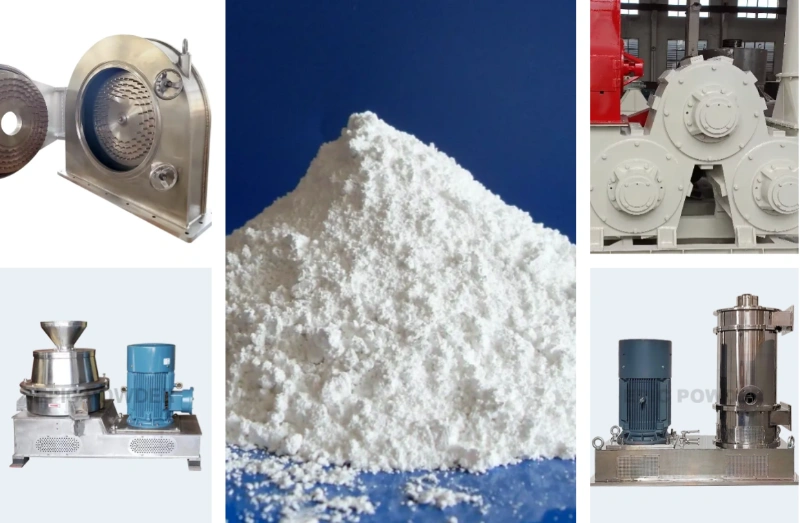
Why Ordinary Calcium Carbonate Falls Short in High-Value Applications
Understanding the limitations of conventional ground calcium carbonate is the starting point for understanding the value of advanced processing. Standard GCC, produced by simple mechanical grinding of limestone, has three fundamental limitations that restrict its use in premium applications:
- untreated CaCO₃ surfaces are strongly hydrophilic, making them incompatible with hydrophobic polymer matrices such as polyethylene, polypropylene, and PVC. Without surface treatment, CaCO₃ particles aggregate rather than dispersing uniformly, creating stress concentration points that reduce mechanical properties.: Poor dispersion in organic systems
- the absence of reactive surface chemistry means untreated CaCO₃ does not bond to the polymer matrix. It acts as a passive filler rather than a reinforcing agent, limiting its ability to improve tensile strength, impact resistance, or elongation at break.: Weak interfacial adhesion
- ordinary CaCO₃ contributes nothing beyond volume and whiteness. Advanced applications — flame retardancy, drug delivery, CO₂ capture, lithium battery electrolyte stabilisation — require controlled particle morphology, specific surface chemistry, and engineered porosity that standard grinding cannot deliver.: No functional properties
Advanced calcium carbonate powder processing addresses all three limitations systematically, transforming a commodity mineral into a designed functional material.
Nano-Calcium Carbonate Production: Synthesis Routes and Process Control
Nano-calcium carbonate — defined as CaCO₃ with at least one dimension below 100 nm — is produced primarily by chemical synthesis rather than mechanical grinding. The distinction matters: chemical synthesis allows controllable crystal form (calcite, aragonite, or vaterite), precise particle size distribution, and designed surface chemistry from the outset. Mechanical grinding of limestone cannot reliably reach nano dimensions and does not provide crystal form control.
Primary Synthesis Routes
Preparation methods for nano-CaCO₃ divide into two broad categories: physical methods based on mechanical energy, and chemical methods that exploit precipitation, carbonation, or phase transformation. Chemical methods dominate industrial production because they provide the process control that high-performance nano-CaCO₃ grades require.
- limestone is calcined to produce CaO, which is slaked with water to form Ca(OH)₂ slurry. CO₂ is then introduced to precipitate CaCO₃. The carbonation step is the critical control point: particle size, morphology, and crystal form are determined by Ca(OH)₂ concentration, initial carbonation temperature, CO₂ partial pressure, and total gas flow rate. These conditions collectively determine solution supersaturation and gas-liquid mass transfer characteristics, which drive nucleation rate and crystal growth kinetics.: Carbonation method (dominant industrial route)
- direct reaction of soluble calcium salts (e.g., CaCl₂) with carbonate sources (Na₂CO₃, (NH₄)₂CO₃) in controlled aqueous conditions. Precipitation method offers excellent crystal form control and is favoured for producing speciality morphologies such as aragonite needles or vaterite spheres.: Precipitation method
- used for producing ultra-uniform nano-CaCO₃ with extremely tight particle size distribution, primarily for pharmaceutical and electronic materials applications where size consistency is critical.: Emulsion and sol-gel methods
Carbonation Process Variants
Within the carbonation method, three distinct process configurations are used industrially, each with different throughput, particle size distribution, and capital cost profiles:
| Carbonation Process | Particle Size Control | Throughput | Best For |
| Batch carbonation | Good — each batch individually controlled | Low – medium | R&D, speciality grades, small volume |
| Multi-stage spray carbonation | Very good — staged conditions enable narrow PSD | Medium – high | Production-scale narrow distribution grades |
| High-gravity (RPB) carbonation | Excellent — intense mixing enables ultra-fine control | High | Ultra-fine nano-CaCO₃, tight size distribution |
The high-gravity carbonation process, using a rotating packed bed (RPB) reactor, represents the current state of the art for nano-CaCO₃ production. The intense centrifugal mixing it provides achieves gas-liquid mass transfer rates orders of magnitude higher than conventional stirred reactors, enabling production of nano-CaCO₃ with D50 below 30 nm and coefficient of variation below 15% — specifications that batch or spray carbonation cannot consistently achieve.
Ground Calcium Carbonate (GCC) Production: Grinding Technology Comparison
Ground calcium carbonate is produced by mechanical size reduction of high-purity limestone or marble. Unlike nano-CaCO₃, GCC is defined by its particle size range (typically 1–100 μm, expressed as mesh number from 325 to 6500 mesh) rather than crystal form. The production process — ore selection, primary crushing, grinding, classification, surface modification — is well established, but the grinding technology chosen has a major impact on product quality, energy consumption, and production economics.
Four primary grinding technologies are used in industrial GCC production:
Ring Roller Mill Process
The ring roller mill feeds material into the gap between grinding rollers and a grinding ring, achieving size reduction through impact, extrusion, and shear. Compared to the Raymond mill, ring roller mills deliver significantly higher grinding efficiency, lower specific energy consumption, and better product particle size consistency. Their power-saving characteristics and lower capital investment have driven rapid adoption across the GCC industry. The primary constraint is throughput: single-machine capacity is lower than ball mills, limiting their application in high-volume commodity GCC production.
Ball Mill Process
The ball mill uses a rotating cylinder and grinding media to achieve size reduction through impact and attrition. Ball mills offer the highest single-unit production capacity of any GCC grinding technology. They can produce products from 600 mesh to 6,500 mesh. The trade-offs are significant: ball mills exhibit over-grinding phenomena. Its specific energy consumption is higher than ring roller mills at equivalent fineness. For GCC grades where a narrow particle size distribution is critical — such as paper coating grades or high-transparency film applications — ball mills require closed-circuit classification to control product PSD.
| GCC Technology Selection Guide325–1250 mesh, low capital budget: Ring roller mill process600–6500 mesh, high throughput priority: Ball mill process (closed circuit with classifier)1250–6500 mesh, high-end narrow PSD |
Calcium Carbonate Surface Modification: Transforming a Filler into a Functional Material
Surface modification is the processing step that most directly determines whether calcium carbonate functions as a commodity filler or a high-value performance additive. By applying organic surface coatings to CaCO₃ particles, modification transforms a hydrophilic mineral surface into an organophilic one — dramatically improving compatibility with polymer matrices, increasing dispersibility, and enabling the interfacial bonding that drives mechanical property improvement.
Annual demand for surface-modified calcium carbonate has grown at 10–15% per year over the past decade, driven by increasing use in engineering plastics, high-performance sealants, and specialty coatings. The premium over unmodified GCC is substantial: surface-modified grades typically command 1.5–3× the price of equivalent unmodified product.
Surface Modification Agents
The choice of surface modification agent determines both the surface chemistry achieved and the application suitability of the product:
- the most widely used surface treatment for general polymer applications (PVC, polyolefins, rubber). Stearic acid reacts with CaCO₃ surface Ca²⁺ sites to form calcium stearate, creating a hydrophobic monolayer. Treatment levels of 1–3 wt% are typical. Cost-effective and well-established, but limited to non-polar polymer systems.: Stearic acid and fatty acid salts
- form chemical bridges between the CaCO₃ surface and the polymer matrix, improving both dispersion and interfacial adhesion. More effective than stearic acid in polar polymer systems and at elevated processing temperatures. Used in engineering plastics, high-performance sealants, and adhesives.: Titanate coupling agents
- similar mechanism to titanate agents, with better compatibility in polyolefin and rubber systems. Often used where cost-performance balance is the primary consideration.: Aluminate coupling agents
- used in wet modification processes, particularly for paper coating grades where high-solids slurry stability is required. Provide steric stabilisation rather than chemical bonding.: Water-soluble polymers (polyacrylate, polycarboxylate)
- the premium choice for demanding applications (automotive sealants, high-performance adhesives, electronic encapsulants). Silane modification provides the strongest interfacial bonding and the best performance at elevated temperatures and humidity.: Silane coupling agents
Dry vs. Wet Modification Process
Dry surface modification is the mainstream process for most CaCO₃ grades. In the dry process, powder is heated to activation temperature in a high-speed modification reactor, the modifier is added as a liquid spray or vapour, and intensive mixing ensures uniform coating. Residence time is short (typically 5–15 minutes), energy consumption is low, and the process integrates easily into existing dry powder production lines.
Wet modification is used for slurry-form products (paper coating grades) and for certain nano-CaCO₃ applications where surface chemistry must be established before drying to prevent agglomeration. The wet process provides more uniform coating at the nano scale but requires downstream drying, increasing process cost and complexity.
Innovative Applications of High-End Calcium Carbonate: Where the Value Is
Advanced calcium carbonate processing has opened application markets that were unavailable to conventional ground calcium carbonate. The following areas represent the highest-value opportunities in the current market:
High-Performance Plastics and Polymer Composites
Surface-modified ultrafine CaCO₃ (D50 1–5 μm) is now used as a functional additive — not just a filler — in polyolefin and PVC compounds. When properly surface-treated and dispersed, ultrafine CaCO₃ acts as a nucleating agent and stress concentrator that toughens the polymer matrix, improving impact resistance by 30–70% compared to unfilled resin. In biaxially oriented polypropylene (BOPP) film and breathable film applications, ultrafine CaCO₃ creates controlled micro-voids during stretching, enabling the film’s moisture vapour transmission function without compromising tensile properties.
Lithium Battery Materials
Nano-calcium carbonate is emerging as a functional additive in lithium-ion battery electrolytes and electrode coatings. Its ability to scavenge hydrofluoric acid (HF) — a decomposition product of LiPF₆ electrolytes — without introducing harmful metal ions makes it an attractive alternative to conventional Al₂O₃ additives. High-purity (>99.9%), narrow-PSD nano-CaCO₃ applied as a coating on lithium cathode materials has been shown to reduce side reactions and improve cycle life. This is an early-stage but rapidly developing application for speciality nano-CaCO₃ producers.
Pharmaceutical and Food-Grade Applications
Calcium carbonate is a well-established pharmaceutical excipient and dietary calcium source, but high-value pharmaceutical applications require specifications that ordinary GCC cannot meet: controlled particle size for tablet compressibility, ultra-high purity (>99.9% CaCO₃, trace metals below detection limits), and specific crystal form (calcite preferred for bioavailability). Precipitated calcium carbonate produced by the carbonation route, with appropriate post-synthesis surface treatment, meets these specifications. The price premium over industrial GCC is 5–20×.
Environmental and CO₂ Capture Applications
Porous calcium carbonate — produced by templated synthesis or controlled precipitation — has demonstrated effectiveness as a CO₂ sorbent in post-combustion carbon capture applications. The high surface area (typically 20–60 m²/g, compared to 1–5 m²/g for conventional GCC) and controllable pore structure provide the adsorption capacity and regeneration kinetics that industrial CO₂ capture requires. Calcium carbonate whiskers (high aspect ratio aragonite crystals) are also being evaluated as a reinforcing filler in polymer composites, offering mechanical reinforcement at lower loadings than spherical particles.
Electronic and Specialty Materials
In electronic materials, ultra-high-purity calcium carbonate serves as a precursor for specialty barium titanate and strontium titanate ceramics used in capacitors and sensors. The purity requirements — total heavy metals below 10 ppm, controlled Na⁺ and K⁺ — necessitate dedicated high-purity production lines with rigorous raw material screening and contamination-controlled processing environments.
| Application | Required Grade | Key Specification | Value Premium vs. Standard GCC |
| Toughened polyolefins / BOPP film | Ultrafine modified GCC | D50 1–3 μm | Surface-treated | 1.5–2.5× |
| Lithium battery electrolyte additive | High-purity nano-CaCO₃ | Purity >99.9% | D50 <50 nm | 10–30× |
| Pharmaceutical excipient / tablet filler | Pharma-grade PCC | USP/EP compliant | Controlled PSD | 5–20× |
| CO₂ capture sorbent | Porous nano-CaCO₃ | BET >20 m²/g | Controlled pore size | 8–15× |
| Electronic ceramics precursor | Ultra-high-purity PCC | Heavy metals <10 ppm | Narrow PSD | 15–40× |
| High-gloss paper coating | Ultrafine GCC slurry | D90 <2 μm | High solids stability | 1.5–3× |
Choosing the Right Calcium Carbonate Processing Strategy for Your Market
The diversity of high-end calcium carbonate applications means there is no single ‘right’ processing approach. The optimal strategy depends on three variables: the target application and its specification requirements, the production volume and cost structure, and the available raw material quality.
For manufacturers currently producing commodity GCC looking to move up the value chain, the most accessible path is typically dry surface modification of existing ultrafine GCC using a high-speed modification reactor. Capital investment is relatively low, the technology is well-established, and the market premium is immediate. The next step — developing ultrafine grades with tighter PSD control using a vertical mill or closed-circuit ball mill — opens the door to film, coating, and engineering plastics applications.
For manufacturers targeting nano-CaCO₃ markets (battery materials, pharmaceuticals, specialty coatings), the investment requirements are substantially higher: a dedicated carbonation synthesis line, tight process control systems, high-purity raw material supply chain, and cleanroom-compatible packaging. The returns, however, are proportionally larger — nano-CaCO₃ for battery applications commands prices 10–30× above commodity GCC.
In both cases, the processing equipment choice is critical. EPIC Powder Machinery’s engineering team can help identify the optimal equipment configuration for your target product specification, production volume, and capital budget — with lab-scale trials to validate performance before full production commitment.
Discuss Your Calcium Carbonate Processing Requirements with EPIC Powder Machinery
| Whether you are scaling up GCC production, developing surface-modified grades for high-value polymer applications, or exploring nano-calcium carbonate for new energy or pharmaceutical uses, EPIC Powder Machinery has the processing expertise and equipment portfolio to support your project from laboratory trial through to full production.Our systems cover the complete calcium carbonate value chain: ultrafine grinding, classification, dry surface modification, nano-CaCO₃ synthesis, and functional compounding. We work with manufacturers across plastics, coatings, rubber, adhesives, new energy materials, and specialty chemicals → Request a Free Process Consultation: www.nonmetallic-ore.com/contact → Explore Our Calcium Carbonate Processing Equipment: www.nonmetallic-ore.com |
Frequently Asked Questions
What is the difference between ground calcium carbonate (GCC) and precipitated calcium carbonate (PCC)?
Ground calcium carbonate (GCC) is produced by mechanical crushing and grinding of natural limestone or marble. Its crystal form, whiteness, and chemical purity are determined by the source ore. Precipitated calcium carbonate (PCC) is produced by chemical synthesis — typically the carbonation of Ca(OH)₂ slurry — which allows precise control of crystal form (calcite, aragonite, or vaterite), particle morphology, and size distribution. PCC can consistently achieve finer particle sizes and more uniform distributions than GCC, and it is the only route to nano-scale CaCO₃ with controlled crystal form. PCC commands a premium of 2–10× over GCC, depending on grade.
How does surface modification of calcium carbonate improve its performance in plastics?
Untreated calcium carbonate has a hydrophilic surface that is incompatible with hydrophobic polymer matrices, causing poor dispersion and weak interfacial adhesion. Surface modification — most commonly with stearic acid or coupling agents — converts the CaCO₃ surface from hydrophilic to organophilic, enabling uniform dispersion in the polymer melt and strong interfacial bonding. Well-dispersed, surface-treated ultrafine CaCO₃ acts as a nucleating agent and impact modifier, improving impact resistance by 30–70% in polyolefin compounds. In film applications, it creates controlled micro-voids during orientation, enabling breathable film functionality.
What grinding technology produces the finest calcium carbonate particle size?
For ground calcium carbonate, the ultrafine vertical mill and closed-circuit ball mill are the two technologies capable of producing the finest grades (1,250–6,500 mesh, D97 < 5 μm). Between the two, the ultrafine vertical mill offers better energy efficiency and PSD control at the finest end of the GCC range. For nano-scale calcium carbonate (D50 < 100 nm), mechanical grinding is insufficient — chemical synthesis via the carbonation method is required. High-gravity carbonation using a rotating packed bed reactor achieves the tightest particle size distribution at nano scale.
What purity grade of calcium carbonate is required for battery material applications?
Lithium battery applications require calcium carbonate with CaCO₃ purity above 99.9%, total heavy metal content below 10 ppm, and controlled Na⁺/K⁺ content to avoid electrolyte contamination. Particle size must be nano-scale (D50 typically 20–80 nm) with a narrow distribution to ensure uniform coating of electrode materials. These specifications require chemical synthesis via the carbonation route, high-purity raw materials, and contamination-controlled processing environments. Standard GCC or industrial PCC cannot meet these requirements.
What is the most cost-effective first step for a GCC producer looking to move into high-value markets?
For most GCC producers, dry surface modification of existing ultrafine grades is the most accessible entry point into high-value markets. A high-speed dry modification reactor has moderate capital cost, the technology is well-established, and surface-treated GCC commands a price premium of 1.5–3× over unmodified product in plastics, rubber, and sealant markets. From this base, upgrading grinding technology to produce tighter PSD grades for film and coating applications is the logical next step. EPIC Powder Machinery can advise on the optimal upgrade path for your existing production infrastructure.
Epic powder
Epic Powder, 20+ years of work experience in the ultrafine powder industry. Actively promote the future development of ultra-fine powder, focusing on crushing, grinding, classifying and modification process of ultra-fine powder. Contact us for a free consultation and customized solutions! Our expert team is dedicated to providing high-quality products and services to maximize the value of your powder processing. Epic Powder—Your Trusted Powder Processing Expert!