
In a calcium carbonate grinding plant, the classifier is where most energy inefficiency hides. The mill gets the attention. It is the biggest motor, the loudest machine, the most visible part of the circuit. But it is the classifier that determines how much of the mill’s output gets accepted and how much goes back for regrinding. A poorly performing classifier forces the mill to work harder than it needs to, running up your energy bill on every tonne.
The good news is that classifier performance is fixable. Cut-point accuracy, airflow balance, rotor speed calibration, and maintenance condition are all adjustable variables. Improving them does not require major capital investment. In most cases, the energy savings pay back whatever changes are made within six to twelve months.
This guide explains how classifier efficiency connects to grinding energy consumption, how to diagnose underperformance in your own circuit, and what specific optimisation steps deliver the biggest savings. It draws on real production data from GCC plants producing for plastics, paper, and coatings markets.
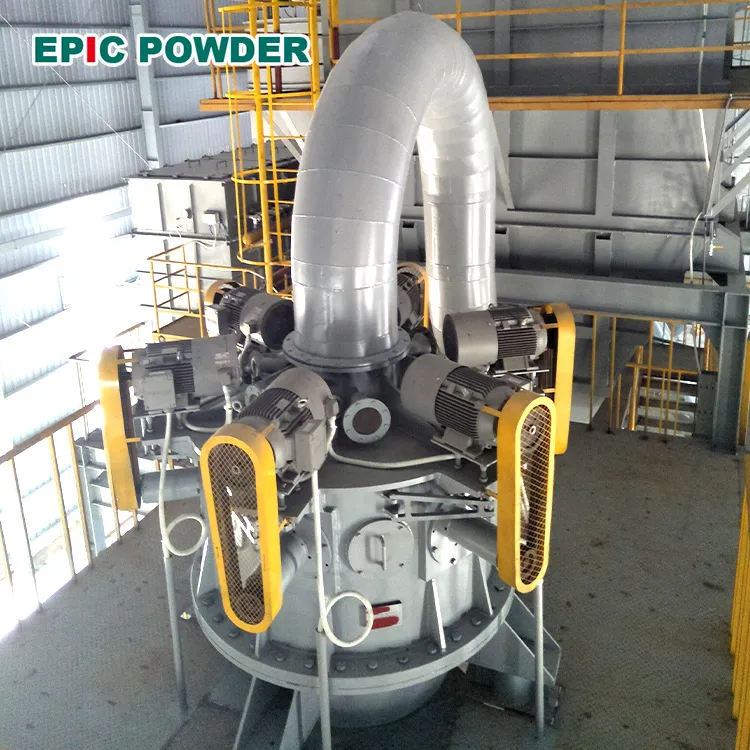
Why the Classifier Determines Your Grinding Energy Cost
The Circulating Load Problem
In a closed-circuit calcium carbonate grinding system, the classifier sits between the mill and the product collection system. It measures every particle that comes out of the mill and makes a binary decision: pass (fine enough, send to product) or reject (too coarse, send back to the mill for another pass).
The circulating load is the ratio of material returned to the mill versus the fresh feed entering the circuit. A circulating load of 200% means that for every tonne of product leaving the circuit, two tonnes of already-processed material is going back through the mill. Every tonne of circulating material consumes grinding energy without contributing to product output. Reducing circulating load — by improving how accurately the classifier makes its pass/reject decision — directly reduces specific energy consumption (kWh per tonne of product).
The Three Ways a Poor Classifier Wastes Energy
•Sending fine material back to the mill (misclassification of fines): when the classifier has poor separation sharpness, fine particles that meet the product specification are incorrectly rejected and returned to the mill. The mill then grinds already-fine particles even finer, consuming energy on material that was already specification-quality. This is the single most common source of avoidable energy waste in GCC grinding circuits.
•Allowing coarse particles through to product (misclassification of coarse): when the cut point drifts or the classifier is overloaded, oversized particles pass through to the product. This shows up as a PSD that is broader than the target, with elevated D97 and D99 values. The product may fail customer specification, requiring it to be reprocessed — doubling the energy cost on that material.
•Pressure drop and fan energy: a classifier with clogged internals, worn guide vanes, or an unbalanced rotor requires higher airflow to maintain the same classification performance. Higher airflow means a larger fan load — often 10-15% of total circuit energy — that is invisible unless you are tracking fan motor amps separately from the mill motor.
| Key Performance Indicators to Track in Your Classifier CircuitCirculating load ratio: target 150-250% for most GCC applications. Above 300% signals overgrinding or classifier underperformance Cut point accuracy (d75/d25 ratio): a sharpness index below 0.5 indicates poor separation — fine and coarse fractions are mixing significantly Specific energy consumption (kWh/t): track against product D50. Rising kWh/t for the same D50 target = efficiency loss in the classifier or mill Product PSD D97/D99: widening D97 indicates cut-point drift — the classifier is letting coarse particles through Fan motor amp draw: baseline this and trend it. Rising amps at constant airflow = increasing pressure drop from wear or fouling |
How to Diagnose Classifier Underperformance in Your Plant
Before adjusting anything, measure your current baseline. You need four data points: feed PSD going into the classifier, product PSD exiting to collection, reject PSD returning to the mill, and the mass flow rates of all three streams. With this data, you can calculate your actual classifier separation efficiency — and compare it to the design specification.
Step 1: Audit Your Current Circuit
Take representative samples from the classifier feed, product, and reject streams simultaneously (within the same 15-minute window). Analyse all three by laser diffraction. Plot the partial separation efficiency curve — the fraction of each particle size that reports to the product stream. In an ideal classifier, this curve is a step function: 100% of particles below the cut point report to product, 0% above. In practice, there is always a transition zone. The width of that transition zone is your sharpness of cut.
A wide transition zone means fine particles are being returned to the mill and coarse particles are passing to product. Both are happening simultaneously. This is the classifier operating inefficiently, and it has a direct energy cost.
Step 2: Check These Four Things First
•Rotor speed: is the speed at the correct design value for your target cut point? Classifier rotor speed is the primary control variable for cut point. Check actual RPM against design specification — belt slip or drive wear can cause speed to drop without triggering alarms.
•Airflow balance: measure static pressure at the classifier inlet and compare to commissioning values. Increased resistance (from worn guide vanes, fouled screens, or partially blocked ducts) reduces airflow and shifts the effective cut point coarser. This is a very common cause of product D97 drift.
•Guide vane condition: worn or corroded guide vanes change the swirl pattern inside the classifier, which broadens the separation curve. Inspect visually at each planned maintenance stop. Replace before wear exceeds 30% of original thickness.
•Rotor balance: an unbalanced rotor creates vibration that perturbs the airflow pattern in the classification zone. If you are seeing elevated vibration on the classifier bearing, poor separation sharpness, and no obvious cause from the above checks, rotor balance is the likely culprit.
Step 3: Optimise the Cut Point
Once you have confirmed that all mechanical components are in good condition, optimise the cut point for minimum circulating load at your target product fineness. The procedure:
•Establish the baseline: measure product PSD and circulating load at current operating parameters
•Increase rotor speed in 5% steps: measure the change in product D50, D97, and circulating load at each step
•Find the efficiency peak: the optimal speed is where circulating load is at its minimum for your target D50. Above this speed, you are grinding finer than needed and wasting energy. Below it, circulating load rises.
•Adjust airflow to match: once rotor speed is optimised, fine-tune airflow to achieve the best separation sharpness at the new speed. Higher airflow moves the cut coarser; lower airflow moves it finer.
Document the validated parameter set and set it as the control recipe. Classifier performance is highly reproducible once the recipe is established — but it drifts if operators make ad-hoc adjustments without a baseline to return to.
How Much Energy Can You Actually Save?
The savings depend on how far your current classifier is from optimal. In our experience working with GCC producers, plants that have never systematically audited their classifier typically show 15-25% higher specific energy consumption than their theoretical optimum. Plants that have done one optimisation but not maintained the gains typically show 8-15% above optimum.
| Optimisation Action | Typical Energy Saving | Implementation Cost |
| Rotor speed recalibration | 5-10% reduction in kWh/t | Low — parameter change only |
| Airflow rebalancing | 3-8% reduction in kWh/t | Low — damper adjustment or duct inspection |
| Guide vane replacement | 5-12% reduction in kWh/t | Medium — planned maintenance shutdown |
| Classifier rotor upgrade (higher sharpness) | 10-18% reduction in kWh/t | Medium — replacement part cost |
| Full classifier replacement (new generation) | 15-25% reduction in kWh/t | Higher — new equipment investment |
| Process control automation upgrade | 5-10% additional reduction | Medium — control system investment |
Energy savings are cumulative if multiple actions are taken. Actual savings depend on current baseline performance, material characteristics, and target fineness.
Two Plants That Cut Grinding Energy with Classifier Optimisation
CASE STUDY 1
Roller Mill Circuit Eliminates Overgrinding — 22% Energy ReductionThe situation
A calcium carbonate producer running a roller mill for the paper coating market was targeting D50 2 microns (approximately 1250 mesh). They were running at 128 kWh/t and experiencing significant product loss through overgrinding — approximately 15% of product mass was below D10 0.5 micron, which caused rheology problems in their customer’s coating slurry.
What we found
The classifier was operating with poor separation sharpness (d75/d25 sharpness index of 0.38) — well below the 0.55 achievable with the installed equipment. Investigation found that the rotor assembly had accumulated calcium carbonate scale on one side, creating an imbalance that was generating turbulence in the classification zone. The turbulence was pulling fine particles back into the reject stream and allowing coarse particles to slip through to product — simultaneously making the product both too fine (fines misclassified as rejects, ground further) and too coarse (coarse misclassified as product).
Actions taken
Rotor cleaning and rebalancing: scale removed and rotor rebalanced in situ
Feed rate reduction: temporary 12% reduction to reduce classifier loading while re-optimising
Airflow adjustment: fine-tuned to restore sharpness index to 0.57
Results
Specific energy: reduced from 128 kWh/t to 100 kWh/t — a 22% reduction
Fines below D10 0.5 micron: reduced from 15% to below 4% of product mass
Throughput: recovered to original level within 6 weeks as the circuit stabilised
Customer slurry rheology: complaints eliminated — coating viscosity back within specification
CASE STUDY 2
Ultra-Fine GCC Line: 600 Mesh to 2500 Mesh Without Increasing Power Budget
The situation
A calcium carbonate producer was commissioned to supply ultra-fine D97 5-micron GCC (approximately 2500 mesh) for a specialty coatings customer. Their existing line was configured for D97 25 microns (600 mesh). Moving to the finer specification without additional power infrastructure was the constraint — they could not increase the total connected load on their site.
The approach
EPIC Powder Machinery conducted a full circuit analysis and identified that their existing classifier was capable of achieving the tighter cut point required for 2500 mesh product, but the mill-classifier balance was wrong: the mill was undersized relative to the classification capacity, creating a low circulating load that meant the classifier was classifying at too coarse a setting. The solution was to increase classifier rotor speed (moving the cut point finer), reduce airflow volume (increasing residence time in the classification zone), and accept a 35% reduction in throughput relative to the 600 mesh production rate — which the customer’s volume requirement allowed.
Results
Product fineness achieved: D50 2.1 microns, D97 5.2 microns — meeting the 2500 mesh specification
Total power consumption: unchanged from the 600 mesh configuration — the same installed power produced a finer product at lower throughput
Specific energy at 2500 mesh: increased from 85 kWh/t (at 600 mesh) to 210 kWh/t (at 2500 mesh) — this is the thermodynamic cost of finer grinding, but it was achieved within the existing power budget
Capital investment required: zero — the result was achieved through parameter optimisation alone, with no new equipment
Maintenance Practices That Protect Classifier Efficiency
Classifier performance does not stay at its optimised level without active maintenance. The three components that degrade fastest and have the biggest impact on efficiency are:
Guide Vanes
Guide vanes direct the airflow into the correct swirl pattern inside the classifier. As they erode, the swirl angle changes, broadening the separation curve and reducing sharpness. Measure vane thickness at each planned maintenance stop. Set a replacement trigger at 25-30% thickness loss — do not wait for complete wear-through. For highly abrasive feed materials (calcite with silica content above 2%), specify hard-facing vane materials at the initial equipment purchase.
Classifier Rotor
The rotor is the highest-wear component in a dynamic classifier. Scale accumulation on rotor blades (common in humid environments or with wet feed) creates imbalance and turbulence. Check for scale buildup visually at every maintenance stop and clean if any imbalance is detectable. Full rotor inspection and balancing check should occur every 2,000-4,000 operating hours depending on feed abrasiveness.
Seals and Bearing Housing
Seal failures allow unclassified dust to bypass the classifier and report directly to product, widening the PSD and increasing D97. Check bearing housing seals for leakage at each shift and replace at any sign of dust egress. Bearing temperature monitoring (thermocouple or IR thermometer) provides early warning of lubrication failure before it becomes a bearing failure.
| Reduce Your Calcium Carbonate Grinding Energy Costs — Talk to EPIC Powder Machinery Whether you are running a GCC line for plastics and paper, a PCC plant for coatings, or an ultra-fine CaCO3 system for specialty applications, EPIC Powder Machinery can audit your classifier performance, identify your biggest efficiency losses, and recommend specific equipment or parameter changes.We offer free process audits and can run classifier performance trials on your feed material before you commit to any equipment change. Request a Free Process Audit: www.nonmetallic-ore.com/contact Explore Our Classifier Range for CaCO3: www.nonmetallic-ore.com |
Frequently Asked Questions
What is the most effective way to reduce energy costs in a calcium carbonate grinding line?
The highest-return action in most GCC grinding circuits is classifier optimisation, not mill upgrade. This is because the classifier controls circulating load. The ratio of material being returned to the mill versus the new feed entering the circuit. A poorly performing classifier raises circulating load above its optimal level. It means the mill is grinding already-specification material repeatedly, consuming energy on work that has already been done. In our experience with GCC plants, classifier-related inefficiency typically accounts for 15-25% of avoidable specific energy consumption. Optimising rotor speed, airflow balance, and guide vane condition — in that order — delivers the fastest and lowest-cost energy savings. A full classifier audit and parameter re-optimisation typically costs far less than a mill upgrade and delivers comparable energy savings.
How can I tell if my current classifier isn’t performing well?
Signs of underperformance include inconsistent particle sizes, higher power consumption than expected, or excessive overgrinding of calcium carbonate particles. You can analyze key performance metrics such as cut size, efficiency, and throughput. If these metrics aren’t aligning with your production goals or industry standards, it’s a clear indication your classifier may need an upgrade or adjustment. Regular inspection and monitoring can help catch these signs early.
Is it possible to retrofit my existing grinding mill with a more efficient classifier?
Yes, retrofitting is often a practical and cost-effective option. Many high-efficiency classifiers can be installed into existing systems, significantly boosting performance without a complete overhaul. Working with experts, like Epic Powder, can ensure the retrofit is tailored to your specific grinding line, helping you improve particle classification accuracy and lower the energy required for fine grinding.
What’s the typical payback period for upgrading a classifier?
In most cases, upgrading to a high-performance classifier can pay back within 6 to 12 months, thanks to energy savings and increased production efficiency. The exact payback depends on your current setup, energy costs, and the level of improvement achieved. It’s worth considering this investment, especially for large-scale calcium carbonate producers looking to reduce operational costs and improve product quality.
Epic Powder
Epic Powder, 20+ years of experience in the ultrafine powder industry. Actively promote the future development of ultra-fine powder, focusing on crushing, grinding, classifying and modification process of ultra-fine powder. Contact us for a free consultation and customized solutions! Our expert team is dedicated to providing high-quality products and services to maximize the value of your powder processing. Epic Powder—Your Trusted Powder Processing Expert!

“Thanks for reading. I hope my article helps. Please leave a comment down below. You may also contact EPIC Powder online customer representative Zelda for any further inquiries.”
— Emily Chen, Engineer