
A mineral processing company in Tanzania had high-quality marble deposits. They wanted to sell coated calcium carbonate powder to plastic, paint, and construction material manufacturer. But they had a problem. Their old coating equipment could not keep up. Output was too low. Coating quality was inconsistent. Many particles were left uncoated. So they needed a pin mill coating system that could:
- Produce 3 tonnes per hour of coated powder
- Reach a fineness of D97 ≤ 8μm (about 1600 mesh)
- Apply solid stearic acid as the coating agent
- Run continuously, 24 hours a day
They contacted EPIC Powder Machinery after multiple comparisons.
Why Coating Calcium Carbonate Matters
Raw calcium carbonate is hydrophilic. That means it attracts water. When you mix it into plastic or rubber, it does not blend well. It clumps together and creates weak spots in the final product.
Coating calcium carbonate with stearic acid changes this. It makes the surface hydrophobic (water-repelling). The coated powder blends easily with plastic like PP, PE, and PVC.
The result:
- Better dispersion in plastic
- Stronger final products
- Higher filler loading without losing quality
- Smoother surface finish on molded parts
This is why surface-modified calcium carbonate is in high demand — especially for plastics manufacturers.
The Customer’s Raw Material Specifications
| Parameter | Details |
|---|---|
| Raw material | Ground calcium carbonate (GCC) |
| Mohs hardness | Less than 3 |
| SiO₂ content | Less than 0.2% |
| Moisture | Less than 0.02% |
| Feed particle size | D97: 450 to 2000 mesh (3–32μm) |
| Target fineness | D97 ≤ 8μm |
| Coating agent | Solid stearic acid |
| Coating dosage | About 1.2% |
| Feed temperature | At least 60°C |
| Target output | 3.0 t/h (±10%) |
Why the Old Equipment Failed
Before working with EPIC Powder, the plant tried conventional high-speed mixers. These machines had three key problems:
1. Uneven coating. The mixers could not evenly coat ultra-fine particles. Some particles got too much stearic acid. Others got none at all.
2. Agglomeration. Fine particles clumped together. This made the final powder inconsistent and harder to use.
3. Low throughput. The mixers could only produce about 2 t/h — far below the 3 t/h target.
A completely different approach was needed.
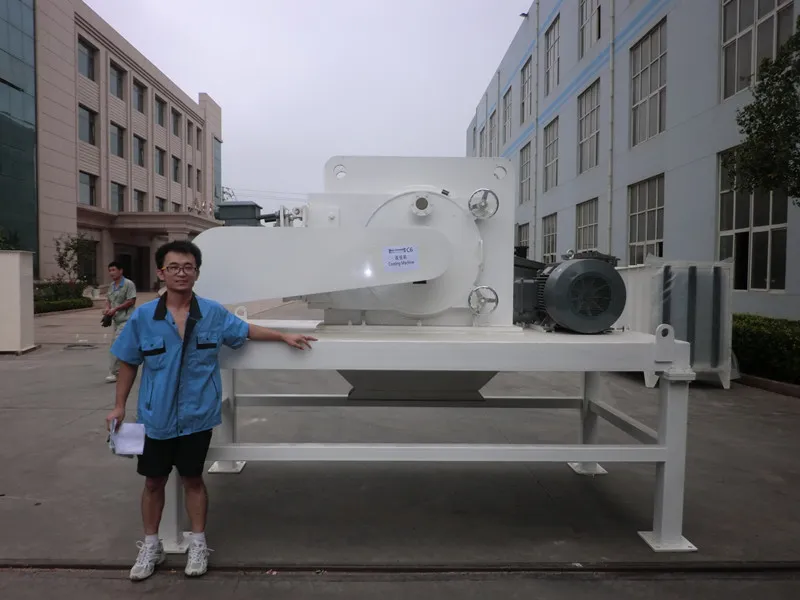
The EPIC Powder Solution: PM-C Series Pin Mill Coating System
After reviewing the customer’s material samples, EPIC Powder recommended the PM-C series pin mill coating system.
This machine was designed specifically for high-capacity, continuous surface modification of ultra-fine mineral powders.
How the Pin Mill Coating System Works
Here is the process in simple steps:
- Pre-heated calcium carbonate powder enters the center of the mill. The feed temperature is kept at 60°C or above.
- Solid stearic acid is melted in a separate heating tank. It is then pumped into the mill through a high-pressure atomizing system — turning it into a fine mist.
- Inside the mill, two pin discs spin in opposite directions (counter-rotating). The outermost pins reach a tip speed of up to 240 m/s.
- The centrifugal force spreads both the powder and the stearic acid mist evenly. Every particle gets coated individually.
- The intense impact, shear force, and heat inside the mill help the stearic acid stick to each particle surface. This is called mechano-chemical surface modification.
- The finished powder exits from the bottom and goes to the collection system.
Key Features of the PM-C Pin Mill Coating System
| Feature | Why It Matters |
|---|---|
| Dual counter-rotating pin discs (up to 240 m/s) | Creates the impact energy needed to reach D98 ≤ 8μm while dispersing stearic acid uniformly |
| High-shear atomizing injection system | Produces a fine mist of stearic acid droplets — no oversized droplets, no particle clumping |
| Wide chamber housing | Handles sticky, greasy, or moist materials without clogging |
| Adjustable disc speed | Lets operators fine-tune product fineness for different grades |
| No screen structure | Smooth discharge, high throughput, low heat buildup |
| Large hinged door | Easy to open, clean, and maintain between product runs |
| Permanently lubricated bearings | Sensors monitor temperature and vibration, triggering alerts before any failure |
| Optional air classifier | Can be added to precisely control final particle size |
| PLC control system | Real-time monitoring and adjustment of all process parameters |
Complete System Configuration Installed in Tanzania
EPIC Powder supplied and commissioned the full production line, which included:
- PM-C series pin mill coating machine
- Pre-heating screw conveyor (to maintain ≥60°C feed temperature)
- Stearic acid melting tank with temperature control
- High-pressure atomizing pump for stearic acid injection
- Loss-in-weight feeder for precise 1.2% dosing
- Cyclone separator and dust collector
- PLC-based control panel
Results: What the System Achieved After 72 Hours of Continuous Running
| Parameter | Target | Achieved |
|---|---|---|
| Product fineness | D95 ≤ 8μm | D97 = 7.8μm ✅ |
| Production capacity | 3.0 t/h ±10% | 3.3 t/h ✅ |
| Activation rate | ≥96% | 97.2% ✅ |
| Stearic acid dosing accuracy | 1.2% ±0.1% | 1.19%–1.22% ✅ |
Every target was met — or exceeded.
Benefits the Customer Gained
Better Products for Their Buyers
The coated calcium carbonate produced by this system is now used in:
- Plastic compounding — better dispersion, fewer agglomerates, stronger finished parts
- PVC pipes — the customer reported about 12% improvement in impact strength during in-house testing
- Masterbatch production — consistent particle size means predictable results for batch manufacturers
- Paints and coatings — improved hydrophobicity reduces moisture absorption in storage
Lower Operating Costs
- The pin mill uses less energy than conventional coating methods
- No screen means less blockage and faster discharge
- Permanently lubricated bearings mean fewer unplanned shutdowns
- The dust collection system keeps the plant clean and compliant with environmental rules
New Markets and Higher Revenue
Before this system, the plant could only sell uncoated or low-grade coated powder. Now they supply premium D98 ≤ 8μm coated calcium carbonate to high-value customers in plastics and construction. They have already begun planning a second production line.
What the Customer Said
“EPIC Powder’s pin mill coating system solved the coating uniformity and capacity problems that had limited our business for years. The system runs stably. The activation rate consistently exceeds 97%. Our plastic customers have noticed the difference in dispersion quality. We are already discussing a second line.”
— Production Manager, Tanzania Calcium Carbonate Processing Plant
Is the Pin Mill Coating System Right for You?
This system works well for producers who need to:
✅ Coat calcium carbonate, barite, talc, or other mineral powders with stearic acid or similar agents
✅ Achieve fine particle sizes (D97 ≤ 8μm or similar)
✅ Run high-capacity, continuous production (1 t/h to 6+ t/h)
✅ Sell to plastics, rubber, paint, or paper manufacturers
✅ Replace old high-speed mixers or batch coating equipment
If any of these match your situation, the PM-C pin mill coating system is worth a serious look.
Frequently Asked Questions
What is a pin mill coating system? A pin mill coating system is a machine that grinds mineral powder to an ultra-fine size and applies a surface coating agent (such as stearic acid) at the same time. The two counter-rotating pin discs create high-speed impact that both reduces particle size and disperses the coating evenly.
What is stearic acid coating for calcium carbonate? Stearic acid is a fatty acid applied to calcium carbonate surfaces to make them hydrophobic (water-repelling). This improves compatibility with plastics, rubber, and other polymers. The result is better dispersion, stronger products, and higher filler loading.
What does activation rate mean? Activation rate measures how completely each powder particle has been coated. A rate of 97.2% means 97.2% of particles were fully coated with stearic acid. Higher is better — rates below 96% typically lead to poor dispersion in plastics.
What output capacity is available? The PM-C series can be configured for output from 1 t/h up to 15+ t/h, depending on target fineness, coating agent type, and raw material properties.
Can the system handle other minerals? Yes. The pin mill coating system can process talc, barite, kaolin, and other non-metallic minerals with Mohs hardness below 3.
Contact EPIC Powder Machinery
EPIC Powder Machinery has over 20 years of experience in ultra-fine grinding, classifying, and powder coating systems. We supply equipment to clients in more than 160 countries.
If you want to know whether the pin mill coating system is right for your plant, our engineers can review your material samples and recommend a solution.
Website: www.nonmetallic-ore.com
Email: [email protected]
Phone / WhatsApp: 0086-15762272120 (8:00am – 5:00pm)
Factory: No. 369, Road S209, Huanxiu, Qingdao City, China
Our experts will contact you within 6 hours of your inquiry.
Related pages you may find useful:

“Thanks for reading. I hope my article helps. Please leave a comment down below. You may also contact EPIC Powder online customer representative Zelda for any further inquiries.”
— Jason Wang, Engineer