
Unmodified calcium carbonate has a hydrophilic surface. Plastics, rubber, and cable compounds are hydrophobic. Put an unmodified CaCO3 filler into a polymer matrix and the two materials resist each other: poor dispersion, reduced tensile strength, weak interfacial adhesion between filler and matrix. The compound performs worse than unfilled polymer in several critical properties.
Surface modification with a fatty acid converts the calcium carbonate surface from hydrophilic to hydrophobic. Stearic acid is the most common one. A monolayer of stearic acid molecules bonds to the surface, presenting a hydrocarbon tail that is chemically compatible with the polymer matrix. The result is better dispersion, higher achievable filler loading. It improves tensile and impact properties, and lower compound viscosity at equivalent loading.
The pin mill is the production technology that performs this coating efficiently at continuous scale. It generates the temperature and mechanical energy needed to melt, disperse, and bond the modifier to the mineral surface in a single pass. Without an external heat source, batch processing, and the coating quality problems that high-speed mixers produce when modifier distribution is uneven. This article explains exactly how it works, what the key process parameters control, and how to verify that the modification has been done correctly.
Why the Calcium Carbonate Surface Needs to Change
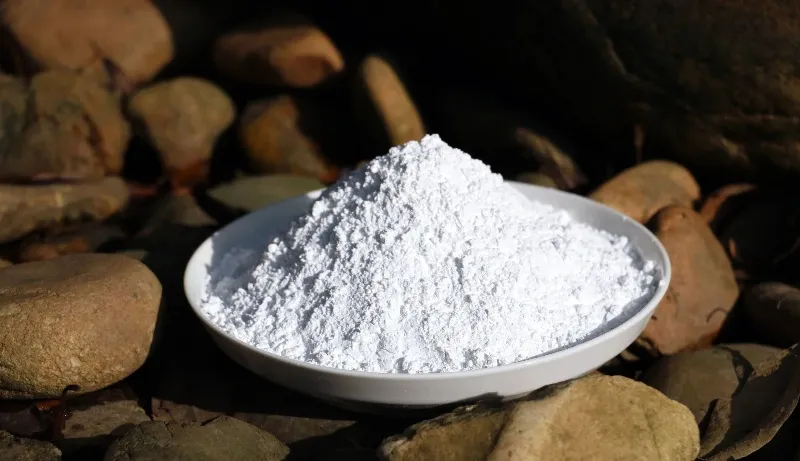
Calcite (the mineral form of calcium carbonate) has a surface covered with calcium and carbonate ions that form hydrogen bonds with water molecules readily. This is what makes unmodified CaCO3 hydrophilic: it prefers water to oil, and it prefers water to polymer chains. In a plastics compound, this preference shows up as poor wettability by the polymer melt. It means the filler surface is not fully enveloped by the matrix, creating weak interfaces.
At low filler loading — below about 15% by weight — the problem is manageable. The polymer has enough continuous phase to partially bridge the poor interfaces. Above 20-30% loading, which is where the economics of CaCO3 as a filler start to become meaningful, the weak interfaces compound and the mechanical properties of the compound fall noticeably below what the loading level would predict. Tensile strength drops. Impact resistance drops. The filler is present but not contributing.
Surface modification with stearic acid (or other fatty acids) works by a reaction between the carboxyl group (–COOH) of the acid and the calcium ions at the CaCO3 surface. The calcium displaces the hydrogen. Calcium stearate forms at the surface, with the long hydrocarbon tail of the stearate pointing outward. That hydrocarbon tail is compatible with polyolefin and PVC polymer chains. They interact through van der Waals forces in the same way that polymer chains interact with each other. The filler surface now behaves like part of the polymer matrix, not like a foreign object in it.
What a Pin Mill Modifier Is and How It Works
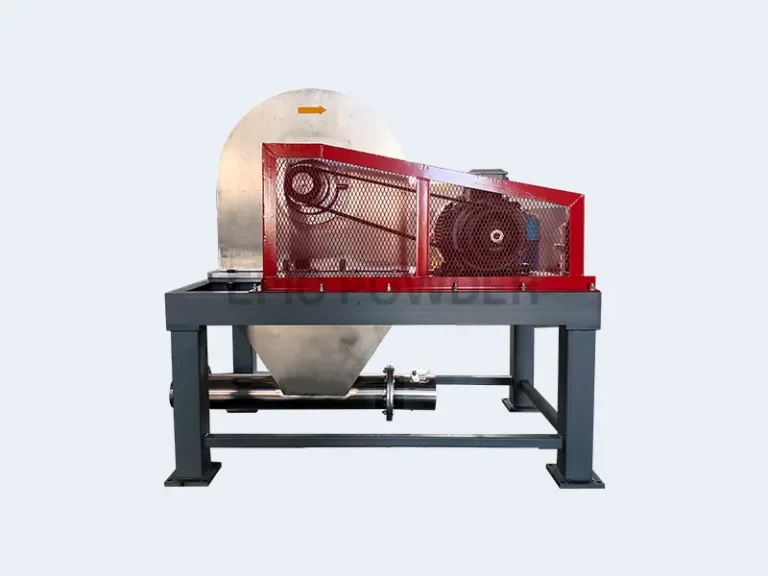
A pin mill modifier consists of two discs mounted on a horizontal shaft, each fitted with rows of pins arranged in concentric rings. The discs rotate in opposite directions — counter-rotation — at speeds that produce a relative linear velocity at the outer pin ring of 200-250 m/s. Feed material and modifier enter at the centre and are thrown outward through successive rings of pins before exiting at the periphery.
Three things happen simultaneously in those milliseconds of transit through the pin field.
Dispersion
The first pin ring encounters the feed as a mixture of calcium carbonate particles and solid stearic acid granules or powder. The impact forces at 200+ m/s shatter any agglomerates instantly. By the second or third pin ring, the material is fully individualised. Every CaCO3 particle is exposed and separate, surrounded by dispersed modifier particles. No high-speed mixer or paddle blender achieves this degree of dispersion in continuous operation.
Frictional Heating
The kinetic energy of the pin impacts converts to heat. In a well-configured pin mill running calcium carbonate at typical production throughput, the material temperature rises from ambient to 120-130°C in under one second of residence time. Stearic acid melts at 69.6°C; palmitic acid at 63°C. The mixed fatty acids commonly used in industrial modifiers melt between 55-75°C. By the time the material reaches the middle pin rings, the modifier has melted and is in the liquid phase — available to wet the mineral surface.
This is the key advantage over high-speed mixers that use external heating jackets. A jacket heats the material from the outside wall inward. The material near the wall is hotter than the material in the centre. In a batch mixer processing several hundred kilograms, the temperature gradient across the batch during heating can be 20-30°C. This means some material is being coated at the correct temperature while other material is below the modifier melting point. In a pin mill, every particle passes through the same high-energy pin field and experiences the same frictional heating. Temperature uniformity across the product is far better.
Mechanochemical Bonding
With the modifier in liquid phase and fully dispersed around the individualised CaCO3 particles, the mechanical energy of the remaining pin impacts drives the calcium stearate reaction. The reaction between the carboxyl group and the surface calcium ion is thermodynamically favourable at 120°C. However, the mechanical activation from pin impact accelerates the kinetics. This is the mechanochemical aspect. The result is a covalent or ionic bond between modifier molecule and particle surface, not merely physical adsorption.
Physical adsorption is reversible: the modifier layer can be displaced by water or by mechanical shear in processing. A chemically bonded coating is far more durable. It survives compounding, extrusion, and the thermal cycling that a finished product undergoes in service. The difference shows up in long-term hydrophobicity retention and in the consistency of mechanical properties in the compounded material.
Key Process Parameters and What They Control
Modifier Loading Rate
Stearic acid is typically added at 0.5-1.2% by weight of the calcium carbonate feed. The optimum loading for a specific CaCO3 depends on the particle surface area: finer particles have higher surface area per unit mass and require more modifier for monolayer coverage.
The concept of monolayer coverage is important. One molecule of stearic acid occupies approximately 0.20-0.22 nm² of surface area when adsorbed flat-on, or approximately 0.05 nm² when standing perpendicular (the chemically bonded orientation on CaCO3). A complete monolayer — the target — provides the maximum hydrophobic effect per unit of modifier cost. Under-coating leaves bare hydrophilic patches on the surface; over-coating produces excess free modifier that acts as a lubricant in the compound and can cause processing problems (die drool, surface bloom).
| Estimating the Target Modifier Loading for Your Feed D50 2-3 um CaCO3 (BET ~3-4 m2/g): Typical stearic acid loading: 0.9-1.2% by weight D50 5-8 um CaCO3 (BET ~1.5-2 m2/g): Typical stearic acid loading: 0.6-0.9% by weight D50 10-15 um CaCO3 (BET ~0.8-1.2 m2/g): Typical stearic acid loading: 0.4-0.7% by weight How to calculate precisely: Theoretical loading (g/100g) = BET surface area (m²/g) × 0.004. Verify against activation rate test. |
Pin Speed and Residence Time
Rotor speed controls both the frictional heat input and the mechanical activation energy. Higher speed means higher temperature rise and more intense mechanochemical activation — but also shorter residence time per particle pass (because the material is expelled faster). Most pin mill modifiers are designed with a fixed optimal speed range for calcium carbonate with stearic acid: typically equivalent to a peripheral velocity of 150-200 m/s at the outer pin ring. Running below this range reduces coating efficiency; running above it can overheat the modifier, causing thermal degradation of the stearate coating.
Feed Temperature and Material Dryness
Moisture on the CaCO3 surface competes with the stearate coating reaction. Water molecules bond to the surface calcium ions and must be displaced before the stearate can react. A feed material with moisture content above 0.3-0.5% will consistently produce lower activation rates than dry material processed under identical conditions. Many producers dry the CaCO3 feed to below 0.2% moisture before modification, particularly for the finest grades where surface area per unit mass is highest and moisture competition is most significant.
Some pin mills include a mild pre-heating section before the modification zone for this reason — not to melt the modifier, but to drive residual moisture from the feed particle surfaces before they enter the pin field.
How to Verify That Modification Has Worked
Three tests together give a complete picture of modification quality. Running only one of them gives an incomplete view.
Activation Rate
The activation rate measures the fraction of the modified CaCO3 surface that is hydrophobic. The test: add a measured sample of modified powder to water, stir gently, and measure the fraction that floats (hydrophobic, well-modified) versus the fraction that sinks (hydrophilic, unmodified or under-modified). A well-modified product for plastics applications should show an activation rate above 98%. Below 95% indicates significant under-coating, which will show up as poor dispersion and reduced mechanical properties in the compounded product.
Oil Absorption
Oil absorption (measured by the linseed oil method per ISO 787-5) decreases as surface modification improves. Unmodified CaCO3 typically shows oil absorption of 25-45 g/100g depending on particle size. Well-modified product shows 15-30 g/100g — a 30-40% reduction. The reduction is significant because oil absorption in this test correlates with plasticiser and binder demand in real compound formulations. Lower oil absorption means lower compounding cost and better processability at high filler loading.
Contact Angle
A water droplet placed on a compacted disc of unmodified CaCO3 spreads immediately — contact angle near 0°. On well-modified CaCO3, the droplet beads: contact angle 100-120° for stearic acid coating, higher for some silane-treated products. Contact angle measurement (goniometer) is the most direct confirmation of surface hydrophobicity, but it requires pressing a uniform disc and is more commonly used for QC sampling than for continuous production monitoring.
| Test | Unmodified CaCO3 | Well-Modified CaCO3 (Stearic Acid) |
| Activation rate | 0% | ≥98% |
| Oil absorption (g/100g) | 25-45 | 15-30 |
| Water contact angle | <10° (spreads immediately) | 100-120° (beads) |
| Sedimentation in water | Sinks rapidly | Floats (>98% floats for good modification) |
| Compound viscosity (relative) | Baseline | 10-30% lower at same loading |
Pin Mill vs. High-Speed Mixer: Which Is Right for Your Operation?
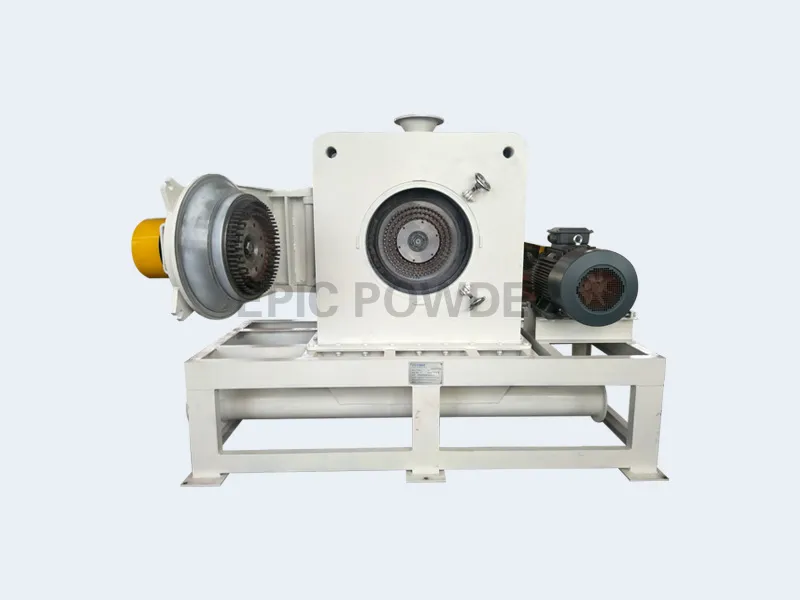
Both technologies are used commercially for CaCO3 surface modification. The choice depends on production volume, modifier type, and the coating quality requirements of the end application.
| Factor | Pin Mill Modifier | High-Speed Mixer (Batch) |
| Production mode | Continuous | Batch (typically 200-500 kg per cycle) |
| Heating method | Frictional (no external source needed) | External jacket + mechanical friction |
| Temperature uniformity | Excellent — every particle passes the same pin field | Variable — gradient between wall and centre |
| Modifier suitable for | Solid modifiers (stearic acid, other fatty acids, solid silanes) | Solid and liquid modifiers |
| Residence time | <1 second | 10-30 minutes per batch |
| Energy per tonne | Lower (no heating energy wasted between batches) | Higher (batch start-up energy repeated each cycle) |
| Coating quality | Very uniform — continuous dispersion prevents agglomerate reformation | Can be non-uniform if hot spots form near the jacket |
| Best for | Production volumes above ~1 t/h, solid modifiers, consistent grade | Flexible small-batch production, liquid modifiers, R&D |
Beyond Calcium Carbonate: Other Minerals the Pin Mill Modifies
The pin mill’s modification mechanism — frictional heating, mechanochemical activation, continuous dispersion — applies to any mineral filler where surface hydrophobicity is the target. The same equipment, with adjusted feed rates and sometimes adjusted pin geometry, processes:
- Kaolin: for rubber and polymer applications requiring improved dispersion and reduced water sensitivity. Aluminate coupling agents and silane treatments both work well in pin mill conditions.
- Talc: for polypropylene compounds, where surface modification improves the filler-matrix interface and allows higher loading without viscosity penalties.
- Magnesium hydroxide: for flame-retardant cable compounds, where surface modification with silane or fatty acid is needed to maintain mechanical properties at the high Mg(OH)2 loading (60%+) required for effective flame retardancy.
- Barium sulfate: for engineering plastics and speciality coatings, where stearate coating improves dispersion in hydrophobic resin systems.
The modifier loading calculation and the verification tests (activation rate, oil absorption, contact angle) apply to all of these materials with adjustments for their specific surface chemistry. Kaolin, for example, has an alumino-silicate surface that reacts differently with stearic acid than calcite does — silane coupling agents are often more effective for kaolin because they can form stronger bonds with the surface Al–OH groups.
| Optimising Calcium Carbonate Surface Modification for Your Application? EPIC Powder Machinery’s application engineers have configured pin mill modification systems for calcium carbonate, kaolin, talc, magnesium hydroxide, and barium sulfate across a range of modifier types and end applications. Tell us your feed fineness, target activation rate, modifier type, and production volume — we will recommend the right configuration and run a trial before you commit.We offer pilot-scale modification trials at our R&D facility. You supply the feed material and modifier; we return modified product with full characterisation data including activation rate, oil absorption, and contact angle. Request a Modification Trial: www.quartz-grinding.com/contact Explore EPIC Powder Pin Mill Modifier Range: www.quartz-grinding.com |
Frequently Asked Questions
What is the difference between a pin mill modifier and a high-speed mixer for calcium carbonate surface modification?
The fundamental difference is continuity and heating mechanism. A high-speed mixer is a batch machine: it loads a fixed quantity of calcium carbonate and modifier, heats the batch via an external jacket while the high-speed rotor provides additional frictional heating, and discharges after 15-30 minutes. During the heating phase, material near the heated jacket wall is hotter than material in the centre — temperature gradients of 20-30°C across a large batch are common. This non-uniformity means some material is coated at optimal temperature while other material is below the modifier melting point. A pin mill is continuous: the feed enters at the centre, passes through successive rings of counter-rotating pins in under one second, and exits fully modified. Every particle experiences the same pin field and the same frictional heating. Temperature uniformity is far better. For production volumes above about 1 tonne per hour with solid modifiers, the pin mill consistently produces higher activation rates at lower energy cost per tonne.
How do I calculate the correct stearic acid dosage for my specific calcium carbonate?
The theoretical calculation starts from the BET specific surface area of your feed material. Measure BET surface area (nitrogen adsorption method, ISO 9277) and multiply by approximately 0.004 to get the target stearic acid loading in grams per 100 grams of CaCO3. As a practical example: a D50 5 μm CaCO3 with BET 2.0 m²/g has a calculated target of 2.0 × 0.004 = 0.08 g/g = 0.8% by weight. This is a starting point — verify by running trials at 0.6%, 0.8%, and 1.0% loading and measuring activation rate at each point. The optimal loading is typically the point where activation rate plateaus (adding more modifier does not improve the rate) — excess modifier above this point contributes free acid to the product, which causes problems in compounding. For most commercial GCC used in plastics, the optimum stearic acid loading falls between 0.5% and 1.2% by weight.
What activation rate should I target for calcium carbonate used in polyethylene film?
For blown polyethylene film — the most demanding CaCO3 application from a surface quality perspective — the activation rate target is 99% or above. In blown film, even a small fraction of unmodified (hydrophilic) CaCO3 surface creates weak points in the film matrix that can become pinhole defects or tear initiation sites during stretching. The activation rate test (water flotation method) should show less than 1% of the product sinking after gentle agitation. For blown film, you should also verify oil absorption (target below 25 g/100g for a D50 5-8 μm product) and check for free acid — free stearic acid in the product above about 0.1% can cause surface haze and die drool in film extrusion. For less demanding applications such as PVC pipe or cable filling compound, an activation rate of 95-98% is generally acceptable, with oil absorption below 30 g/100g.
Epic Powder
Epic Powder, 20+ years of experience in the ultrafine powder industry. Actively promote the future development of ultra-fine powder, focusing on crushing, grinding, classifying and modification process of ultra-fine powder. Contact us for a free consultation and customized solutions! Our expert team is dedicated to providing high-quality products and services to maximize the value of your powder processing. Epic Powder—Your Trusted Powder Processing Expert!

“Thanks for reading. I hope my article helps. Please leave a comment down below. You may also contact EPIC Powder online customer representative Zelda for any further inquiries.”
— Emily Chen, Engineer