
Many GCC producers struggle with the same problem: their existing equipment can no longer meet customer demands for finer particle sizes, yet upgrading to a full system seems costly and complex. If this sounds familiar, understanding the difference between CTC and MBS classifiers is your first step toward a solution.
Ground calcium carbonate is one of the most versatile industrial minerals, serving industries from plastics and PVC pipes to paints, coatings, paper, and sealants. But not all GCC is created equal – and neither are the processing lines that produce it. A common question among GCC producers is why some plants use a single machine to classify their product while others require a full system with cyclones, dust collectors, and fans. The answer lies in understanding two classification technologies – the CTC centrifugal classifier and the MBS powder separator. The right choice depends entirely on your target particle size and the market you intend to serve.
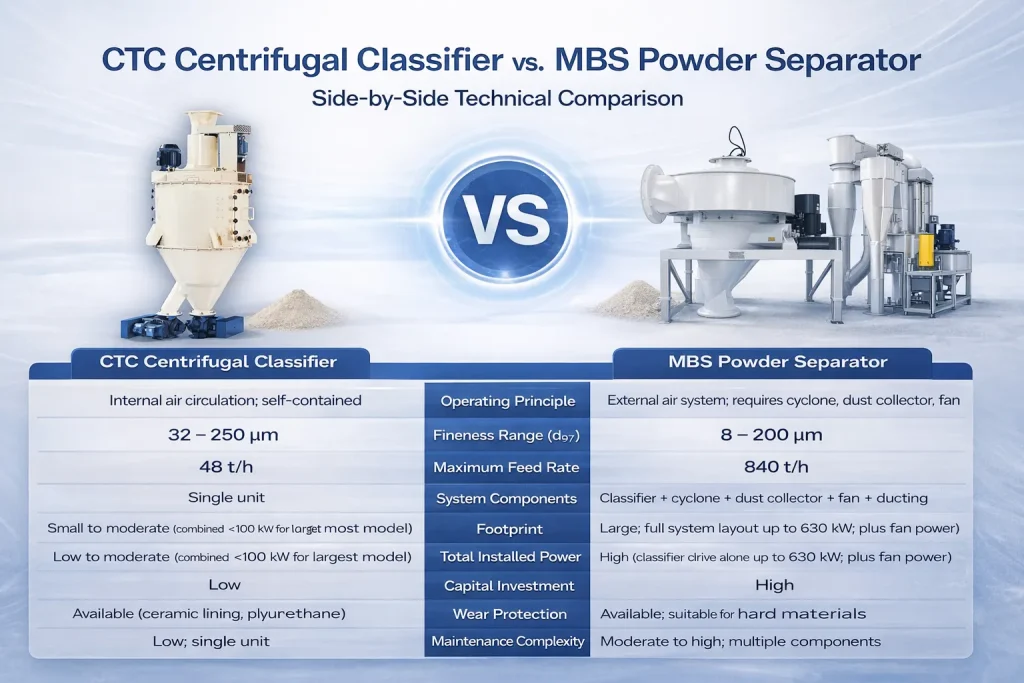
GCC Particle Size Requirements Across Applications
Different downstream applications demand different GCC particle size distributions. Understanding these requirements is the first step in equipment selection. The following table outlines typical fineness specifications by industry:
| Application | Typical Fineness (d97) | Recommended Classifier |
|---|---|---|
| PVC pipes, plastic masterbatch | 38 – 75 μm (200–400 mesh) | CTC |
| Artificial stone, fillers | 45 – 250 μm | CTC |
| Paints and coatings | 10 – 23 μm (600–1250 mesh) | MBS |
| Paper filling and coating | 8 – 10 μm | MBS |
| High-end sealants and adhesives | 8 – 15 μm | MBS |
The same material – GCC – spans a fineness range from coarse (200 mesh) to ultra-fine (2500 mesh). The equipment required for each end of this spectrum is fundamentally different, which is why understanding your target market is essential before selecting classification equipment.
CTC Centrifugal Classifier for Coarse GCC
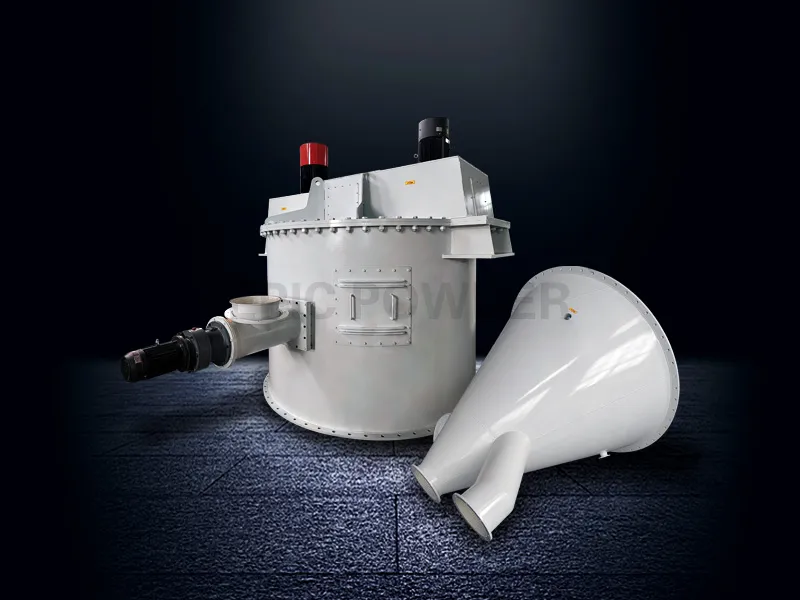
For GCC producers targeting the coarser end of the market – typically 200 mesh (75 microns) to 500 mesh (25 microns) – the CTC centrifugal classifier offers a compelling value proposition. Its internal air circulation design eliminates the need for cyclone collectors, bag filters, and induced draft fans. Raw material enters from the top, and finished product discharges from the bottom. That simplicity translates directly to lower capital investment, reduced operating costs, and a compact footprint that fits easily into plant expansions or retrofit projects.
The CTC is particularly well-suited for applications such as PVC pipe filler (200–325 mesh), plastic masterbatch (325 mesh), and artificial stone aggregate (45–250 microns). A GCC processing plant in Vietnam, for example, uses a CTC-6 classifier to produce 325-mesh product for the local PVC pipe industry, achieving 15 tons per hour of d97 45 micron material with minimal operator intervention and reliable performance. When processing GCC, the CTC can be equipped with wear-resistant linings to extend service life, and for applications sensitive to iron contamination, alumina ceramic or polyurethane linings are available. For detailed specifications of the CTC series, visit our [link to CTC product page].
MBS Powder Separator for Ultra-Fine GCC
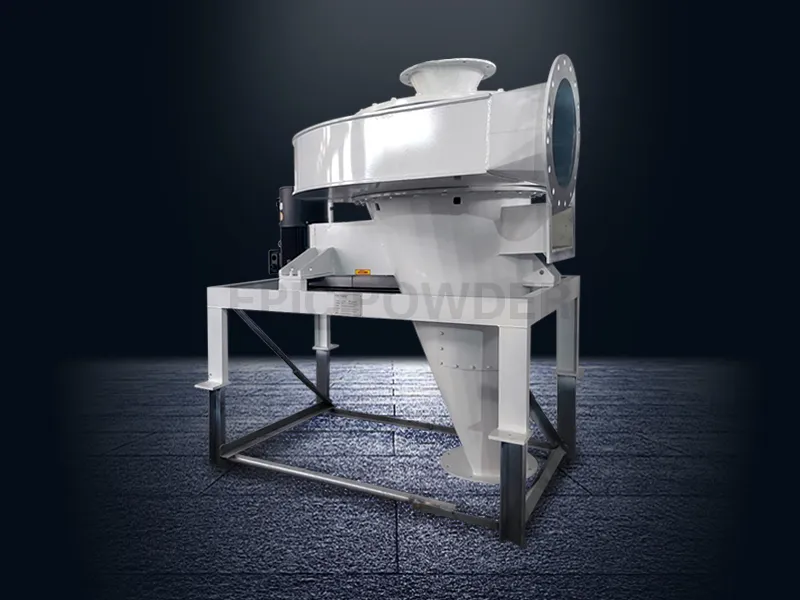
For GCC producers targeting high-value markets such as paints, coatings, paper, and sealants, ultra-fine particle sizes – typically d97 between 8 and 23 microns – are required. For these applications, the MBS powder separator has become the industry standard. The MBS achieves sharp cut points with minimal oversize particles, which is critical for applications like paper coating where particle size consistency directly affects brightness and opacity.
When paired with a ball mill, the MBS forms a closed-circuit grinding system where coarse material returns to the mill for further grinding while fine product is collected efficiently – a configuration that optimizes energy consumption and product consistency. A GCC producer in China upgraded to an MBS-12 separator integrated with a ball mill to produce d97 10 micron ultra-fine GCC for the paint industry, achieving 150,000 tons per year with consistent quality and lower energy consumption per ton compared to their previous setup. The MBS system can also be equipped with wear protection and ceramic linings to maintain product purity and extend equipment life. See the full MBS series technical parameters [link to MBS product page].
Technical Parameters at a Glance
For engineers and technical buyers, a direct comparison of key specifications helps in initial screening. The table below contrasts typical mid-range models (CTC-6 vs. MBS-10):
| Parameter | CTC-6 (Centrifugal Classifier) | MBS-10 (Powder Separator) |
|---|---|---|
| Classifier drive power | 30 kW (internal fan) + 11 kW (classifier wheel) | 160 kW (main drive) |
| Air flow rate | Internal circulation (no external fan) | 150,000 m³/h (external fan required) |
| Maximum feed rate | 30 t/h | 210 t/h |
| Fineness range (d97) | 40 – 200 μm | 8 – 28 μm |
| Auxiliary equipment needed | None | Cyclone, dust collector, induced draft fan, ducting |
| Typical footprint | ~20 m² | ~120 m² (complete system) |
Note that larger CTC models (up to CTC-8) can reach 48 t/h, and larger MBS models (up to MBS-18) can reach 840 t/h. For a full parameter list, refer to our [link to technical data sheets].
Cost-Benefit Analysis: Investment vs. Product Value
The choice between CTC and MBS is ultimately a business decision that balances capital investment against product margin. The following table summarizes the key economic considerations:
| Factor | CTC for Coarse GCC | MBS for Ultra-Fine GCC |
|---|---|---|
| Equipment investment | Low to moderate | High |
| Auxiliary equipment | None | Cyclone, dust collector, fan, ducting |
| Installation complexity | Simple | Complex; requires system engineering |
| Energy consumption | Low | Moderate to high |
| Product selling price | Baseline (commodity) | Premium (2–3x coarse GCC) |
| Target industries | Plastics, construction, artificial stone | Paints, coatings, paper, sealants |
| ROI timeline | Shorter (lower investment, steady margin) | Longer (higher investment, higher margin) |
In terms of actual pricing, a typical 325-mesh GCC (d97 45 microns) sells for $80 to $100 per ton, with production costs of $50 to $60 per ton and margins of $30 to $40 per ton. Ultra-fine GCC (d97 10 microns) commands $180 to $250 per ton, with production costs of $100 to $130 per ton and margins of $80 to $120 per ton. While the ultra-fine line requires more capital upfront, the margin per ton is significantly greater, making MBS systems attractive for producers targeting premium markets. Learn more about [link to ball mill closed-circuit systems].
How to Select the Right Model for Your GCC Line
To select the appropriate classifier for your GCC operation, you’ll need to define five key parameters. First is target fineness: if you need 32 to 250 microns, the CTC is suitable; if you need 8 to 32 microns, the MBS is the right choice. Second is hourly capacity: for production under 50 tons per hour, the CTC may suffice for coarse products, while the MBS offers larger models up to 840 tons per hour for higher throughput. Third is integration with existing equipment: the CTC works well as a standalone operation, while the MBS is the standard for ball mill closed-circuit systems.
Fourth is feed material characteristics. Both classifiers can accommodate hard materials with appropriate wear protection, but you should evaluate your feed particle size distribution, moisture content (ideally below 1 percent for both systems), and abrasiveness. Fifth is iron contamination sensitivity: both units can be lined with alumina ceramic or polyurethane to minimize iron contact, though the CTC may offer fewer contact points due to its simpler system.
Before making a final decision, EPIC Powder Machinery recommends testing your GCC material with both classifier types. A small-scale trial reveals achievable fineness range, throughput capacity, wear characteristics, and power consumption – allowing you to validate your selection before committing to equipment.
Frequently Asked Questions (FAQ)
Q1: Can I use a CTC classifier to produce ultra-fine GCC below 20 microns?
No. The CTC centrifugal classifier is designed for a fineness range of d97 32 to 250 microns. Attempting to push it below 32 microns will result in poor classification efficiency, increased oversize particles, and potential material buildup. For ultra-fine GCC below 20 microns, an MBS powder separator with a complete air system (cyclone, dust collector, fan) is required to achieve sharp cut points and consistent product quality.
Q2: How much floor space do I need for each system?
A standalone CTC classifier requires approximately 15–30 square meters depending on the model, since no auxiliary equipment is needed. The MBS system, by contrast, requires significantly more space – typically 80–200 square meters – to accommodate the classifier, cyclone collector, bag filter or dust collector, induced draft fan, and interconnecting ductwork. For plants with space constraints, the CTC offers a clear advantage, but this must be weighed against the finer product capabilities of the MBS.
Q3: Can the classifier handle GCC with moisture above 1%?
Both CTC and MBS are designed for dry classification. Moisture above 1.5% can cause material adhesion on the classifying wheel and guide vanes, reducing efficiency and potentially blocking the system. If your feed GCC has moisture exceeding 1.5%, pre-drying (e.g., using a rotary dryer or fluid bed dryer) is strongly recommended before classification. For slightly damp material (1–1.5%), you may still operate but should monitor for buildup and clean the system more frequently.
Q4: How long does it take to get a CTC or MBS classifier delivered?
Typical production period for EPIC Powder Machinery classifiers is 1–2 months, as each unit is non-standard and customized to your material and capacity requirements. After production, sea freight delivery adds another 20–40 days depending on your destination port. EPIC provides on-site installation guidance and can also arrange online technical support during commissioning. For urgent projects, expedited production may be available – contact our sales team for current lead times.
Ready to Choose the Right Classifier for Your GCC Plant?
Selecting the correct classification equipment can significantly impact your product quality, operating costs, and market competitiveness. EPIC Powder Machinery offers three ways to help you move forward:
- 📄 Download our free guide: How to Conduct a Material Classification Test – a step-by-step protocol to evaluate classifier performance with your own GCC sample.
- 📞 Request a quote: Provide your target fineness (d97) and hourly capacity, and we will recommend the most suitable air classifier model with a preliminary investment estimate.
- 🔬 Submit a sample for a free classification trial: Send us 5–10 kg of your GCC feed material, and our lab will run a classification test and provide you with a particle size analysis report at no charge.
Align Equipment with Your Target Market
Your choice between CTC and MBS classifiers should ultimately reflect your business strategy. If your target markets are plastics, PVC pipes, and construction fillers, and you require 200 to 500 mesh GCC with low investment and fast ROI, the CTC centrifugal classifier offers a simple, reliable, low-maintenance solution. If your target markets are paints, coatings, paper, and sealants, and you require ultra-fine GCC with premium pricing, the MBS powder separator integrated with a ball mill closed-circuit system is the proven industry standard.
EPIC Powder
EPIC Powder Machinery has supplied classification equipment to GCC producers worldwide. Our team has more than 20 years experience in various powders processing. Epic Powder is specialized in fine powder processing technology for mineral industry, chemical industry, food industry, pharama industry, etc. We can assist with material testing, system design, and equipment selection based on your specific production goals.
Contact us today for a free consultation and customized equipment proposal.

“Thanks for reading. I hope my article helps. Please leave a comment down below. You may also contact EPIC Powder online customer representative Zelda for any further inquiries.”
— Emily Chen, Senior Engineer