
Most GCC producers focus their attention on the mill — the ball mill motor rating, the grinding media, the liner material. The classifier gets less attention. However it is the classifier that actually defines the particle size distribution of the product. The mill produces a broad range of particle sizes. The classifier is what decides which particles are on-spec product and which go back for regrinding. Get the classifier wrong and no amount of mill optimisation will fix the product.
The difference between economy-grade GCC (D97 above 50 microns, broad distribution) and premium coating-grade GCC (D97 below 15 microns, narrow span) is not primarily a difference in grinding intensity. It is a difference in classifier precision. A classifier with poor separation sharpness. A gradual transition between fine and coarse fractions rather than a sharp cut. It produces a broad distribution regardless of how long you grind. A classifier with a sharp, well-controlled cut point produces the tight distribution that premium coatings, plastics, and paper markets require.
This article explains how air classifier design determines GCC product quality, what the critical performance parameters are, and what real GCC production lines achieve when the classifier is correctly specified and configured.
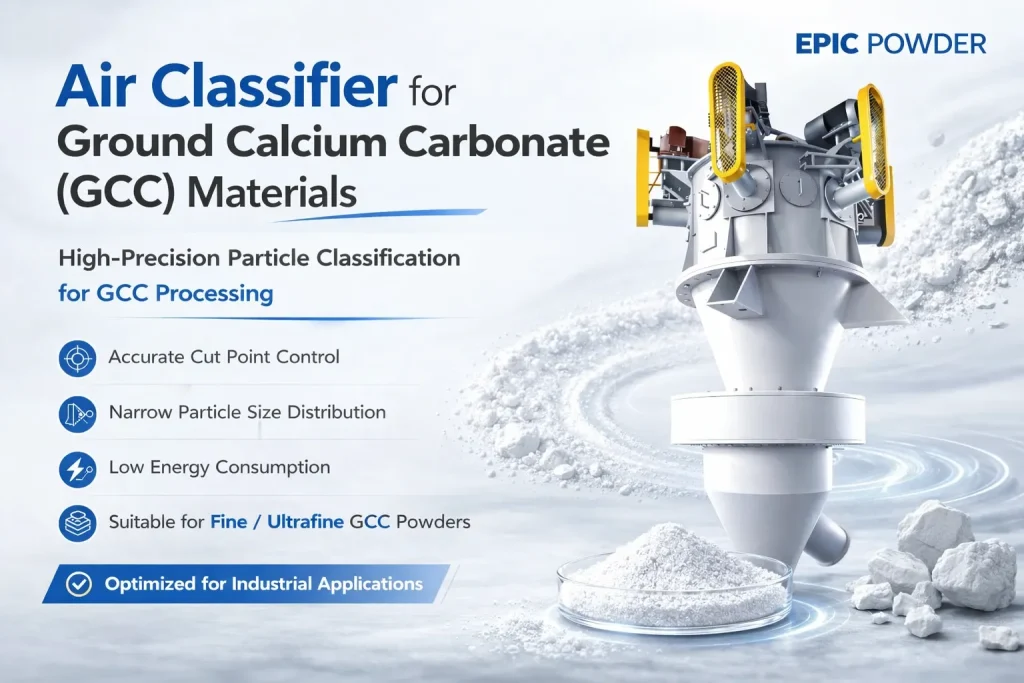
How a Dynamic Air Classifier Works — and What ‘Precision’ Actually Means
An air classifier separates particles by exploiting the balance between two competing forces. The centrifugal force applied by a spinning classifier wheel and the aerodynamic drag of the airflow carrying particles toward the wheel. A particle is classified as fine (product) when drag overcomes centrifugal force, and as coarse (reject, returned to the mill) when centrifugal force overcomes drag.
The classifier wheel speed is the primary control variable. Higher wheel speed means higher centrifugal force at the wheel face, which rejects larger particles back to the mill and allows only finer particles to pass through to product. Lower wheel speed moves the cut point coarser. This is a continuously adjustable parameter. You can change the product D97 by adjusting wheel speed without stopping the line or changing any mechanical parts.
What ‘Sharpness of Cut’ Means — and Why It Matters
A perfect classifier would have a step-function separation curve: 100% of particles below the target size report to product, 0% above. Real classifiers have a transition zone — a range of sizes where some particles report to product and some to reject. The width of this transition zone is measured by the sharpness index, defined as the ratio of D25 to D75 (the particle size at which 25% of particles report to product, divided by the size at which 75% report to product). A perfect classifier has a sharpness index of 1.0; practical classifiers range from 0.4 to 0.75, with higher-performing designs approaching 0.7.
Why does this matter for GCC? A low sharpness index means fine particles are being sent back to the mill (wasted grinding energy) and coarse particles are passing through to product (raising D97 and broadening the span). Both errors happen simultaneously. For coating-grade GCC where the customer specifies D97 below 12 microns and a narrow span, a classifier with low sharpness simply cannot produce that specification regardless of the wheel speed setting — it produces a broad distribution where some coarse particles always slip through.
| Parameter | Economy-Grade GCC | Premium Coating-Grade GCC |
| D50 target | 15-25 um | 3-8 um |
| D97 target | >45 um | < 12 um |
| Span (D90-D10)/D50 | 2.5-4.0 (broad) | < 1.5 (narrow) |
| Required sharpness index | 0.4-0.5 (standard) | 0.6-0.75 (precision) |
| Classifier type | Standard single-rotor | High-efficiency or multi-rotor |
| Circulating load | 100-200% | 200-400% (higher for finer grades) |
The Three Classifier Design Factors That Determine GCC Product Quality
1. Rotor Design and Wheel Geometry
The classifier wheel is where separation happens. Wheel diameter, blade geometry, and the gap between the wheel face and the housing wall all determine how sharply the centrifugal-drag balance operates. A wider wheel face provides a longer residence time for particles in the classification zone, which improves sharpness but reduces throughput. A narrower gap between wheel and housing reduces the flow of oversized particles slipping through the centrifugal barrier at the periphery.
Premium-grade GCC classifiers use wheel designs with tighter blade spacing and smaller housing clearances than standard designs — this is what achieves the sharpness index of 0.65 or higher needed for D97 below 10 microns with a narrow span. Standard wheel designs adequate for D97 25-45 microns do not provide sufficient separation precision at finer cut points.
2. Airflow Uniformity and Volume
The airflow inside the classifier needs to be uniform across the full height of the classifier wheel. Any asymmetry in airflow — caused by an off-centre inlet, uneven vane spacing, or partial blockage in the feed inlet — creates localised zones where the drag-to-centrifugal balance is different from the design condition. Particles in those zones are classified at a different cut point than particles in the rest of the wheel, which broadens the transition zone and reduces sharpness.
For fine-grade GCC production (D97 below 15 microns), airflow uniformity is a more important design parameter than it is for coarser grades. This is why high-performance GCC classifiers have carefully designed feed inlet geometry and internal flow guides — small improvements in airflow uniformity translate directly into measurable improvements in product span.
3. Wear Resistance for Long-Term PSD Consistency
Calcium carbonate has a Mohs hardness of 3, which is low by mineral standards, but at the throughput rates of industrial GCC production — 5 to 20 t/h continuous operation — classifier wheel wear accumulates and affects performance. A worn wheel changes the effective gap geometry and shifts the cut point coarser over time. The product D97 drifts upward gradually — typically over weeks or months — until maintenance catches it or a customer complaint forces the issue.
For GCC producers holding tight D97 specifications for premium markets, ceramic-coated or full-ceramic classifier wheels provide far longer wear life than standard steel wheels. The cost premium is typically recovered within 12-18 months through reduced maintenance frequency and more consistent D97 performance between maintenance intervals.
Closed-Circuit vs. Open-Circuit: Why the Loop Matters
An open-circuit grinding system grinds material once and sends all output to the product stream. There is no classification, no return of oversize. The product is whatever the mill produces — typically a broad distribution with a high D97. Open-circuit grinding is only acceptable for applications with very loose PSD requirements, such as agricultural lime or coarse construction fill.
A closed-circuit system integrates the mill with a classifier. The classifier continuously separates on-spec product from oversize; oversize returns to the mill for further grinding. The circulating load — the ratio of returned material to fresh feed — is typically 150-400% for fine GCC grades. This means for every tonne of fresh feed entering the circuit, 1.5 to 4 tonnes of already-processed material is circulating through the mill and classifier at any given time.
The circulating load is not waste — it is the mechanism that makes tight PSD control possible. Material stays in the circuit until it meets the size specification, then exits. The classifier’s job is to make that exit gate precise. Higher circulating loads are associated with finer product grades because more grinding passes are needed to reach D97 below 10 microns than D97 below 45 microns.
| What Happens When Circulating Load Rises Above 400% Most common cause: Classifier cut point set finer than the mill can efficiently produce — the mill is not keeping up with the classification demand Visible symptom: Mill motor current rises; product throughput drops while feed rate stays constant Correct response: Check if target D97 is achievable at current mill capacity; reduce classifier wheel speed slightly and re-optimise; or increase mill energy input Not a classifier fault: High circulating load is a circuit balance issue, not a sign of classifier underperformance — as long as the classifier is making a sharp cut at the set point |
Production Results: Two GCC Classification Projects
CASE STUDY 1
Vietnam GCC Producer — Open-Circuit to Closed-Circuit Upgrade for 325-Mesh Product
The situation
A GCC producer in Vietnam was running an open-circuit ball mill for 325-mesh (D97 approximately 45 microns) calcium carbonate filler for the local plastics and construction market. Without classification, their product showed D97 ranging from 48 to 68 microns across different production batches — the variance was causing customer complaints about inconsistent dispersion in plastic compound. Energy consumption was also high because the mill was grinding all material to the finest fraction required rather than stopping when each particle reached specification.
The solution
EPIC Powder Machinery integrated a dynamic air classifier with the existing ball mill in closed circuit. The classifier was configured with a cut point of D97 42 microns. A pneumatic return line conveyed oversize material from the classifier reject outlet back to the mill feed. No changes were made to the mill itself.
Results
- Product D97: reduced from 48-68 microns (variable) to 40-43 microns (consistent) — within customer specification on every batch
- D97 batch-to-batch variation: reduced from 20 microns range to less than 3 microns — product consistency improved substantially
- Specific energy consumption: reduced by approximately 28% because on-spec particles exit the circuit immediately rather than being over-ground
- Customer acceptance: plastics compound customer confirmed improved dispersion consistency; no further particle size complaints in six months of follow-up
CASE STUDY 2
Turkey Coating-Grade GCC — Achieving D97 < 5 μm for Premium Paint Market
The situation
A GCC producer in Turkey supplying the architectural paint market needed to produce coating-grade powder with D97 below 5 microns and narrow span (D90-D10)/D50 below 1.3 for a premium emulsion paint customer. Their existing classifier — a standard single-rotor design — could achieve D97 below 5 microns with the wheel speed at maximum, but the span was consistently above 1.8. Coarse particles were slipping through the classification zone, causing gloss inconsistency in the customer’s dried paint films.
The solution
EPIC Powder Machinery supplied a high-efficiency air classifier with an optimised ceramic-coated rotor wheel and precision inlet geometry designed for fine GCC at D97 below 8 microns. The unit was installed downstream of the existing ball mill, replacing the previous classifier. Classifier wheel speed, airflow, and feed rate were optimised during a two-day commissioning process using the customer’s limestone feed material.
Results
•D50: 4.1 microns
•D97: 4.8 microns — within the customer’s 5-micron maximum
•Span: (D90-D10)/D50 = 1.21 — within the 1.3 target
•Paint gloss consistency: customer confirmed gloss unit variation reduced from +/-7 GU to +/-2.5 GU across production batches
Classifier wear interval: ceramic rotor reached 4,200 hours before first inspection — approximately 2.5x the service life of the previous steel rotor
| Improving GCC Classification Performance on Your Production Line?EPIC Powder Machinery’s application engineers work with GCC producers supplying plastics, paints, paper, and construction markets. Whether you are upgrading from open-circuit grinding, trying to hit a tighter D97 specification, or switching between product grades, we can run your feed material through our test facility and give you specific parameter recommendations.Free process consultation and material trials available before equipment commitment. Request a Free Consultation: www.nonmetallic-ore.com/contact Explore Our GCC Air Classifier Range: www.nonmetallic-ore.com |
Epic Powder
Epic Powder, 20+ years of experience in the ultrafine powder industry. Actively promote the future development of ultra-fine powder, focusing on crushing, grinding, classifying and modification process of ultra-fine powder. Contact us for a free consultation and customized solutions! Our expert team is dedicated to providing high-quality products and services to maximize the value of your powder processing. Epic Powder—Your Trusted Powder Processing Expert!

“Thanks for reading. I hope my article helps. Please leave a comment down below. You may also contact EPIC Powder online customer representative Zelda for any further inquiries.”
— Jason Wang, Engineer