
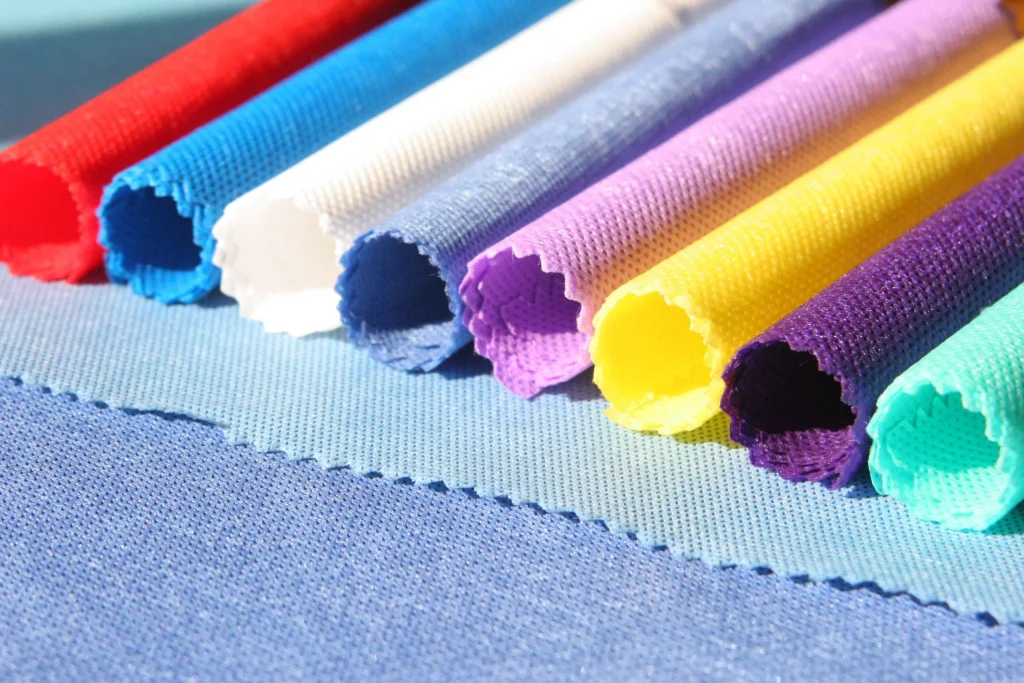
Calcium carbonate plays a critical role in the nonwoven fabrics industry. As a functional filler and performance enhancer, it improves fabric opacity, softness, dimensional stability, and cost efficiency. However, not all calcium carbonate powders are suitable for nonwoven applications. The key lies not only in the raw material but also in selecting the right machine to produce calcium carbonate with the required particle size, purity, and surface characteristics.
This article explains how to select a calcium carbonate production milling machine suitable for nonwoven fabrics, focusing on technical requirements, processing methods, and equipment considerations.

Part 1: Defining Your Requirements – It Starts with the End Product
Before evaluating machines, you must understand the specifications of the calcium carbonate required for nonwoven fabrics, particularly PP spunbond.
- Target Particle Size (Mesh): For nonwoven applications, the calcium carbonate typically needs a mesh size greater than 1500 (often D97 < 10µm). The particles must be fine enough to integrate seamlessly into the polymer matrix without compromising fiber strength, but not excessively fine. Ultrafine powders (< 2µm) are more expensive and notoriously difficult to disperse uniformly, which can create weak points in the fabric.
- Purity and Chemical Properties: The chosen machine must handle and preserve the inherent properties of high-purity CaCO₃: its whiteness, low moisture absorption, and specific gravity (around 2.71). Impurities introduced during processing can affect the nonwoven’s color and performance.
- Coating and Surface Treatment Compatibility: Many advanced nonwoven applications require coated calcium carbonate to improve polymer compatibility. Your production line may need to integrate surface modification steps (e.g., with stearic acid), so machine flexibility is a plus.
- Output Capacity: Align the machine’s throughput with your masterbatch production volume. Consider both current needs and future expansion to avoid bottlenecks.
Part 2: Core Machine Types and Technologies for Calcium Carbonate Production
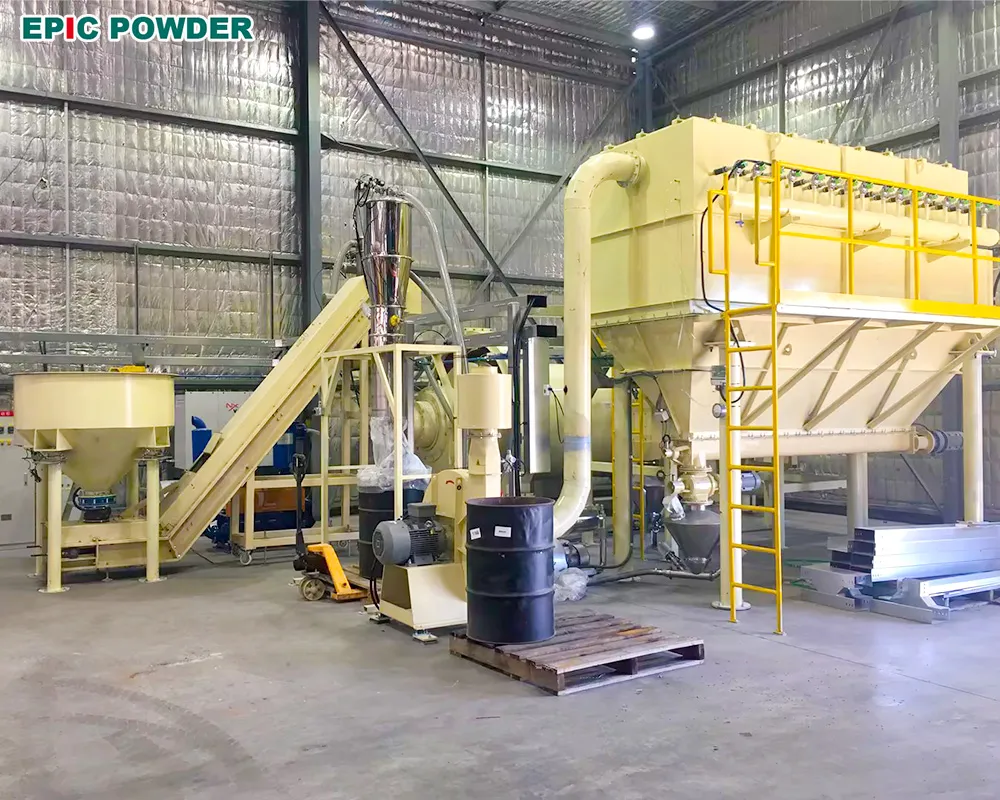
Different grinding and classification technologies yield different results. Here’s a breakdown relevant to nonwoven-grade CaCO₃:
- Ball Mills with Classifiers: A traditional, robust solution for achieving consistent fine powders. They are excellent for producing the 1500-2500 mesh range suitable for nonwovens. Look for systems with high-efficiency air classifiers that provide tight particle size distribution (PSD), which is critical for uniform filler dispersion in the melt.
- Vertical Roller Mills (VRM): Known for energy efficiency, VRMs are becoming a preferred choice for large-scale production of mineral fillers. They combine grinding, drying, and classification in a single unit, offering good control over particle size and lower operational costs.
- Jet Mills (Fluidized Bed Jet Mills): Ideal for producing ultra-fine and high-purity calcium carbonate. They use high-speed jets of compressed air to create particle-on-particle impact, resulting in a contaminant-free product. While excellent for specialized grades, they may be over-specified for standard nonwoven filler production.
- Integrated Grinding & Coating Systems: The most advanced solution for a streamlined operation. These systems can grind the CaCO₃ to the desired fineness and, in a subsequent stage within the same process line, apply surface treatment agents. This ensures a perfectly coated, readily dispersible filler ideal for high-performance nonwoven masterbatches.
Why is Tight Particle Size Distribution (PSD) So Important?
In the nonwoven production process, the CaCO₃/polypropylene mixture is melted, extruded, and spun into fine fibers. Agglomerates or oversized particles can clog spinnerets, break fibers, and create defects in the web. A machine that delivers a consistent, narrow PSD is non-negotiable for quality fabric production.
Part 3: 5 Key Selection Criteria for Your Investment
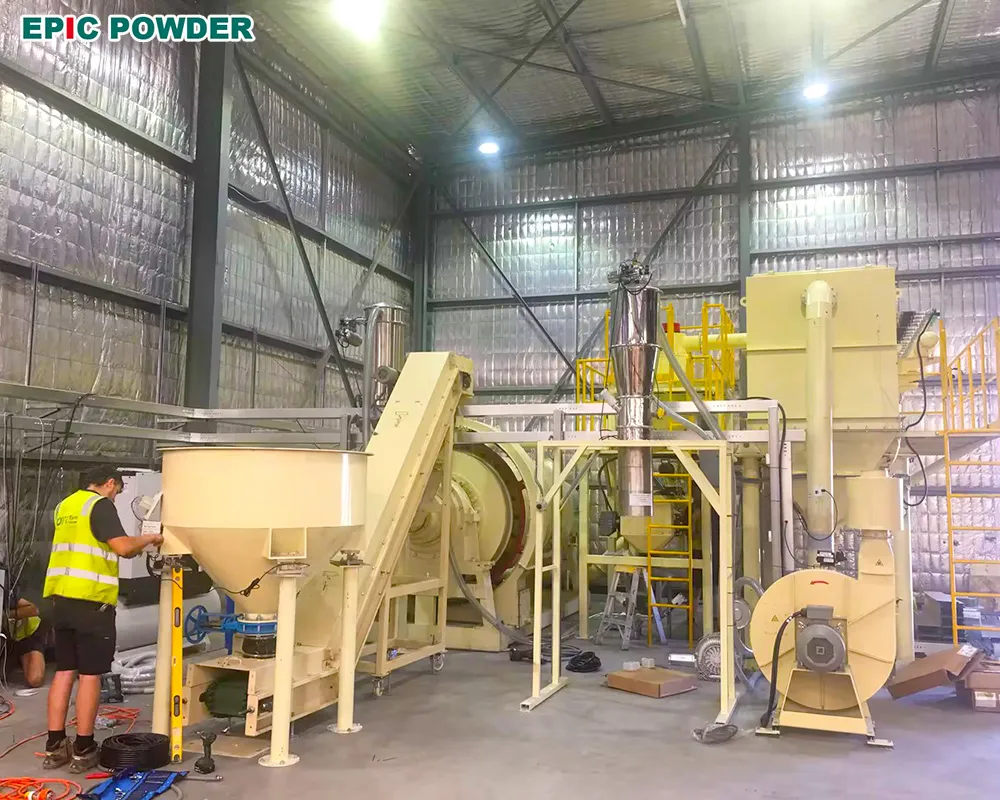
Beyond the machine type, scrutinize these critical aspects:
- Precision of Classification: The classifier is the heart of the system for filler production. Inquire about the cut point accuracy and efficiency of the integrated classifier. Can it reliably and repeatedly produce your target 1500+ mesh product with minimal “fines” or “oversize”?
- Energy Consumption: Grinding is an energy-intensive process. Compare the specific energy consumption (kWh/ton) of different machines. A higher upfront cost for an energy-efficient VRM or modern ball mill can lead to significant savings over the machine’s lifetime, supporting sustainability goals.
- Wear Resistance & Material Purity: The machine’s grinding elements (rollers, balls, liners) must be made from high-wear-resistant materials (e.g., alumina ceramics, specialized alloys). This minimizes metallic contamination, preserving the bright whiteness of your CaCO₃, which is vital for many nonwoven applications.
- Automation & Control System: A modern PLC-based control system allows for precise adjustment of grinding parameters, recipe storage for different product grades, and consistent, repeatable output. It also reduces operator dependency and human error.
- Ease of Maintenance & Supplier Support: Consider the accessibility for routine wear-part replacement and cleaning. More importantly, partner with a supplier who offers robust after-sales support, readily available spare parts, and process expertise. Your production cannot afford extended downtime.
Part 4: Integrating the Filler into the Nonwoven Process
Remember, the end goal is a flawless nonwoven fabric. The production of calcium carbonate is just the first step. In the PP spunbond process, the high-melt-flow-rate polypropylene is uniformly mixed with the CaCO₃ masterbatch. This mixture is extruded, spun, drawn by air, and laid into a web. Any inconsistency in the filler will manifest here.
The Synergy of Material and Machine: While calcium carbonate is chosen for its optimal balance of low cost, high whiteness, and good dispersion, the right production machine ensures these inherent advantages are fully realized in the final product. Sometimes, manufacturers blend CaCO₃ with small amounts of other minerals like kaolin or wollastonite to enhance specific properties. Your chosen grinding system should have the flexibility to handle such formulations if needed.
Epic Powder: Partner for Performance
Selecting machinery to produce calcium carbonate for nonwovens is a technical decision with direct business consequences. It’s an investment in the quality, cost-effectiveness, and sustainability of your entire nonwoven product line.
Epic Powder is specialized in fine powder processing technology for mineral industry, chemical industry, food industry, pharama industry, etc. We are a most professional supplier of powder processing projects, especially powder milling, powder classifying, powder dispersing, powder classifying, powder surface treatment and waste recycling. We supply consultancy, testing, project design, machines, commissioning and training.
Ready to optimize your nonwoven filler production? Contact Epic Powder’s technical team today for a personalized consultation and discover how the right machinery can become your strongest competitive advantage.

“Thanks for reading. I hope my article helps. Please leave a comment down below. You may also contact EPIC Powder online customer representative Zelda for any further inquiries.
— Emily Chen, Senior Engineer